Short-course radiotherapy followed by chemotherapy and surgery showed similar local failure rates to standard care
Locoregional Failure During and After Short-course Radiotherapy Followed by Chemotherapy and Surgery Compared With Long-course Chemoradiotherapy and Surgery: A 5-Year Follow-up of the RAPIDO Trial
Randomized trialHarm found
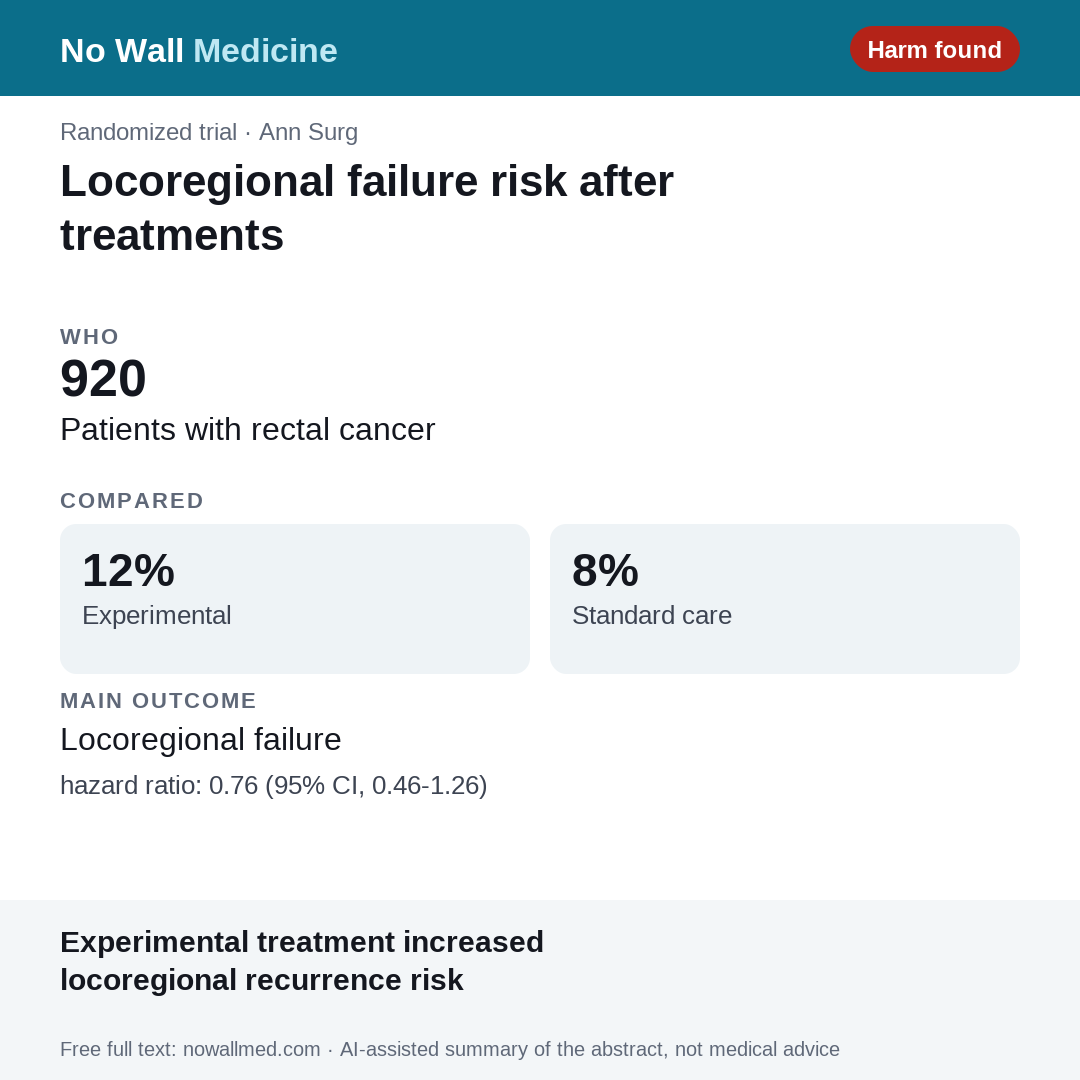
Locoregional failure risk after treatments
Who
920
Patients with rectal cancer
Compared
12%Experimental (54/460)
8%Standard care (36/446)
Main outcome
Locoregional failure
Result: hazard ratio: 0.76 (95% CI, 0.46-1.26)
Bottom line: Experimental treatment increased locoregional recurrence risk
Ann Surg · 2023-01-20Download image
Why it matters: It was unknown if total neoadjuvant treatment, which provides intensive therapy before surgery, maintains similar local control to standard chemoradiotherapy over a 5-year period.
In absolute numbers
Experimental: 12% · Standard care: 8% → a difference of 4 percentage points, so about 25 people would receive it for 1 more to be harmed (number needed to harm) over the trial’s follow-up.
Worked out by us from the two group results above, not reported by the authors. Check the paper for the exact outcome and timing.
Key points
- Researchers compared 460 patients receiving short-course radiotherapy, chemotherapy, and surgery to 446 patients receiving standard chemoradiotherapy and surgery.
- At a median follow-up of 5.6 years, locoregional failure, or cancer returning near the original site, occurred in 12% of the experimental group and 8% of the standard group.
- The experimental group was associated with a higher rate of locoregional recurrence after surgery, specifically 10% compared to 6% in the standard group.
Headline and key points written with AI from the paper’s abstract, with every number checked against it. Read the paper before relying on them.
Was this summary helpful?
Subject terms
Cite this article
Dijkstra EA, Nilsson PJ, Hospers GAP, Bahadoer RR, Meershoek-Klein Kranenbarg E, Roodvoets AGH. Locoregional Failure During and After Short-course Radiotherapy Followed by Chemotherapy and Surgery Compared With Long-course Chemoradiotherapy and Surgery: A 5-Year Follow-up of the RAPIDO Trial. Ann Surg. 2023. doi:10.1097/SLA.0000000000005799
Spotted a mistake? Suggest a correction
Top studies every Monday
The week’s key trials and guidelines in your specialties, plus any topics you follow. By email, free.
Get the weekly digest