Long-term exposure to certain air pollutants was associated with increased dementia risk
Long-term air pollution exposure and incident dementia: a systematic review and meta-analysis
Systematic review and meta-analysisBenefit found
Is long-term outdoor air pollution exposure associated with incident dementia?
Who
Adults aged 18 years or older
Compared
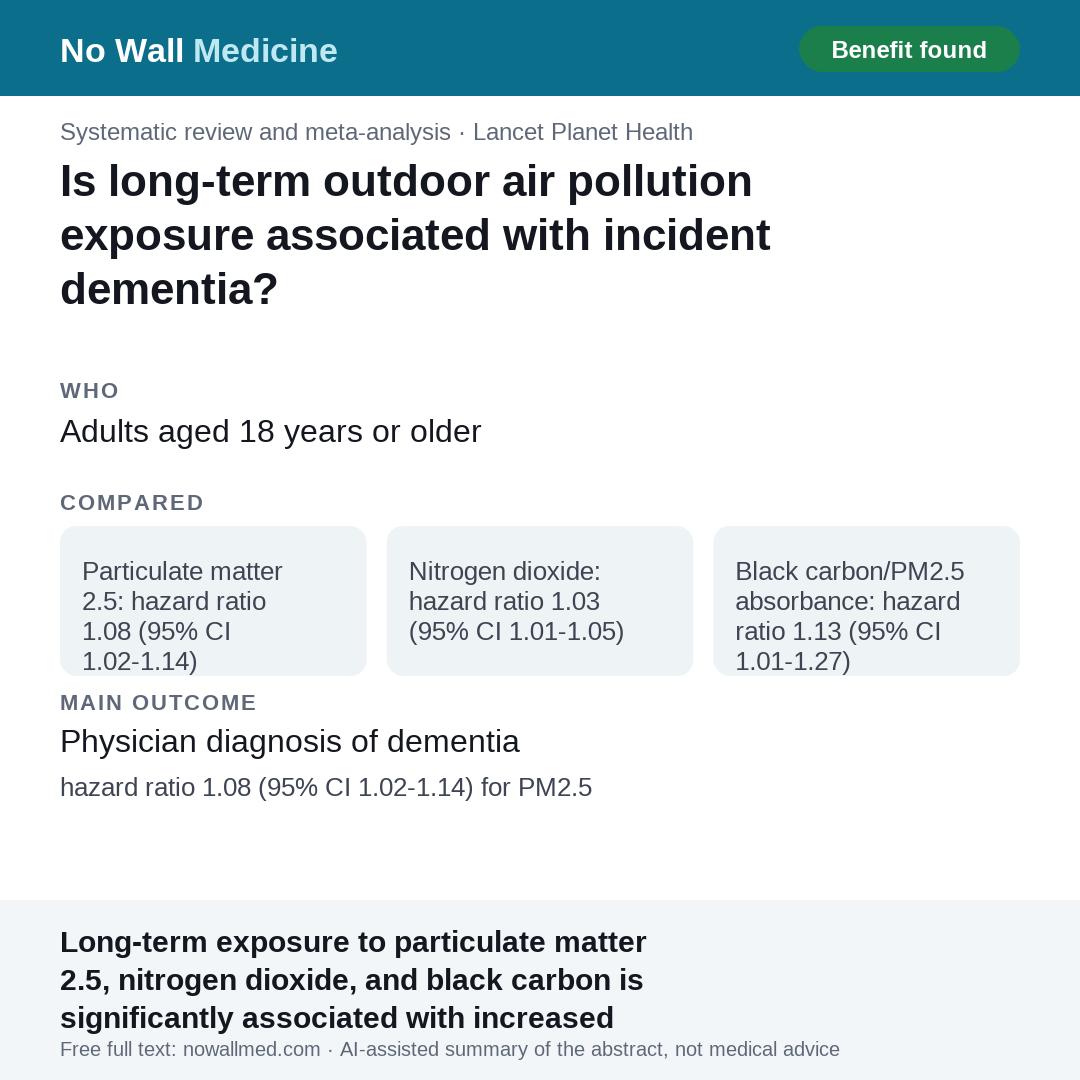
Particulate matter 2.5: hazard ratio 1.08 (95% CI 1.02-1.14)
Nitrogen dioxide: hazard ratio 1.03 (95% CI 1.01-1.05)
Black carbon/PM2.5 absorbance: hazard ratio 1.13 (95% CI 1.01-1.27)
Main outcome
Physician diagnosis of dementia
Result: hazard ratio 1.08 (95% CI 1.02-1.14) for PM2.5
Bottom line: Long-term exposure to particulate matter 2.5, nitrogen dioxide, and black carbon is significantly associated with increased dementia risk.
Limitation: Moderate to considerable heterogeneity between studies in these pooled analyses.
Funded by: European Research Council
Lancet Planet Health · 2025-07-24Download image
Clinical question: Is long-term outdoor air pollution exposure associated with incident dementia?
Key points
- This meta-analysis of 32 studies involving millions of adults examined the link between long-term outdoor air pollution and dementia diagnosis.
- A 5 μg/m3 increase in PM2.5, which is fine particulate matter, was associated with a pooled adjusted hazard ratio of 1.08.
- A 10 μg/m3 increase in nitrogen dioxide was associated with a pooled adjusted hazard ratio of 1.03, while black carbon/PM2.5 absorbance showed a hazard ratio of 1.13 per 1 μg/m3 increase.
Limitation the authors note: The researchers noted moderate to considerable heterogeneity between studies in the pooled analyses.
Headline and key points written with AI from the paper’s abstract, with every number checked against it. Read the paper before relying on them.
Topics
Cite this article
Best Rogowski CB, Bredell C, Shi Y, Tien-Smith A, Szybka M, Fung KW. Long-term air pollution exposure and incident dementia: a systematic review and meta-analysis. Lancet Planet Health. 2025. doi:10.1016/S2542-5196(25)00118-4
Spotted a mistake? Suggest a correction
Top studies every Monday
The week’s key trials and guidelines in your specialties, plus any topics you follow. By email, free.
Get the weekly digest