Long-term effect of neoadjuvant denosumab treatment in high-risk early breast cancer (GeparX)
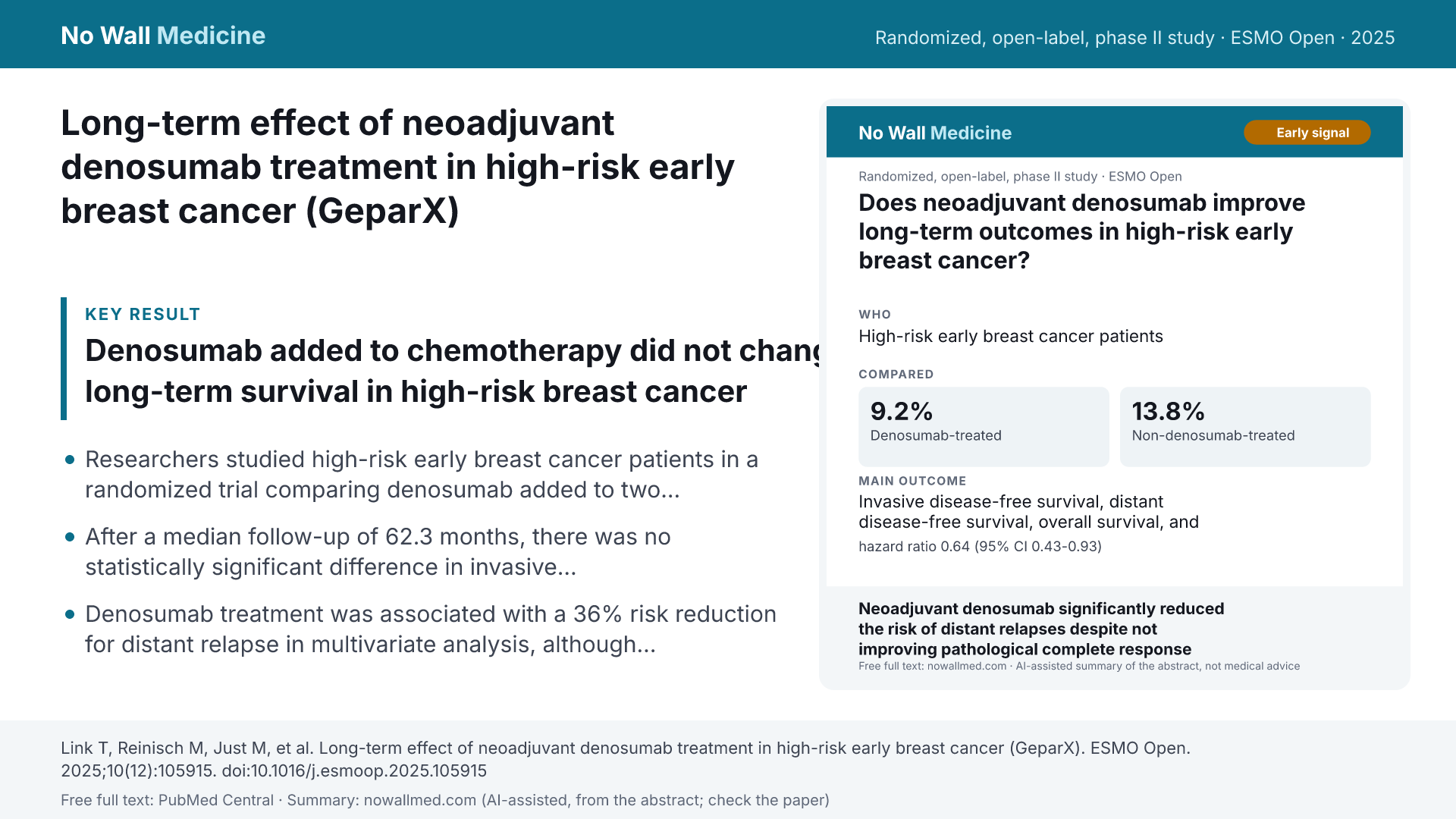
Key result: Denosumab added to chemotherapy did not change long-term survival in high-risk breast cancer
Randomized, open-label, phase II studyEarly signal
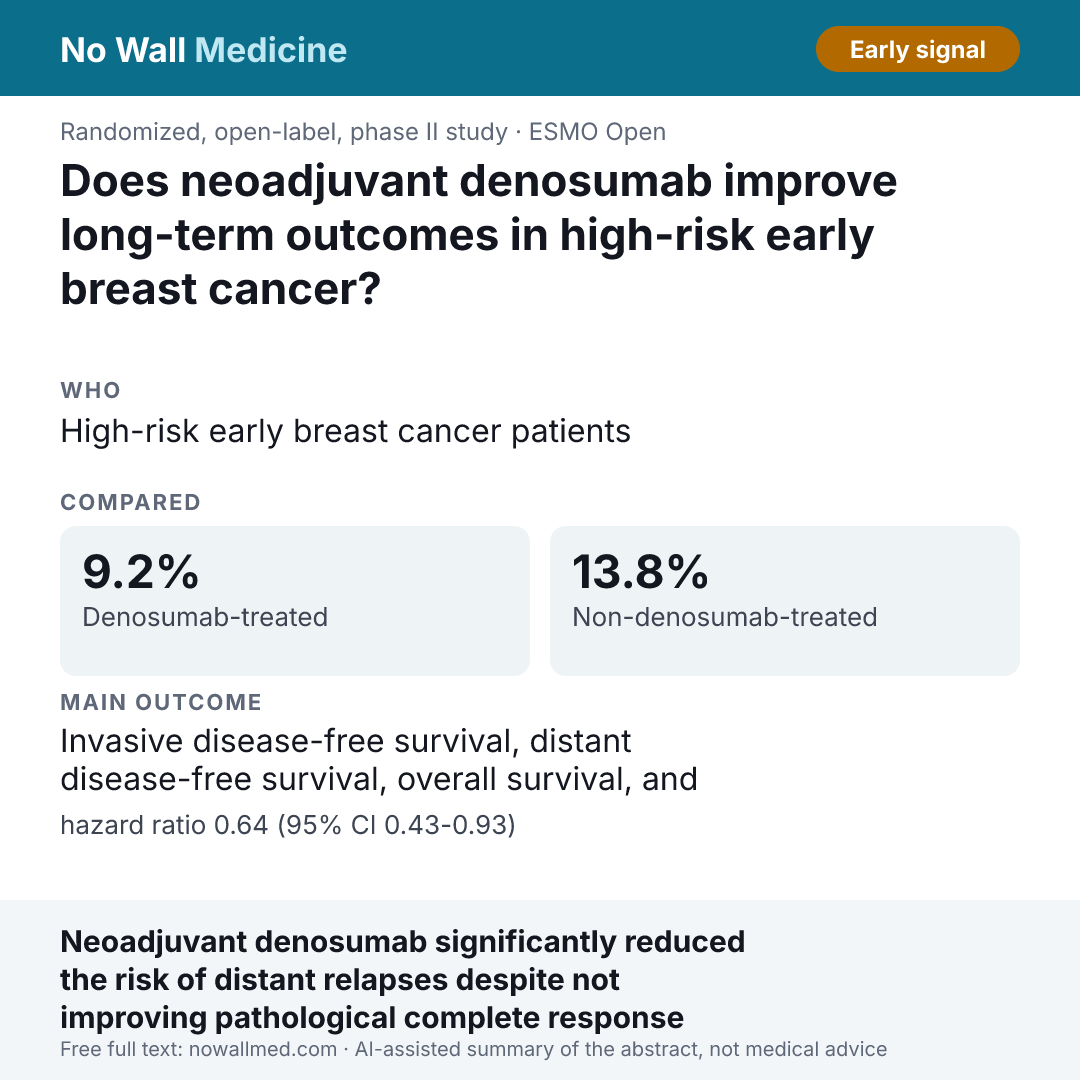
Does neoadjuvant denosumab improve long-term outcomes in high-risk early breast cancer?
Who
High-risk early breast cancer patients
Compared
9.2%Denosumab-treated
13.8%Non-denosumab-treated
Main outcome
Invasive disease-free survival, distant disease-free survival, overall survival, and locoregional recurrence-free interval
Result: hazard ratio 0.64 (95% CI 0.43-0.93)
Bottom line: Neoadjuvant denosumab significantly reduced the risk of distant relapses despite not improving pathological complete response rates.
ESMO Open · 2025-11-27 · Save PNG
Key points
- Researchers studied high-risk early breast cancer patients in a randomized trial comparing denosumab added to two different nab-paclitaxel chemotherapy schedules.
- After a median follow-up of 62.3 months, there was no statistically significant difference in invasive disease-free survival, distant disease-free survival, or overall survival.
- Denosumab treatment was associated with a 36% risk reduction for distant relapse in multivariate analysis, although the pathological complete response rate did not improve.
Discussion prompts
- Would these patients look like yours? Who was left out?
- Is the main outcome one that matters to patients?
- Is the difference large enough to change what you do?
Cite: Link T, Reinisch M, Just M, et al. Long-term effect of neoadjuvant denosumab treatment in high-risk early breast cancer (GeparX). ESMO Open. 2025;10(12):105915. doi:10.1016/j.esmoop.2025.105915
Free full text: PubMed Central · Summary and visual abstract: nowallmed.com/a/long-term-effect-of-neoadjuvant-denosumab-treatment-in-high-risk-czbu7a/ (AI-assisted from the abstract; check the paper before relying on it).