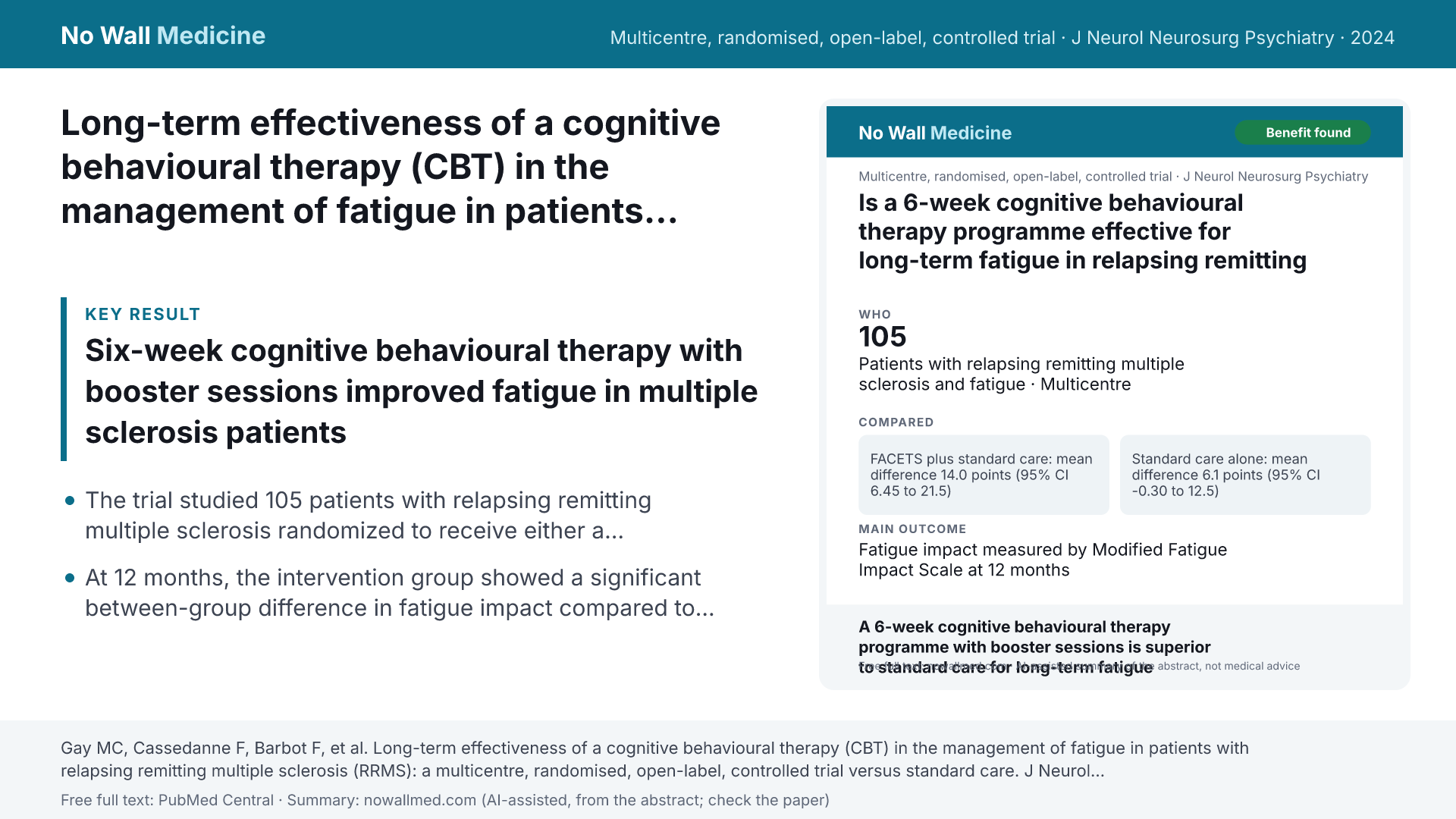
Six-week cognitive behavioural therapy with booster sessions improved fatigue in multiple sclerosis patients
Long-term effectiveness of a cognitive behavioural therapy (CBT) in the management of fatigue in patients with relapsing remitting multiple sclerosis (RRMS): a multicentre, randomised, open-label, controlled trial versus standard care
Multicentre, randomised, open-label, controlled trialBenefit found
Is a 6-week cognitive behavioural therapy programme effective for long-term fatigue in relapsing remitting multiple sclerosis?
Who
105
Patients with relapsing remitting multiple sclerosis and fatigue · Multicentre
Compared
FACETS plus standard care: mean difference 14.0 points (95% CI 6.45 to 21.5)
Standard care alone: mean difference 6.1 points (95% CI -0.30 to 12.5)
Main outcome
Fatigue impact measured by Modified Fatigue Impact Scale at 12 months
Result: adjusted mean difference 7.89 points (95% CI 1.26 to 14.52)
Bottom line: A 6-week cognitive behavioural therapy programme with booster sessions is superior to standard care for long-term fatigue management.
J Neurol Neurosurg Psychiatry · 2024-01-11Download image
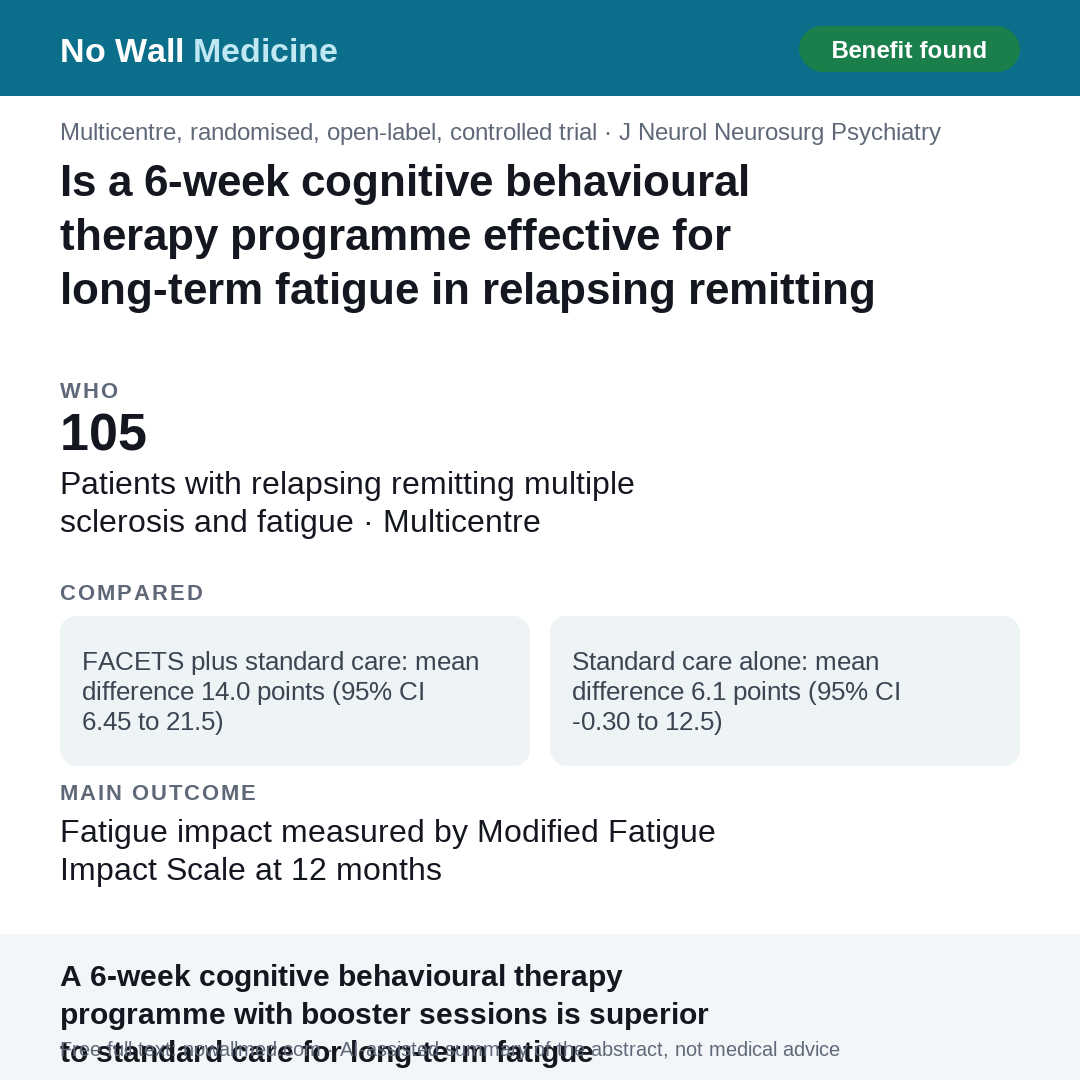
Clinical question: Is a 6-week cognitive behavioural therapy programme effective for long-term fatigue in relapsing remitting multiple sclerosis?
Key points
- The trial studied 105 patients with relapsing remitting multiple sclerosis randomized to receive either a 6-week cognitive behavioural therapy programme with four booster sessions or standard care.
- At 12 months, the intervention group showed a significant between-group difference in fatigue impact compared to standard care with an adjusted mean difference of 7.89 points.
- No trial-related serious adverse events were reported during the study period.
Headline and key points written with AI from the paper’s abstract, with every number checked against it. Read the paper before relying on them.
Was this summary helpful?
Abstract
Background
Fatigue is a disabling symptom of multiple sclerosis (MS). The lack of effective therapeutics has promoted the development of cognitive behavioural therapy (CBT)-based fatigue management programmes. However, their efficacy does not sustain over time. We proposed to test the long-term effectiveness of a 6-week fatigue programme supplemented with four booster sessions ('FACETS+') in patients with relapsing remitting MS (RRMS) and fatigue. Methods
This multicentre, randomised, controlled, open-label, parallel-group trial versus standard care enrolled patients with RRMS and fatigue. Participants were randomised to either FACETS+ plus standard care or standard care alone. The primary outcome measure was fatigue impact (Modified Fatigue Impact Scale (MFIS) at 12 months) based on intention-to-treat analyses. Results
From May 2017 to September 2020, 162 patients were screened; 105 were randomly assigned to FACETS+ (n=57) or standard care (n=48) and 88 completed the primary outcome assessment for the MFIS. At month 12, participants showed improved MFIS compared with baseline in the intervention group (mean difference (MD)=14.0 points; (95% CI 6.45 to 21.5)) and the control group (MD=6.1 points; (95% CI -0.30 to 12.5)) with a significant between-group difference in favour of the intervention group (adjusted MD=7.89 points; (95% CI 1.26 to 14.52), standardised effect size=0.52, p=0.021). No trial-related serious adverse events were reported. Conclusions
A 6-week CBT-based programme with four booster sessions is superior to standard care alone to treat MS-related fatigue in the long term (12 months follow-up). The results support the use of the FACETS+ programme for the treatment of MS-related fatigue. Trial registration number
NCT03758820.
Abstract reproduced under the article’s CC BY NC licence.
Subject terms
Cite this article
Gay MC, Cassedanne F, Barbot F, et al. Long-term effectiveness of a cognitive behavioural therapy (CBT) in the management of fatigue in patients with relapsing remitting multiple sclerosis (RRMS): a multicentre, randomised, open-label, controlled trial versus standard care. J Neurol Neurosurg Psychiatry. 2024. doi:10.1136/jnnp-2023-331537
Spotted a mistake? Suggest a correction