Azithromycin mass administration was associated with persistent macrolide resistance in Streptococcus pneumoniae
Long-term effects of azithromycin mass administration to reduce childhood mortality on Streptococcus pneumoniae antimicrobial resistance: a population-based, cross-sectional, follow-up carriage survey
Population-based, cross-sectional, follow-up carriage surveyNo clear difference
Does azithromycin mass administration affect Streptococcus pneumoniae macrolide resistance long-term?
Who
905
Children aged 1-9 years in Mangochi, Malawi · Mangochi, Malawi
Compared
Azithromycin-treated clusters: 32.1% (61 of 190 isolates) at 3.5 years post-MDA
Placebo-treated clusters: 30.9% (73 of 236 isolates) at 3.5 years post-MDA
Main outcome
Prevalence of Streptococcus pneumoniae macrolide resistance
Result: odds ratio 1.12 (95% CI 0.66 to 1.91) at 3.5 years
Bottom line: Azithromycin mass administration is associated with macrolide resistance that persists and potentially spreads to untreated populations.
Funded by: Gates Foundation, National Institute for Health and Care Research, Wellcome Trust
Lancet Infect Dis · 2025-06-02Download image
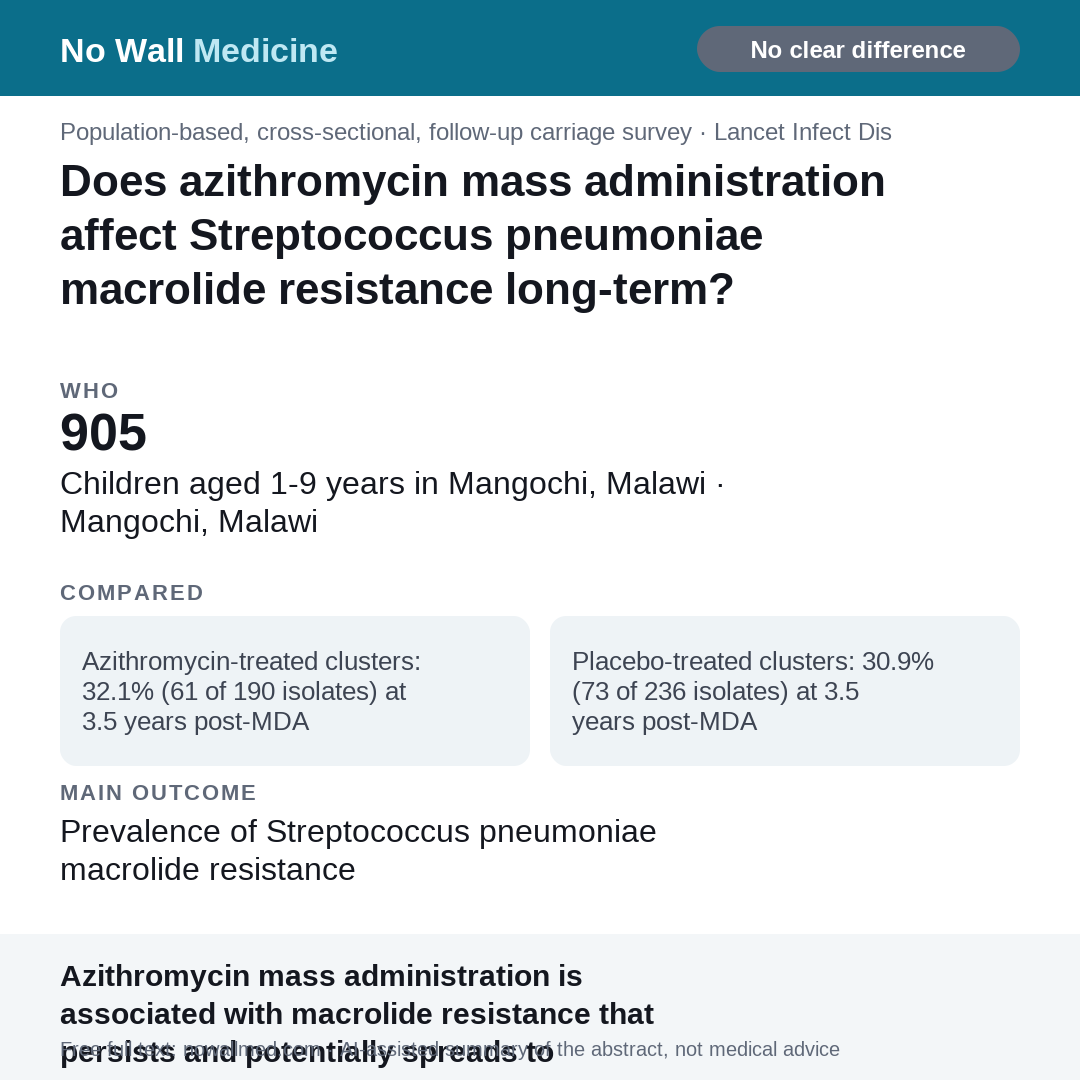
Clinical question: Does azithromycin mass administration affect Streptococcus pneumoniae macrolide resistance long-term?
Why it matters: Concerns exist regarding the long-term effects of mass drug administration programs using azithromycin on antimicrobial resistance in Streptococcus pneumoniae.
Key points
- Researchers studied 905 children aged 1-9 years in Malawi to compare antibiotic resistance in clusters that received azithromycin versus placebo during a previous trial.
- In azithromycin-treated clusters, macrolide resistance was 31.9% at 6 months post-treatment and 32.1% at 3.5 years post-treatment.
- Resistance in placebo-treated clusters was 25.0% at 6 months and 30.9% at 3.5 years, with no significant differences in odds ratios between the two groups.
Headline and key points written with AI from the paper’s abstract, with every number checked against it. Read the paper before relying on them.
Was this summary helpful?
Abstract
Background
Mass drug administration (MDA) programmes with the macrolide antibiotic azithromycin to reduce childhood mortality are expanding in Africa; however, concerns remain about the long-term effects of these programmes on antimicrobial resistance (AMR). We aimed to evaluate the persistence and spread of Streptococcus pneumoniae AMR following a community-randomised MDA trial. Methods
This population-based, cross-sectional, pneumococcal carriage survey was conducted in Mangochi, Malawi, 3·5 years after the MORDOR trial, in which communities received twice-yearly azithromycin or placebo for 2 years. Eligible participants in this carriage survey were children aged 4-9 years who lived in an azithromycin-treated or placebo-treated cluster during the MORDOR trial, and children aged 1-3 years who were resident in a cluster but born after the MORDOR trial ended. Nasopharyngeal swabs were collected from participants and analysed by whole genome sequencing; pneumococcal genomes obtained from a distant site in Malawi, in which MDA had not been conducted, were used as reference genomes. The primary outcome was the prevalence of S pneumoniae macrolide resistance, comparing placebo-treated and azithromycin-treated clusters at baseline, 6 months post-MDA, and 3·5 years post-MDA. Findings
Between April 8 and May 14, 2021, 924 children aged 1-9 years were screened, of whom 19 were excluded and 905 were recruited to the follow-up carriage survey: 452 from azithromycin-treated clusters and 453 from placebo-treated clusters of the MORDOR trial. We assessed 426 isolates from these participants (190 from azithromycin-treated clusters and 236 from placebo-treated clusters), as well as samples from the baseline of the MORDOR trial (164 isolates; 83 from azithromycin-treated clusters and 81 from placebo-treated clusters) and from 6 months post-MDA (223 isolates; 119 from azithromycin-treated clusters and 104 from placebo-treated clusters). In azithromycin-treated clusters, macrolide resistance increased from 21·7% (95% CI 14·2-31·7; 18 of 83 isolates) at baseline to 31·9% (24·2-40·8; 38 of 119 isolates) 6 months post-MDA and to 32·1% (25·9-39·0; 61 of 190 isolates) 3·5 years post-MDA. In placebo-treated clusters, resistance increased from 21·0% (13·5-31·1; 17 of 81 isolates) at baseline to 25·0% (17·7-34·1; 26 of 104 isolates) 6 months post-MDA and to 30·9% (25·4-37·1; 73 of 236 isolates) 3·5 years post-MDA. No significant differences were observed in odds ratios between treatment groups across the survey timepoints: 0·97 (95% CI 0·36-2·55) at baseline, 1·46 (0·67-3·17) at 6 months post-MDA, and 1·12 (0·66-1·91) at 3·5 years post-MDA. Macrolide resistance in the non-MDA site remained stable: 16·9% (95% CI 12·8-21·8; 45 of 267 isolates) at baseline, 16·5% (13·3-20·3; 70 of 424 isolates) at 6 months, and 16·5% (12·5-21·4; 44 of 267 isolates) at 2·5 years. Among children born into azithromycin-treated clusters after MDA, macrolide resistance was 36·0% (27·7-45·1; 41 of 114 children). Multidrug resistance to at least three antibiotic classes was significantly higher in azithromycin-treated (p=0·0015) and placebo-treated (p<0·0001) clusters than in the comparator population at 3·5 years post-MDA and was associated with integrative conjugative elements. Interpretation
Azithromycin MDA is associated with macrolide resistance that persists and potentially spreads to untreated populations. The co-existence of multidrug resistance and transmissible resistance on integrative conjugative elements in these populations is a public health concern. Careful monitoring of AMR is essential in areas where MDA is implemented. Funding
The Gates Foundation, the National Institute for Health and Care Research, and the Wellcome Trust.
Abstract reproduced under the article’s CC BY licence.
Subject terms
Cite this article
Kalizang'oma A, Chan JM, Kalua K, Bonomali F, Brown C, Msefula J. Long-term effects of azithromycin mass administration to reduce childhood mortality on Streptococcus pneumoniae antimicrobial resistance: a population-based, cross-sectional, follow-up carriage survey. Lancet Infect Dis. 2025. doi:10.1016/S1473-3099(25)00212-9
Spotted a mistake? Suggest a correction
Top studies every Monday
The week’s key trials and guidelines in your specialties, plus any topics you follow. By email, free.
Get the weekly digest