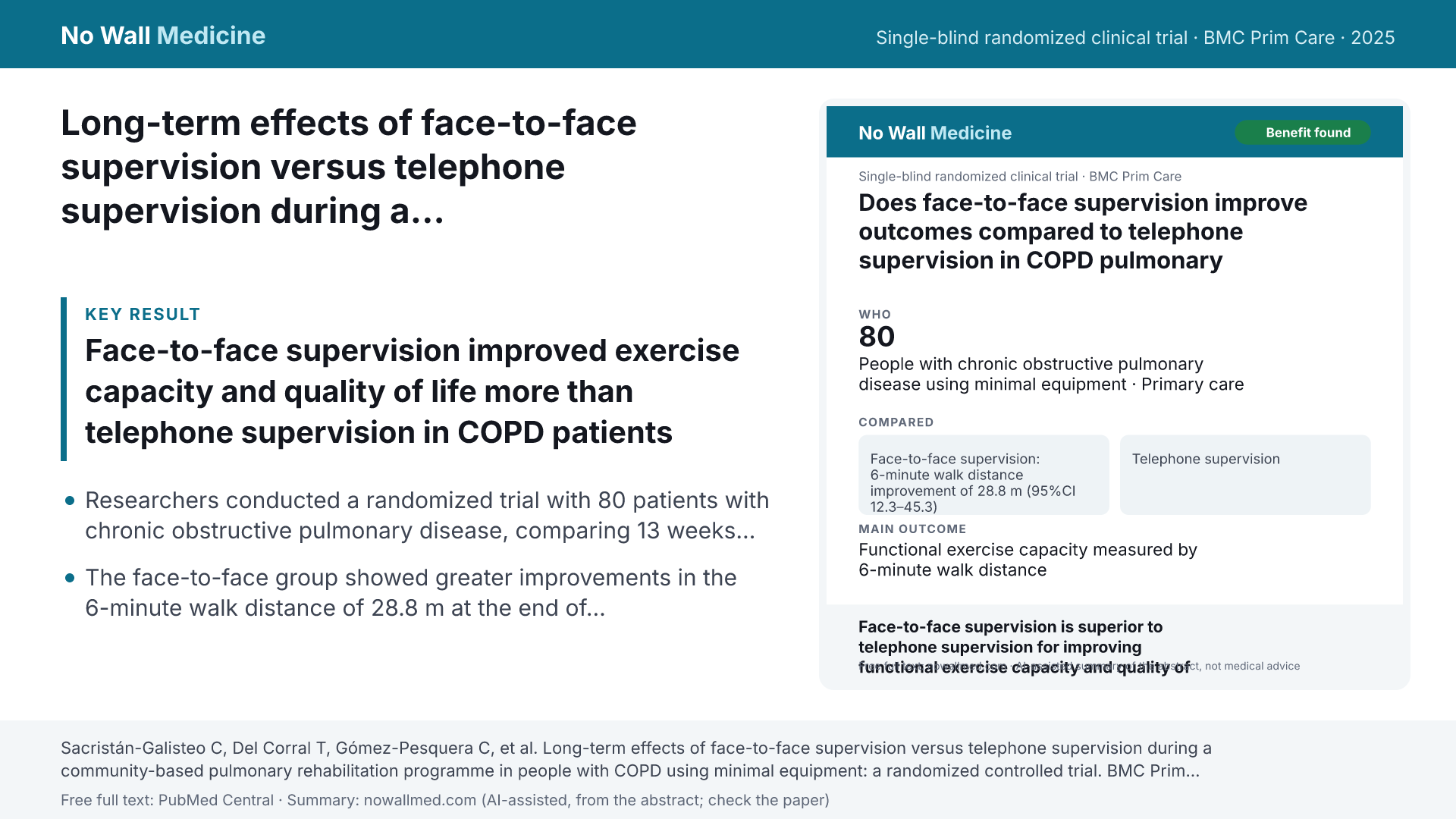
Face-to-face supervision improved exercise capacity and quality of life more than telephone supervision in COPD patients
Long-term effects of face-to-face supervision versus telephone supervision during a community-based pulmonary rehabilitation programme in people with COPD using minimal equipment: a randomized controlled trial
Single-blind randomized clinical trialBenefit found
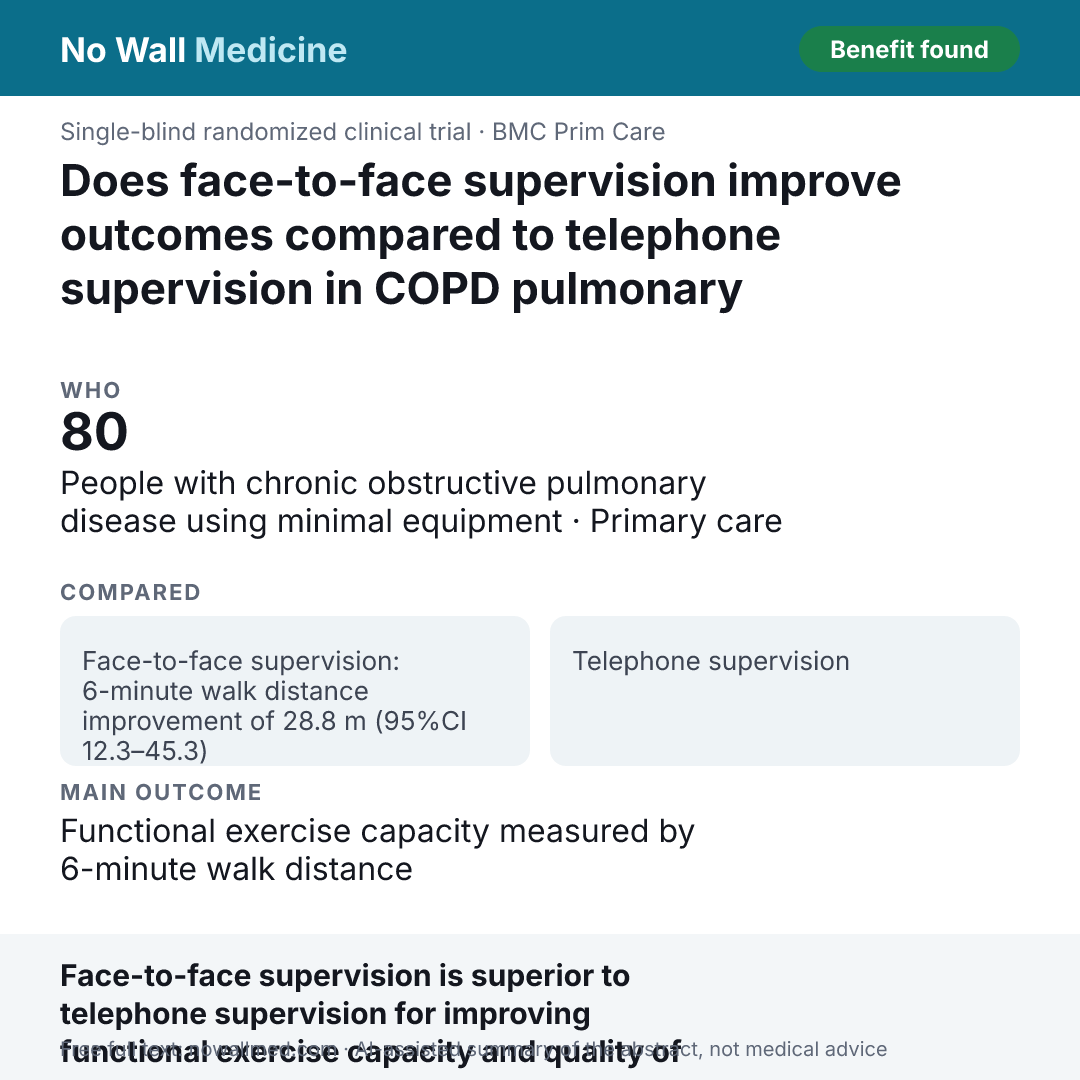
Does face-to-face supervision improve outcomes compared to telephone supervision in COPD pulmonary rehabilitation?
Who
80
People with chronic obstructive pulmonary disease using minimal equipment · Primary care setting
Compared
Face-to-face supervision: 6-minute walk distance improvement of 28.8 m (95%CI 12.3–45.3)
Telephone supervision
Main outcome
Functional exercise capacity measured by 6-minute walk distance
Result: 28.8 m (95%CI 12.3–45.3, p < 0.01)
Bottom line: Face-to-face supervision is superior to telephone supervision for improving functional exercise capacity and quality of life in COPD.
BMC Prim Care · 2025-08-27 · Save PNG
Clinical question: Does face-to-face supervision improve outcomes compared to telephone supervision in COPD pulmonary rehabilitation?
Why it matters: Accessibility is a barrier to pulmonary rehabilitation, so researchers investigated whether telephone supervision is as effective as face-to-face supervision for people with chronic obstructive pulmonary disease.
Key points
- Researchers conducted a randomized trial with 80 patients with chronic obstructive pulmonary disease, comparing 13 weeks of face-to-face supervision to telephone supervision.
- The face-to-face group showed greater improvements in the 6-minute walk distance of 28.8 m at the end of the intervention, 19.15 m at 6 months, and 28 m at 12 months.
- Face-to-face supervision was associated with higher daily step counts and lower anxiety at 6 months, but showed no differences in depression, exercise self-efficacy, exacerbations, or adherence.
Headline and key points written with AI from the paper’s abstract, with every number checked against it. Read the paper before relying on them.
Was this summary helpful?
Subject terms
Headline, design, result, key points, caveat and citation as plain text.
Cite this article
Sacristán-Galisteo C, Del Corral T, Gómez-Pesquera C, et al. Long-term effects of face-to-face supervision versus telephone supervision during a community-based pulmonary rehabilitation programme in people with COPD using minimal equipment: a randomized controlled trial. BMC Prim Care. 2025;26(1):268. doi:10.1186/s12875-025-02962-3
Spotted a mistake? Suggest a correction