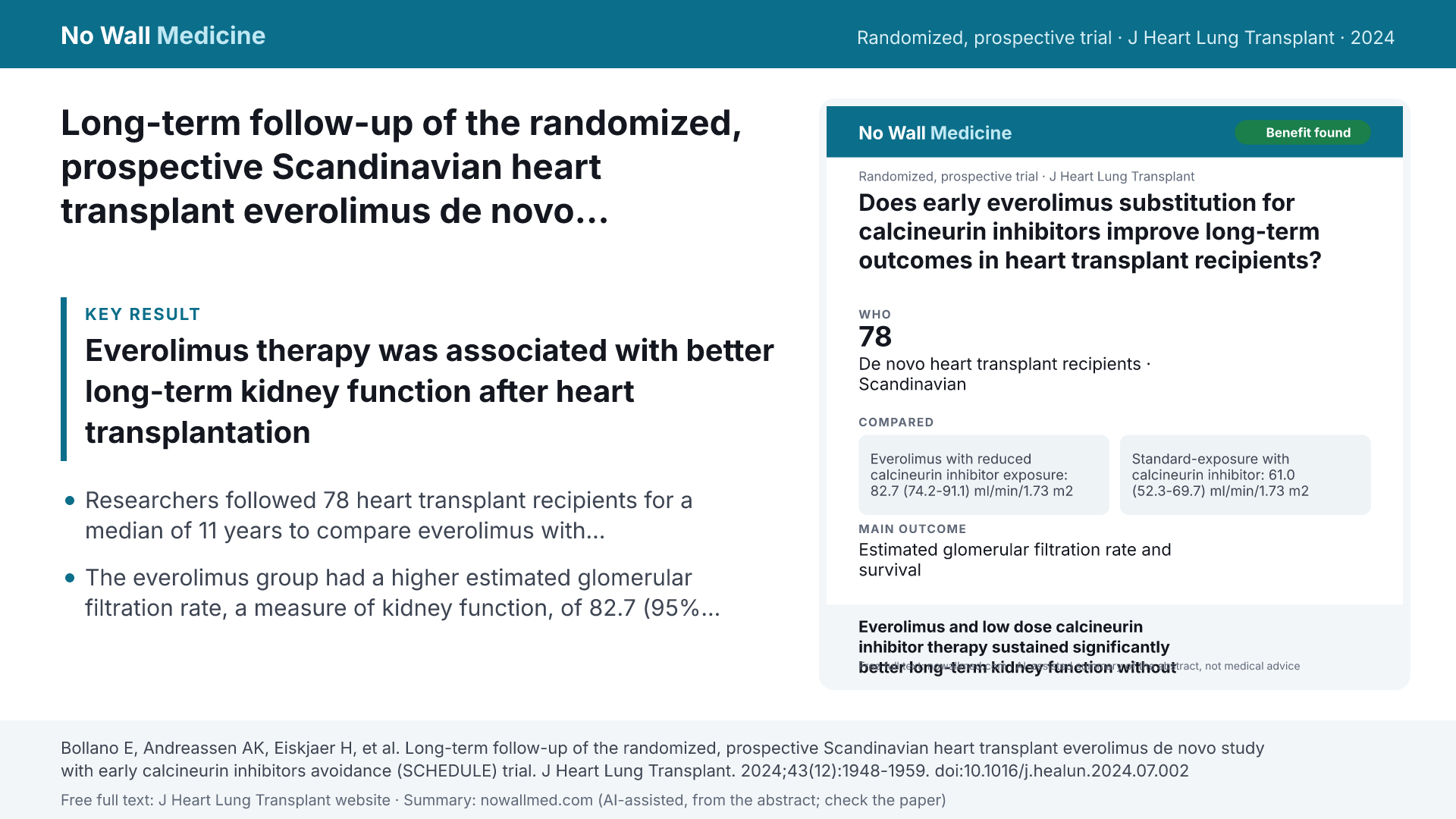
Everolimus therapy was associated with better long-term kidney function after heart transplantation
Long-term follow-up of the randomized, prospective Scandinavian heart transplant everolimus de novo study with early calcineurin inhibitors avoidance (SCHEDULE) trial
Randomized, prospective trialBenefit found
Does early everolimus substitution for calcineurin inhibitors improve long-term outcomes in heart transplant recipients?
Who
78
De novo heart transplant recipients · Scandinavian
Compared
Everolimus with reduced calcineurin inhibitor exposure: 82.7 (74.2-91.1) ml/min/1.73 m2
Standard-exposure with calcineurin inhibitor: 61.0 (52.3-69.7) ml/min/1.73 m2
Main outcome
Estimated glomerular filtration rate and survival
Result: aHR 0.61 (95% CI 0.29-1.30)
Bottom line: Everolimus and low dose calcineurin inhibitor therapy sustained significantly better long-term kidney function without affecting survival.
J Heart Lung Transplant · 2024-07-20 · Save PNG
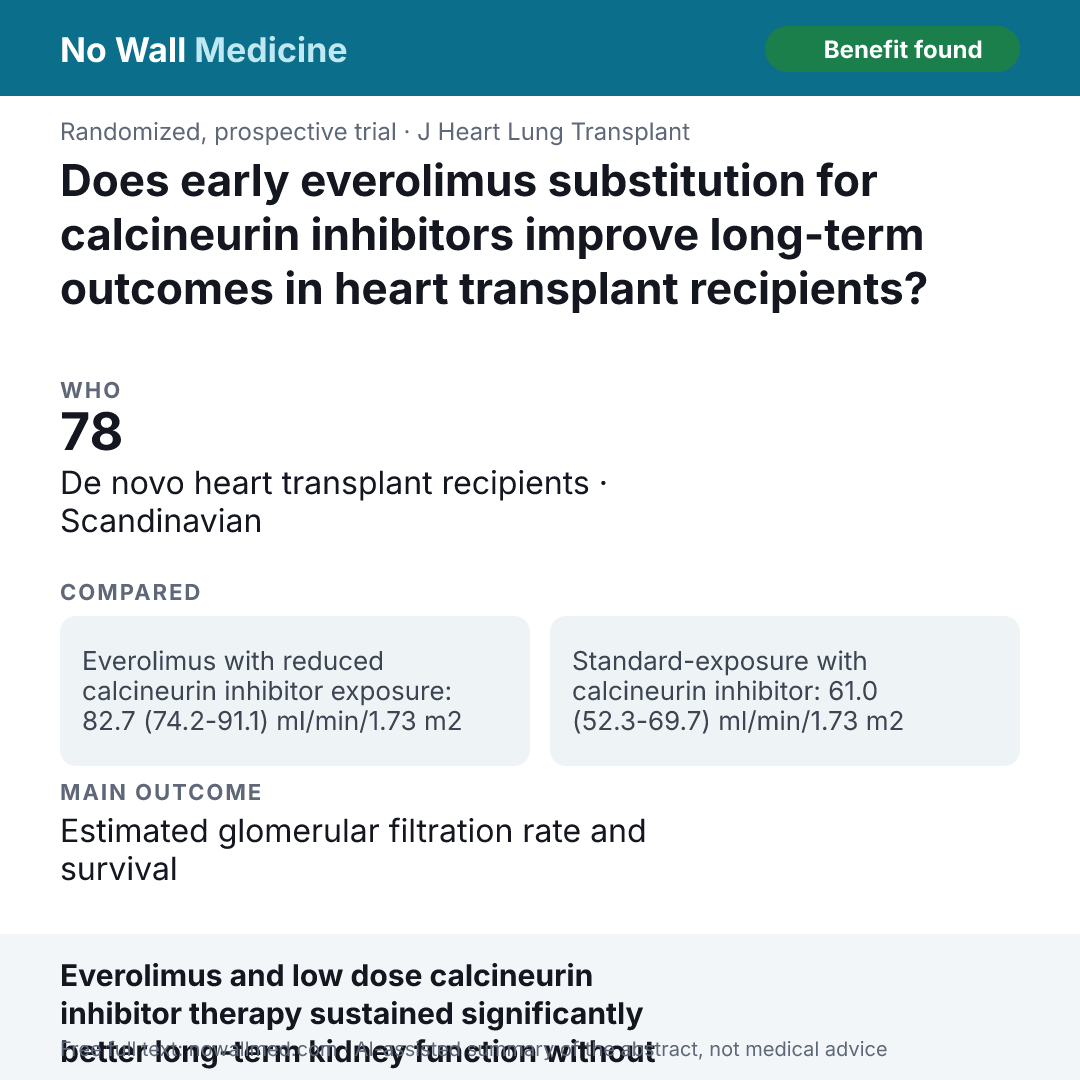
Clinical question: Does early everolimus substitution for calcineurin inhibitors improve long-term outcomes in heart transplant recipients?
Why it matters: Long-term outcomes are unknown for heart transplant recipients who switch from calcineurin inhibitors to mammalian target of rapamycin inhibitors to protect kidney function.
Key points
- Researchers followed 78 heart transplant recipients for a median of 11 years to compare everolimus with reduced calcineurin inhibitor exposure against standard calcineurin inhibitor therapy.
- The everolimus group had a higher estimated glomerular filtration rate, a measure of kidney function, of 82.7 (95% CI 74.2-91.1) ml/min/1.73 m2 compared to 61.0 (95% CI 52.3-69.7) ml/min/1.73 m2 in the standard group.
- There were no significant differences between groups regarding survival or a composite endpoint of death, re-transplantation, heart attack, procedures, dialysis, kidney transplant, or cancer.
Headline and key points written with AI from the paper’s abstract, with every number checked against it. Read the paper before relying on them.
Was this summary helpful?
Subject terms
Headline, design, result, key points, caveat and citation as plain text.
Cite this article
Bollano E, Andreassen AK, Eiskjaer H, et al. Long-term follow-up of the randomized, prospective Scandinavian heart transplant everolimus de novo study with early calcineurin inhibitors avoidance (SCHEDULE) trial. J Heart Lung Transplant. 2024;43(12):1948-1959. doi:10.1016/j.healun.2024.07.002
Spotted a mistake? Suggest a correction