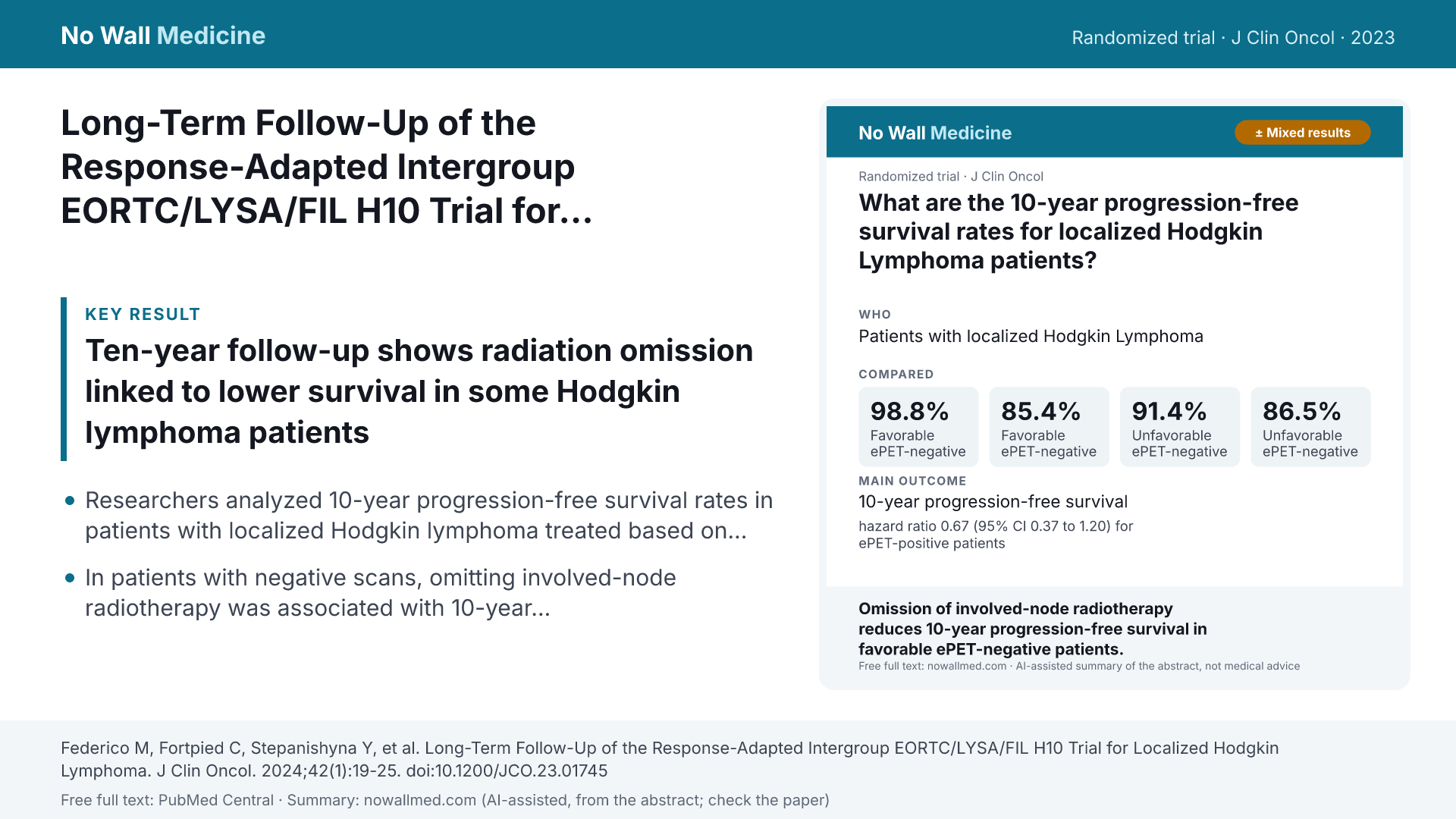
Ten-year follow-up shows radiation omission linked to lower survival in some Hodgkin lymphoma patients
Long-Term Follow-Up of the Response-Adapted Intergroup EORTC/LYSA/FIL H10 Trial for Localized Hodgkin Lymphoma
Randomized trialMixed results
What are the 10-year progression-free survival rates for localized Hodgkin Lymphoma patients?
Who
Patients with localized Hodgkin Lymphoma
Compared
98.8%Favorable ePET-negative ABVD plus involved-node radiotherapy
85.4%Favorable ePET-negative ABVD without involved-node radiotherapy
91.4%Unfavorable ePET-negative ABVD plus involved-node radiotherapy
86.5%Unfavorable ePET-negative ABVD without involved-node radiotherapy
Main outcome
10-year progression-free survival
Result: hazard ratio 0.67 (95% CI 0.37 to 1.20) for ePET-positive patients
Bottom line: Omission of involved-node radiotherapy reduces 10-year progression-free survival in favorable ePET-negative patients.
J Clin Oncol · 2023-11-15 · Save PNG
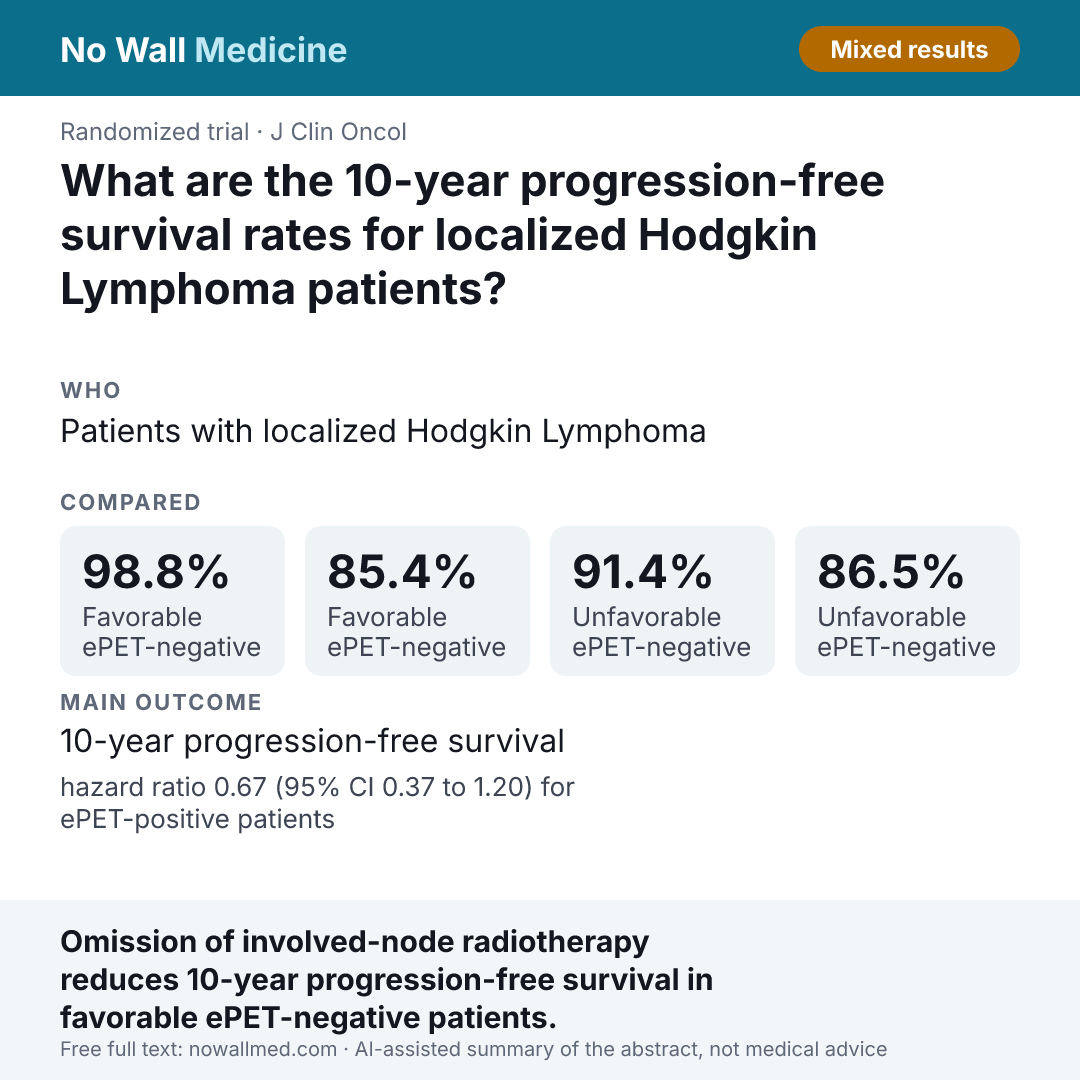
Clinical question: What are the 10-year progression-free survival rates for localized Hodgkin Lymphoma patients?
Key points
- Researchers analyzed 10-year progression-free survival rates in patients with localized Hodgkin lymphoma treated based on early positron emission tomography scans.
- In patients with negative scans, omitting involved-node radiotherapy was associated with 10-year progression-free survival rates of 85.4% compared to 98.8% with radiation.
- In patients with positive scans, the difference in progression-free survival between standard chemotherapy and intensified chemotherapy was no longer statistically significant.
Headline and key points written with AI from the paper’s abstract, with every number checked against it. Read the paper before relying on them.
Was this summary helpful?
Subject terms
Headline, design, result, key points, caveat and citation as plain text.
Cite this article
Federico M, Fortpied C, Stepanishyna Y, et al. Long-Term Follow-Up of the Response-Adapted Intergroup EORTC/LYSA/FIL H10 Trial for Localized Hodgkin Lymphoma. J Clin Oncol. 2024;42(1):19-25. doi:10.1200/JCO.23.01745
Spotted a mistake? Suggest a correction