Single yellow fever vaccine dose provides high long-term protection for healthy adult travellers
Long-term immunity following yellow fever vaccination: a systematic review and meta-analysis
Systematic review and meta-analysisMixed results
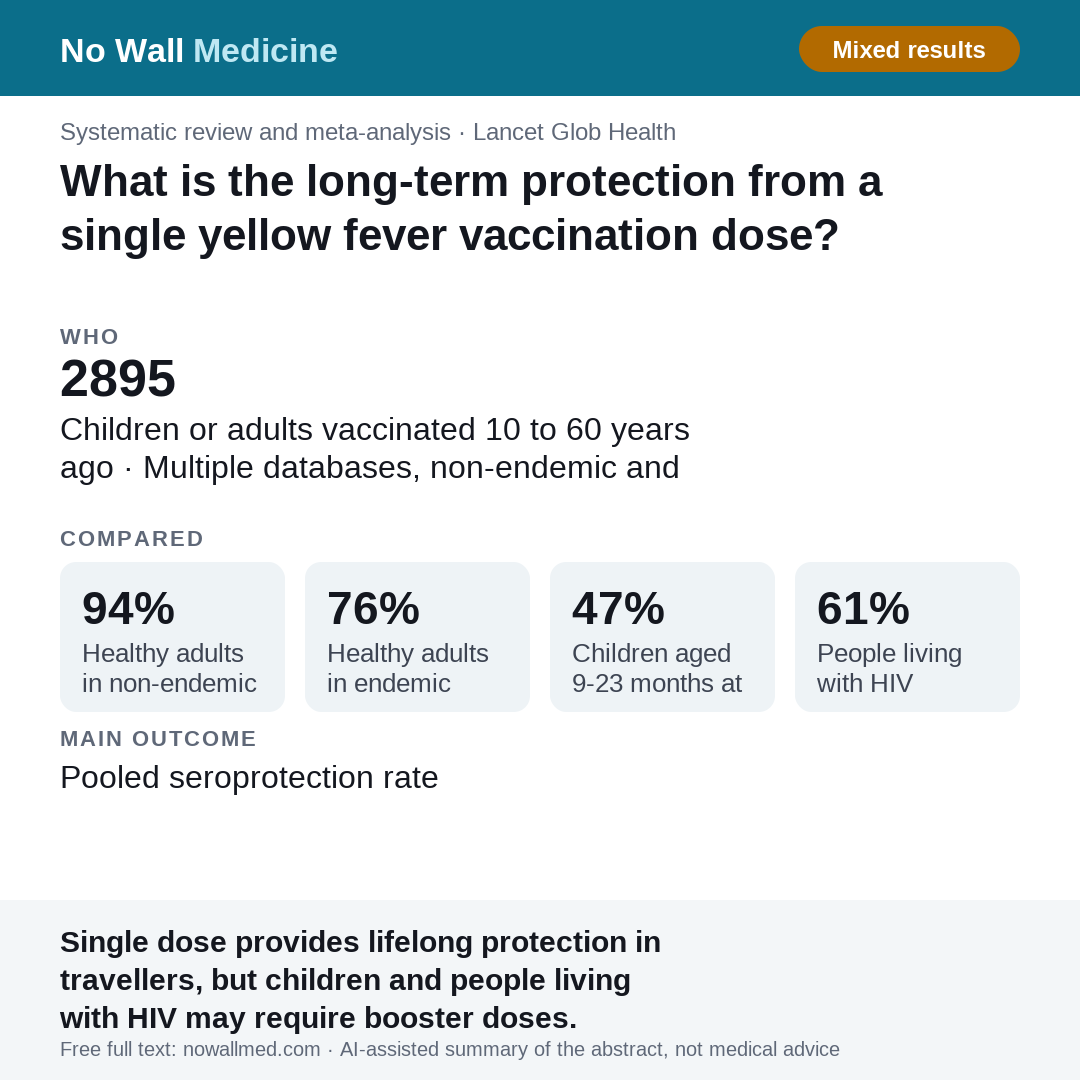
What is the long-term protection from a single yellow fever vaccination dose?
Who
2895
Children or adults vaccinated 10 to 60 years ago · Multiple databases, non-endemic and endemic settings
Compared
94%Healthy adults in non-endemic setting (95% CI 86-99)
76%Healthy adults in endemic setting (65-85)
47%Children aged 9-23 months at vaccination (35-60)
61%People living with HIV (38-82)
Main outcome
Pooled seroprotection rate
Bottom line: Single dose provides lifelong protection in travellers, but children and people living with HIV may require booster doses.
Limitation: Reported criteria for seroprotection were highly heterogeneous and sub-Saharan Africa studies were scarce and low quality.
Lancet Glob Health · 2024-01-22Download image
Clinical question: What is the long-term protection from a single yellow fever vaccination dose?
Why it matters: It is controversial whether a single dose of yellow fever vaccine provides lifelong protection for all groups.
Key points
- Researchers analyzed 20 studies involving 2895 individuals to assess long-term immunity 10 to 60 years after a single yellow fever vaccination.
- The pooled seroprotection rate, or the level of protective antibodies, was 94% (95% CI 86-99) for healthy adults in non-endemic settings.
- Seroprotection rates were lower in children aged 9-23 months at 47% (35-60) and in people living with HIV at 61% (38-82).
Limitation the authors note: Studies from sub-Saharan Africa were scarce and of low quality, preventing conclusions for that region.
Headline and key points written with AI from the paper’s abstract, with every number checked against it. Read the paper before relying on them.
Was this summary helpful?
Abstract
Background
Long-term immunity following yellow fever vaccination remains controversial. We aimed to summarise the literature regarding the long-term protection (≥10 years) conveyed by a single dose of yellow fever vaccination. Methods
In this systematic review and meta-analysis, we searched 11 databases from database inception to Aug 24, 2023. We included cohort and cross-sectional studies reporting immunogenicity outcomes for children or adults who received a single dose of yellow fever vaccination 10 or more years ago. Case series and single case reports were excluded. Participants who received more than one dose of yellow fever vaccination before measurement of the outcome were excluded. Identified records were reviewed by two independent reviewers. The primary outcome of the meta-analysis was the pooled seroprotection rate. Risk of bias was assessed with the Risk Of Bias In Non-randomized Studies of Interventions tool, and the Joanna Briggs Institute tool for analytical cross-sectional studies. Studies of moderate or good quality that reported seroprotection were included for random-effects meta-analysis and stratified by endemicity and specific risk groups. The study was registered with PROSPERO, CRD42023384087. Findings
Of the 7363 articles identified by our search, 39 were eligible for inclusion for systematic review. These studies comprised 2895 individuals vaccinated 10-60 years ago. 20 studies were included in the meta-analysis. Pooled seroprotection rates were 94% (95% CI 86-99) among healthy adults in a non-endemic setting (mostly travellers) and 76% (65-85) in an endemic setting (all Brazilian studies). The pooled seroprotection rate was 47% (35-60) in children (aged 9-23 months at time of vaccination) and 61% (38-82) in people living with HIV. Reported criteria for seroprotection were highly heterogeneous. Interpretation
The gathered evidence suggests that a single dose of yellow fever vaccination provides lifelong protection in travellers. However, in people living with HIV and children (younger than 2 years), booster doses might still be required because lower proportions of vaccinees were seroprotected 10 or more years post-vaccination. Lower observed seroprotection rates among residents of endemic areas were partly explained by the use of a higher cutoff for seroprotection that was applied in Brazil. Studies from sub-Saharan Africa were scarce and of low quality; thus no conclusions could be drawn for this region. Funding
None.
Abstract reproduced under the article’s CC BY licence.
Subject terms
Cite this article
Schnyder JL, de Jong HK, Bache BE, Schaumburg F, Grobusch MP. Long-term immunity following yellow fever vaccination: a systematic review and meta-analysis. Lancet Glob Health. 2024. doi:10.1016/S2214-109X(23)00556-9
Spotted a mistake? Suggest a correction
Top studies every Monday
The week’s key trials and guidelines in your specialties, plus any topics you follow. By email, free.
Get the weekly digest