Reverse total shoulder replacement shows improved function and 88% implant survivorship after 10 years
Long-Term Outcomes Following Reverse Total Shoulder Arthroplasty: A Systematic Review with a Minimum Follow-Up of 10 Years
Systematic review of 7 retrospective case seriesMixed results
What are the long-term clinical and radiological outcomes of reverse total shoulder arthroplasty?
Who
460
Patients undergoing reverse total shoulder arthroplasty
Compared
Reverse total shoulder arthroplasty: 88% revision-free implant survivorship at 10 years
Complications: 36% complication rate
Main outcome
Long-term clinical and radiological outcomes
Bottom line: Reverse total shoulder arthroplasty provides substantial long-term functional improvements despite significant complication and revision rates.
Limitation: High lost-to-follow-up rates and limited data quality in contemporary literature.
JBJS Open Access · 2025-05-01Download image
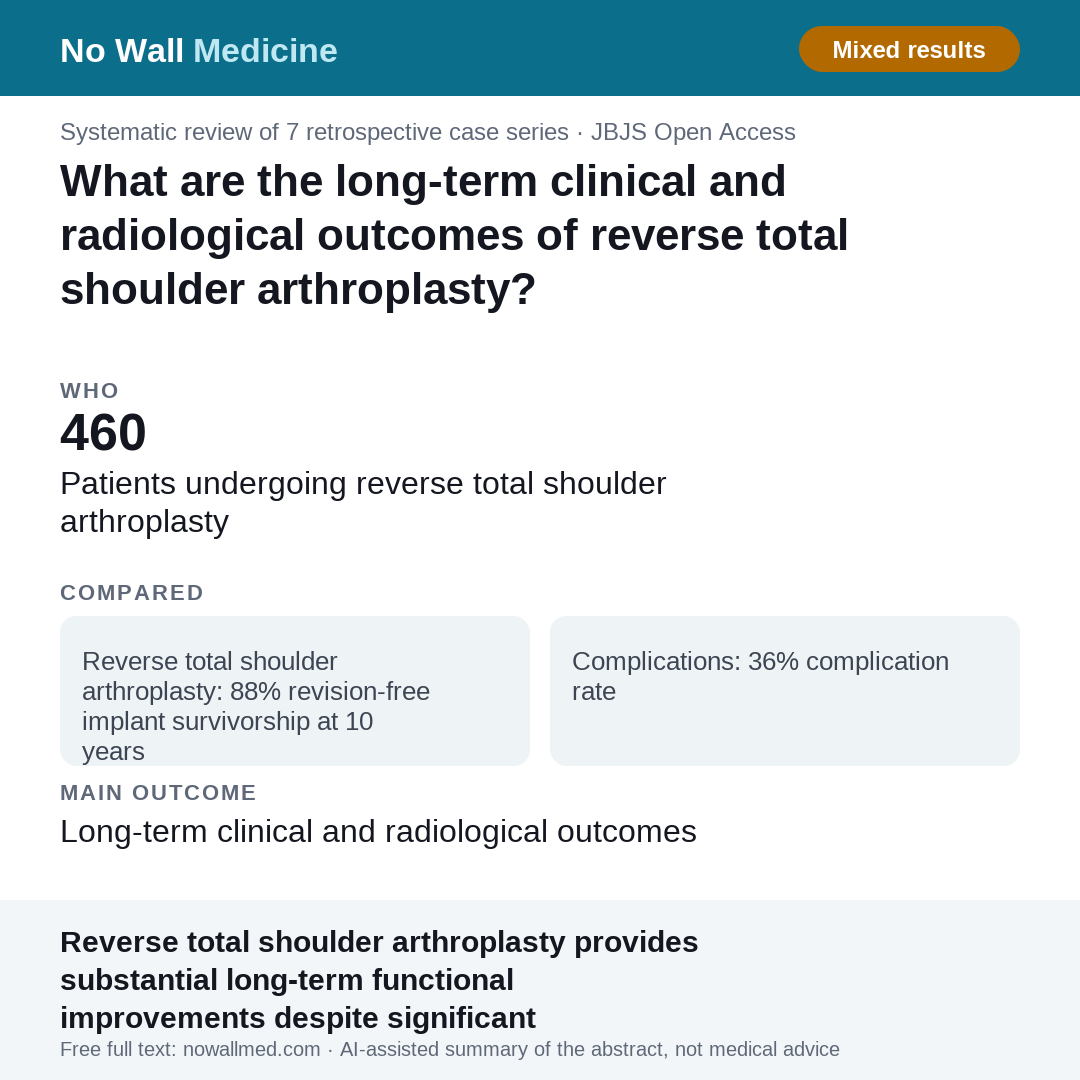
Clinical question: What are the long-term clinical and radiological outcomes of reverse total shoulder arthroplasty?
Why it matters: The long-term clinical and radiological outcomes of reverse total shoulder arthroplasty with at least 10 years of follow-up were not clearly established.
Key points
- Researchers reviewed 7 studies involving 460 patients who underwent reverse total shoulder arthroplasty, a procedure to restore shoulder function and relieve pain.
- The weighted mean revision-free implant survivorship was 88% at 10 years, though the overall complication rate was 36% and 23% of patients required further revision.
- Functional scores improved significantly, such as the American Shoulder and Elbow Surgeons Score increasing from 35 to 74 in one study.
Limitation the authors note: The review was limited by high lost-to-follow-up rates of 63% and limited data quality in the contemporary literature.
Headline and key points written with AI from the paper’s abstract, with every number checked against it. Read the paper before relying on them.
Cite this article
Biner M, Klotz S, Andronic O, Karczewski DC, Zingg L, Karl W. Long-Term Outcomes Following Reverse Total Shoulder Arthroplasty: A Systematic Review with a Minimum Follow-Up of 10 Years. JBJS Open Access. 2025. doi:10.2106/JBJS.OA.25.00025
Spotted a mistake? Suggest a correction
Top studies every Monday
The week’s key trials and guidelines in your specialties, plus any topics you follow. By email, free.
Get the weekly digest