Gene expression scores were not significantly prognostic for survival in muscle-invasive bladder cancer patients
Long-term Outcomes from a Phase 2 Study of Neoadjuvant Chemotherapy for Muscle-invasive Bladder Cancer (SWOG S1314; NCT02177695)
Randomized phase 2 trialNo clear difference
Does the COXEN score predict event-free survival and overall survival in muscle-invasive bladder cancer?
Who
227
Patients with muscle-invasive bladder cancer
Compared
dose-dense methotrexate-vinblastine-adriamycin-cisplatin
gemcitabine-cisplatin
Main outcome
event-free survival and overall survival
Result: hazard ratio 0.87 (95% CI 0.54-1.40) for overall survival
Bottom line: There was no significant difference in survival between dose-dense methotrexate-vinblastine-adriamycin-cisplatin and gemcitabine-cisplatin.
Limitation: The results did not meet the preset study parameters.
Eur Urol · 2023-07-04Download image
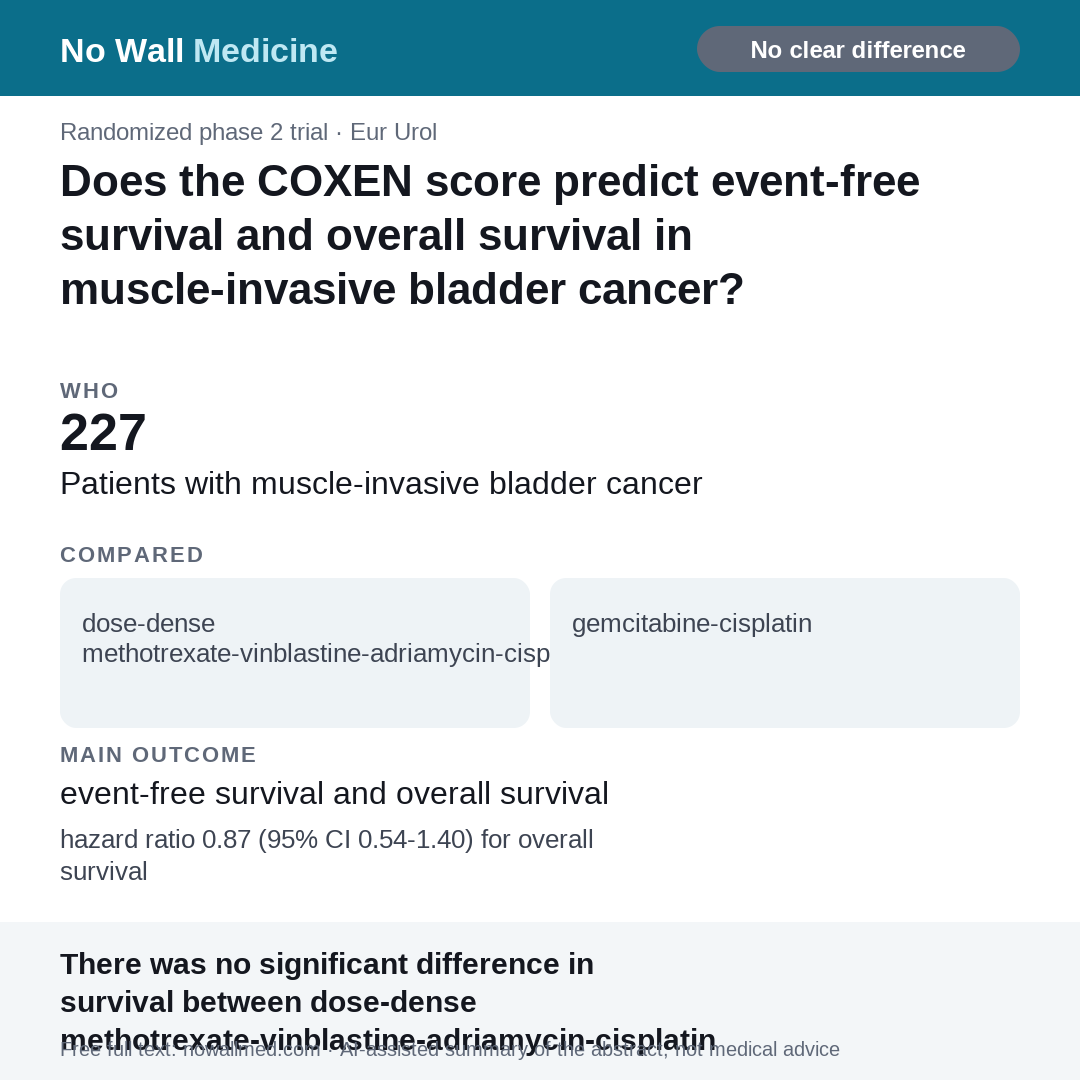
Clinical question: Does the COXEN score predict event-free survival and overall survival in muscle-invasive bladder cancer?
Why it matters: It was unknown if the COXEN gene expression model could accurately predict how patients with muscle-invasive bladder cancer respond to chemotherapy before surgery.
Key points
- Researchers analyzed 167 evaluable patients in a randomized trial comparing gemcitabine-cisplatin or dose-dense methotrexate-vinblastine-adriamycin-cisplatin chemotherapy before surgery.
- The COXEN gene expression scores were not significantly prognostic for overall survival or event-free survival within individual treatment arms.
- In the intent-to-treat group of 227 patients, there was no significant difference between the two chemotherapy regimens for overall survival or event-free survival.
Headline and key points written with AI from the paper’s abstract, with every number checked against it. Read the paper before relying on them.
Was this summary helpful?
Subject terms
Cite this article
Flaig TW, Tangen CM, Daneshmand S, Alva AS, Lucia MS, McConkey DJ. Long-term Outcomes from a Phase 2 Study of Neoadjuvant Chemotherapy for Muscle-invasive Bladder Cancer (SWOG S1314; NCT02177695). Eur Urol. 2023. doi:10.1016/j.eururo.2023.06.014
Spotted a mistake? Suggest a correction
Top studies every Monday
The week’s key trials and guidelines in your specialties, plus any topics you follow. By email, free.
Get the weekly digest