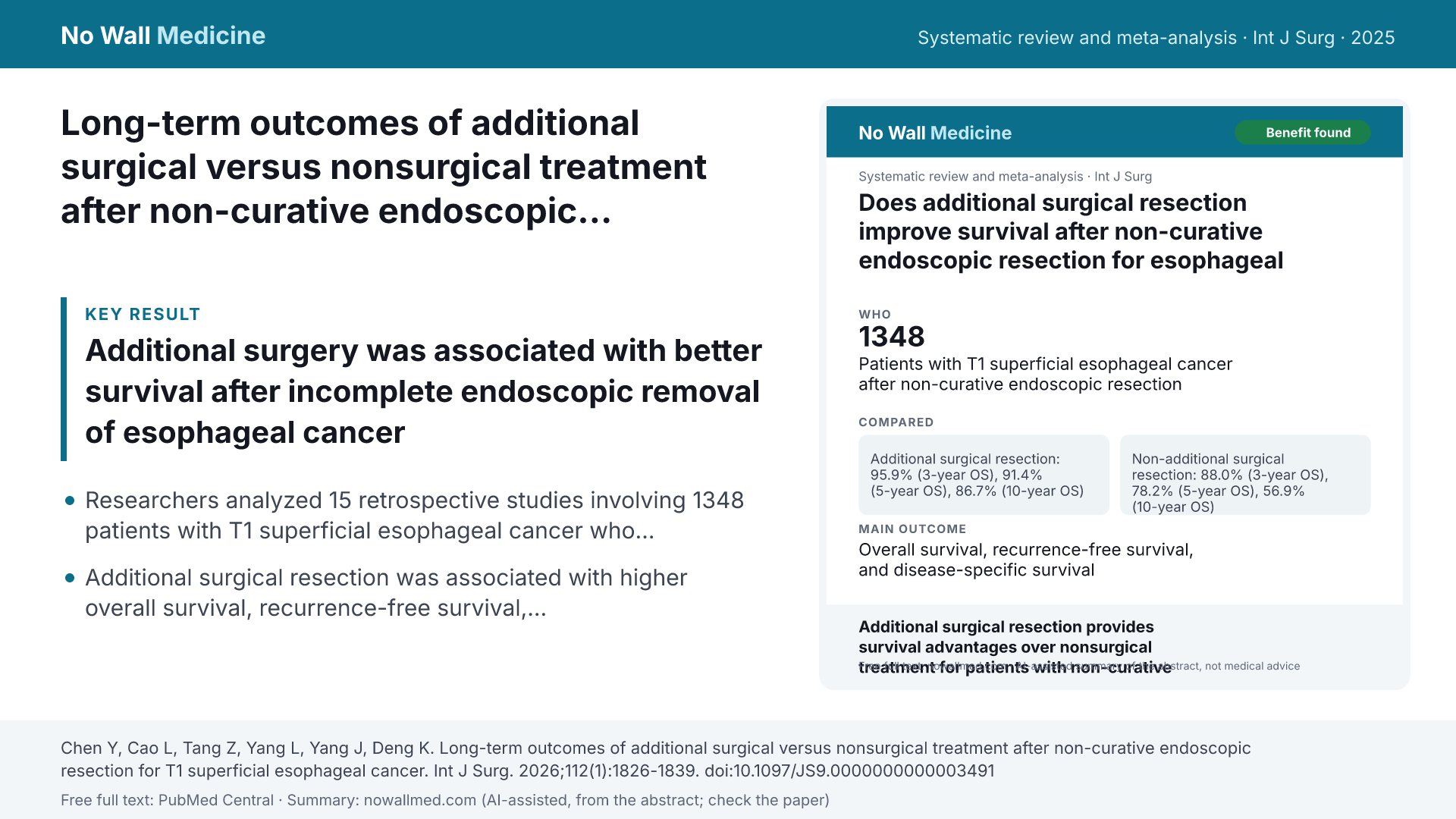
Additional surgery was associated with better survival after incomplete endoscopic removal of esophageal cancer
Long-term outcomes of additional surgical versus nonsurgical treatment after non-curative endoscopic resection for T1 superficial esophageal cancer
Systematic review and meta-analysisBenefit found
Does additional surgical resection improve survival after non-curative endoscopic resection for esophageal cancer?
Who
1348
Patients with T1 superficial esophageal cancer after non-curative endoscopic resection
Compared
Additional surgical resection: 95.9% (3-year OS), 91.4% (5-year OS), 86.7% (10-year OS)
Non-additional surgical resection: 88.0% (3-year OS), 78.2% (5-year OS), 56.9% (10-year OS)
Main outcome
Overall survival, recurrence-free survival, and disease-specific survival
Result: hazard ratio 3.06 (95% CI 2.11-4.43) for overall survival
Bottom line: Additional surgical resection provides survival advantages over nonsurgical treatment for patients with non-curative endoscopic resection.
Limitation: The studies identified were retrospective studies.
Int J Surg · 2025-09-17 · Save PNG
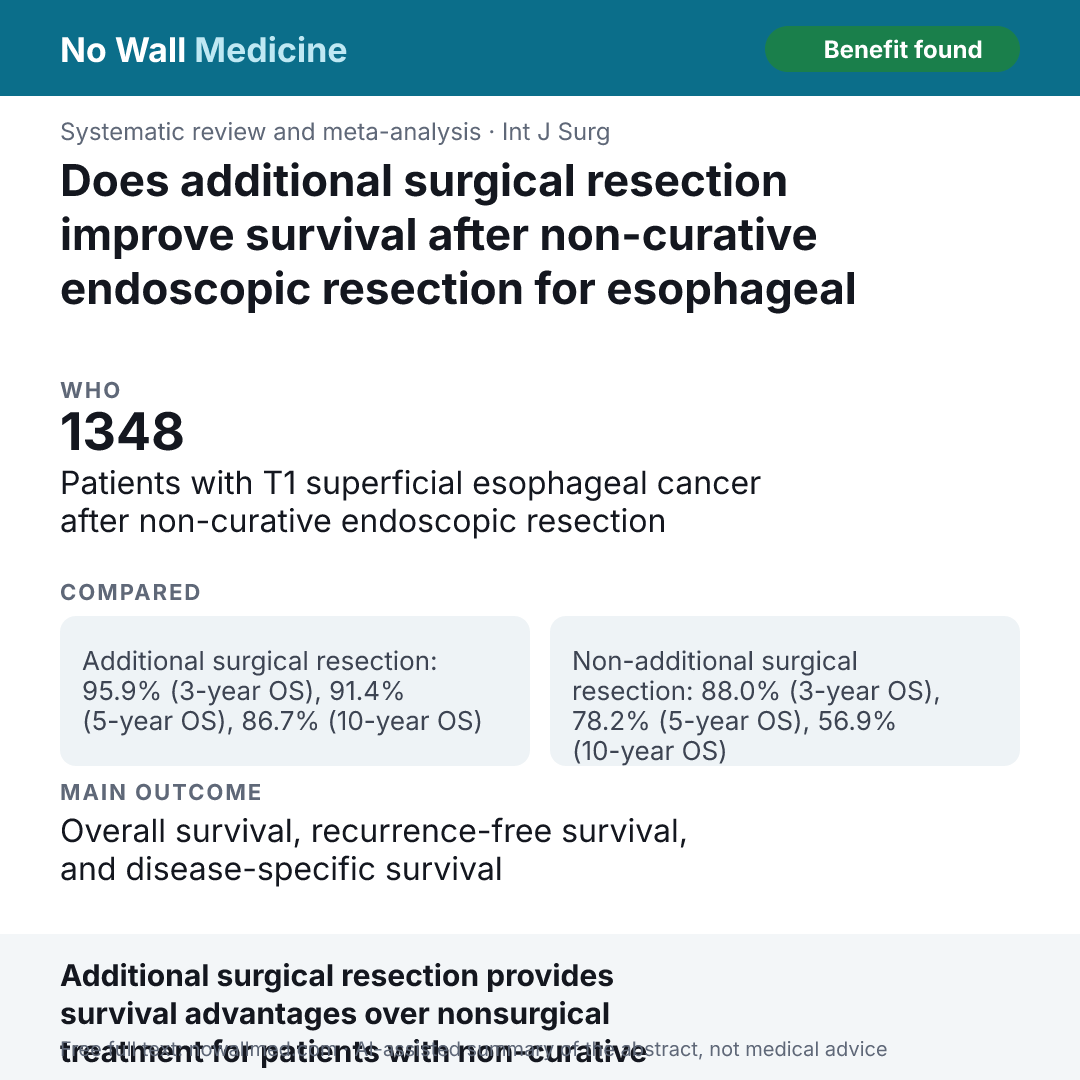
Clinical question: Does additional surgical resection improve survival after non-curative endoscopic resection for esophageal cancer?
Why it matters: The survival benefit of additional surgical resection compared to non-surgical treatment remains unclear for patients with non-curative endoscopic resection of superficial esophageal cancer.
Key points
- Researchers analyzed 15 retrospective studies involving 1348 patients with T1 superficial esophageal cancer who had non-curative endoscopic resection.
- Additional surgical resection was associated with higher overall survival, recurrence-free survival, and disease-specific survival compared to no additional surgery.
- At 10 years, the overall survival rate was 86.7% for the additional surgery group compared to 56.9% for the non-surgical group.
Headline and key points written with AI from the paper’s abstract, with every number checked against it. Read the paper before relying on them.
Was this summary helpful?
Subject terms
Headline, design, result, key points, caveat and citation as plain text.
Cite this article
Chen Y, Cao L, Tang Z, Yang L, Yang J, Deng K. Long-term outcomes of additional surgical versus nonsurgical treatment after non-curative endoscopic resection for T1 superficial esophageal cancer. Int J Surg. 2026;112(1):1826-1839. doi:10.1097/JS9.0000000000003491
Spotted a mistake? Suggest a correction