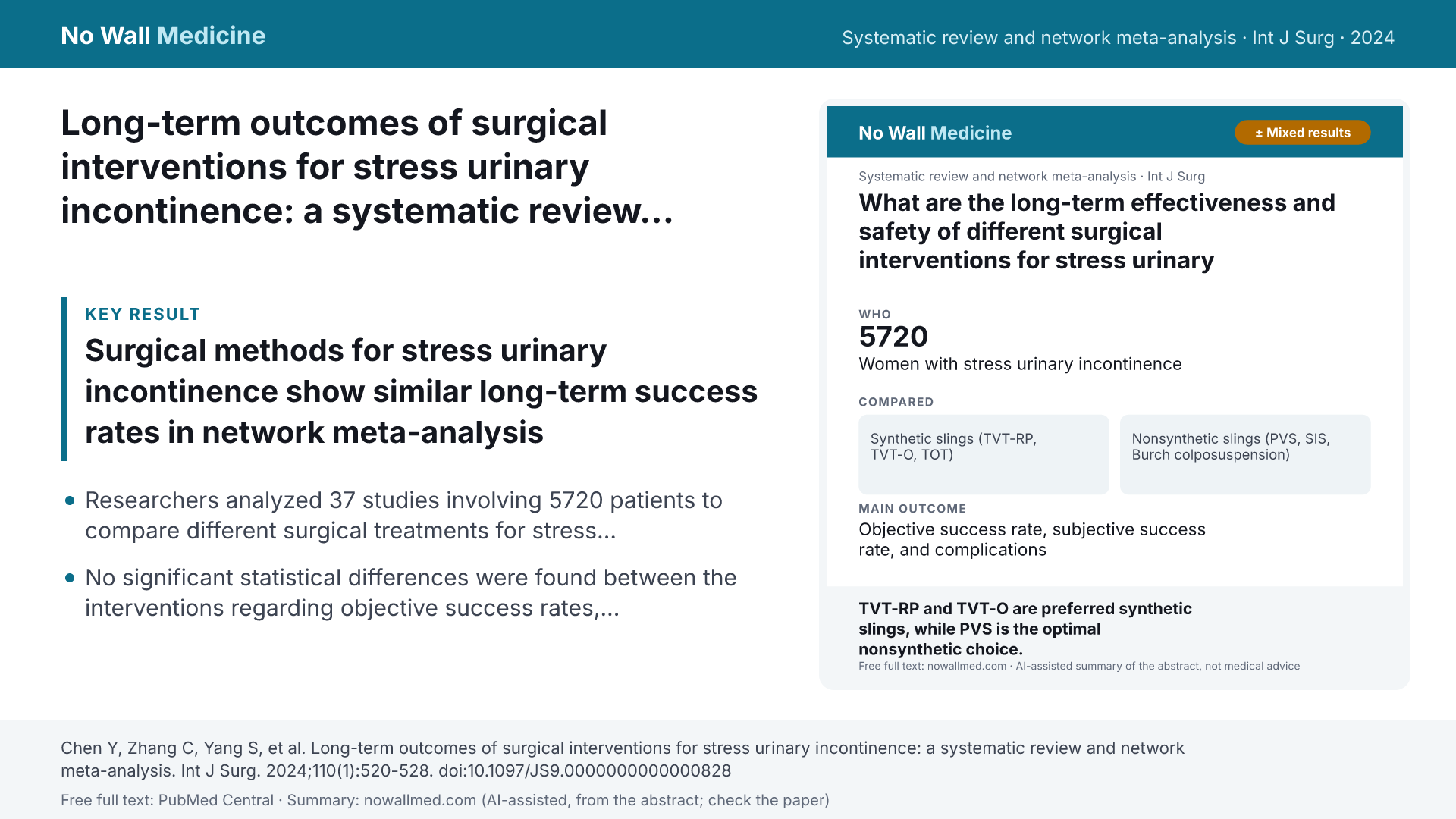
Surgical methods for stress urinary incontinence show similar long-term success rates in network meta-analysis
Long-term outcomes of surgical interventions for stress urinary incontinence: a systematic review and network meta-analysis
Systematic review and network meta-analysisMixed results
What are the long-term effectiveness and safety of different surgical interventions for stress urinary incontinence?
Who
5720
Women with stress urinary incontinence
Compared
Synthetic slings (TVT-RP, TVT-O, TOT)
Nonsynthetic slings (PVS, SIS, Burch colposuspension)
Main outcome
Objective success rate, subjective success rate, and complications
Bottom line: TVT-RP and TVT-O are preferred synthetic slings, while PVS is the optimal nonsynthetic choice.
Int J Surg · 2024-01-01Download image
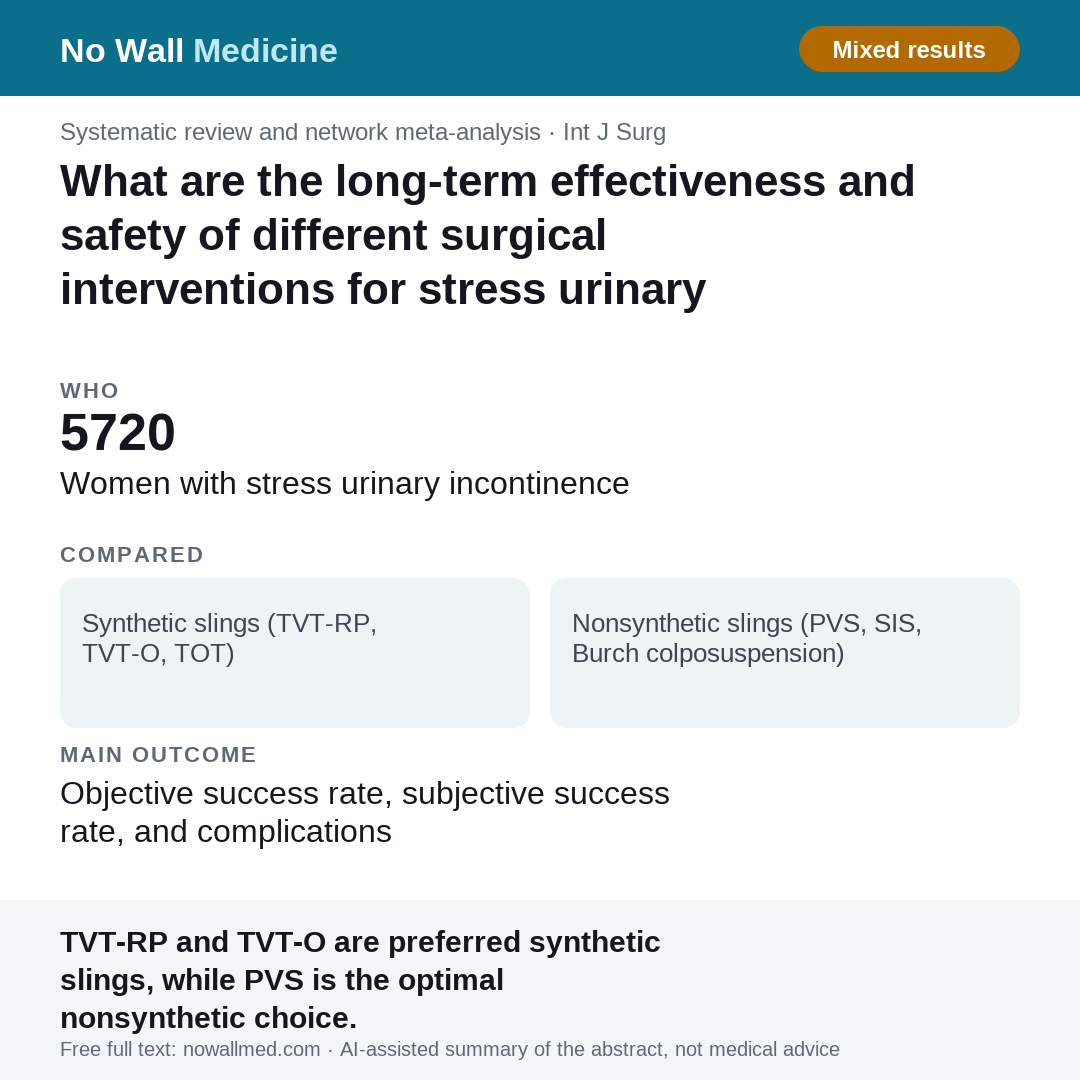
Clinical question: What are the long-term effectiveness and safety of different surgical interventions for stress urinary incontinence?
Why it matters: The long-term effectiveness and safety of various surgical interventions for stress urinary incontinence remain sparsely documented in existing literature.
Key points
- Researchers analyzed 37 studies involving 5720 patients to compare different surgical treatments for stress urinary incontinence.
- No significant statistical differences were found between the interventions regarding objective success rates, though pubovaginal sling had the highest ranking value of 93.1.
- Single-incision sling was associated with lower overall complication and pain rates compared to other methods, while reoperation and infection rates showed no differences.
Headline and key points written with AI from the paper’s abstract, with every number checked against it. Read the paper before relying on them.
Was this summary helpful?
Subject terms
Cite this article
Chen Y, Zhang C, Yang S, et al. Long-term outcomes of surgical interventions for stress urinary incontinence: a systematic review and network meta-analysis. Int J Surg. 2024. doi:10.1097/JS9.0000000000000828
Spotted a mistake? Suggest a correction