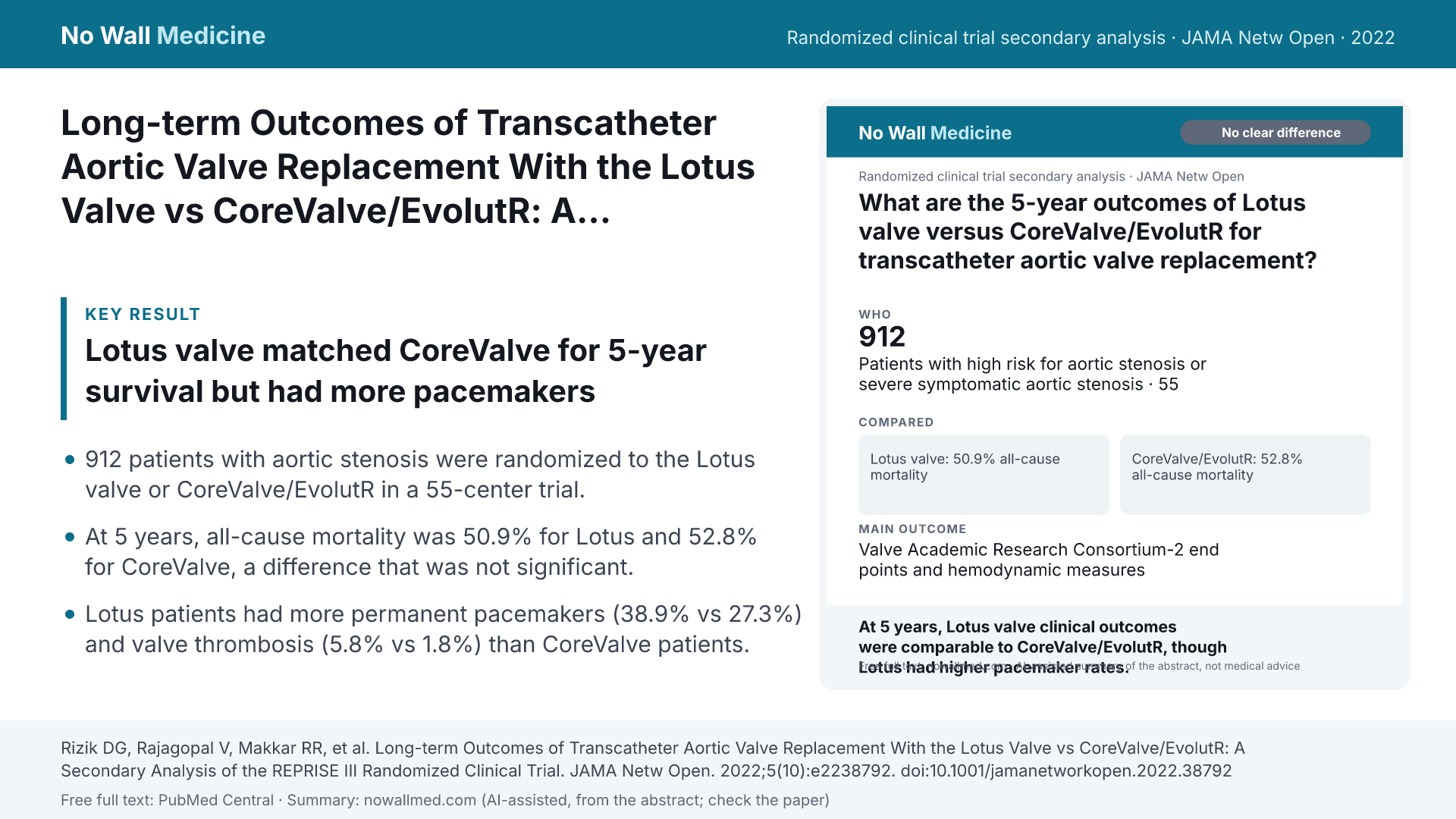
Lotus valve matched CoreValve for 5-year survival but had more pacemakers
Long-term Outcomes of Transcatheter Aortic Valve Replacement With the Lotus Valve vs CoreValve/EvolutR: A Secondary Analysis of the REPRISE III Randomized Clinical Trial
Randomized clinical trial secondary analysisNo clear difference
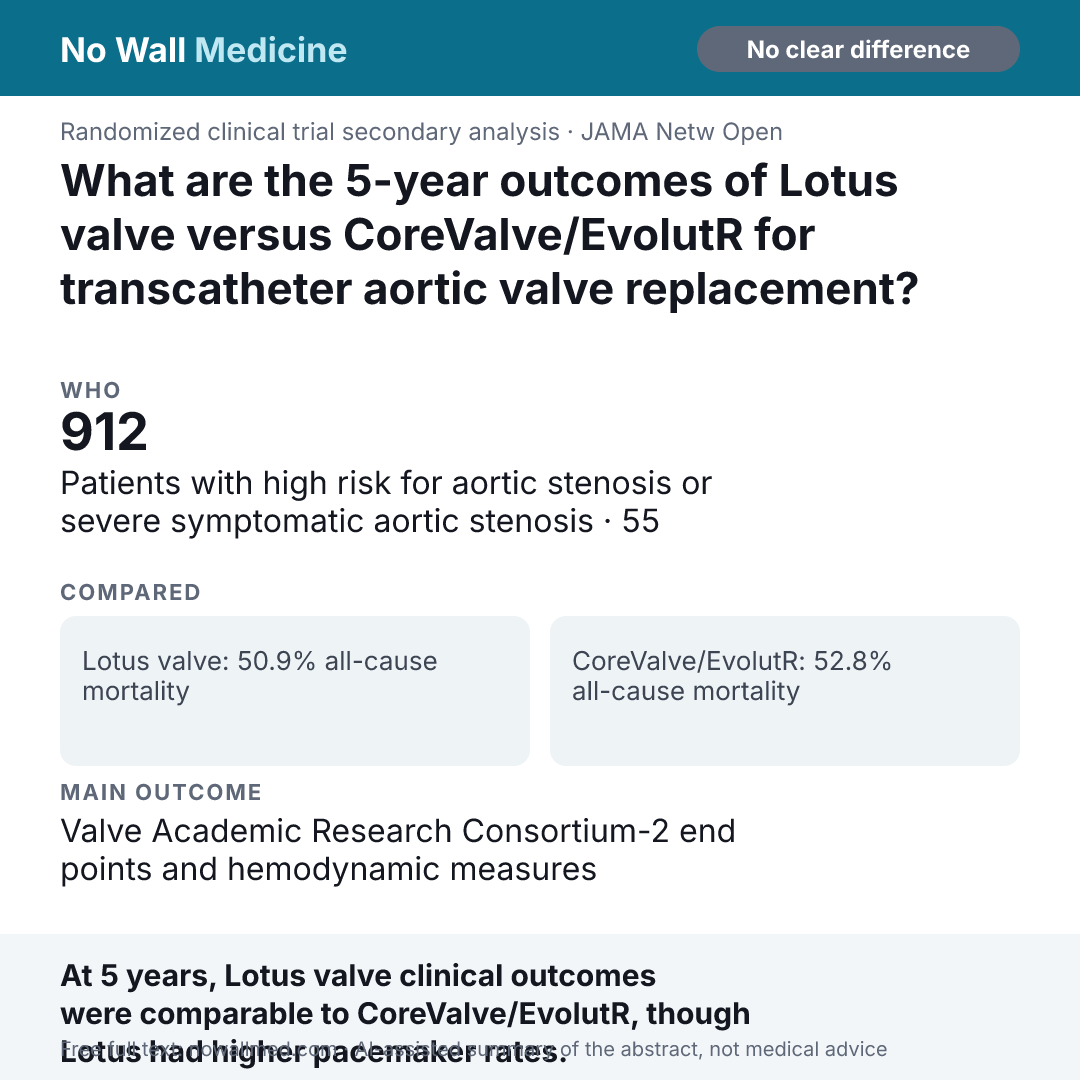
What are the 5-year outcomes of Lotus valve versus CoreValve/EvolutR for transcatheter aortic valve replacement?
Who
912
Patients with high risk for aortic stenosis or severe symptomatic aortic stenosis · 55 centers in North America, Europe, and Australia
Compared
Lotus valve: 50.9% all-cause mortality
CoreValve/EvolutR: 52.8% all-cause mortality
Main outcome
Valve Academic Research Consortium-2 end points and hemodynamic measures
Bottom line: At 5 years, Lotus valve clinical outcomes were comparable to CoreValve/EvolutR, though Lotus had higher pacemaker rates.
JAMA Netw Open · 2022-10-03 · Save PNG
Clinical question: What are the 5-year outcomes of Lotus valve versus CoreValve/EvolutR for transcatheter aortic valve replacement?
Why it matters: Long-term data on mortality and durability of transcatheter heart valves were limited before this 5-year follow-up.
Key points
- 912 patients with aortic stenosis were randomized to the Lotus valve or CoreValve/EvolutR in a 55-center trial.
- At 5 years, all-cause mortality was 50.9% for Lotus and 52.8% for CoreValve, a difference that was not significant.
- Lotus patients had more permanent pacemakers (38.9% vs 27.3%) and valve thrombosis (5.8% vs 1.8%) than CoreValve patients.
Limitation the authors note: Clinical follow-up data were available for only 95.7% of Lotus patients and 93.4% of CoreValve patients.
Headline and key points written with AI from the paper’s abstract, with every number checked against it. Read the paper before relying on them.
Was this summary helpful?
Subject terms
Headline, design, result, key points, caveat and citation as plain text.
Cite this article
Rizik DG, Rajagopal V, Makkar RR, et al. Long-term Outcomes of Transcatheter Aortic Valve Replacement With the Lotus Valve vs CoreValve/EvolutR: A Secondary Analysis of the REPRISE III Randomized Clinical Trial. JAMA Netw Open. 2022;5(10):e2238792. doi:10.1001/jamanetworkopen.2022.38792
Spotted a mistake? Suggest a correction