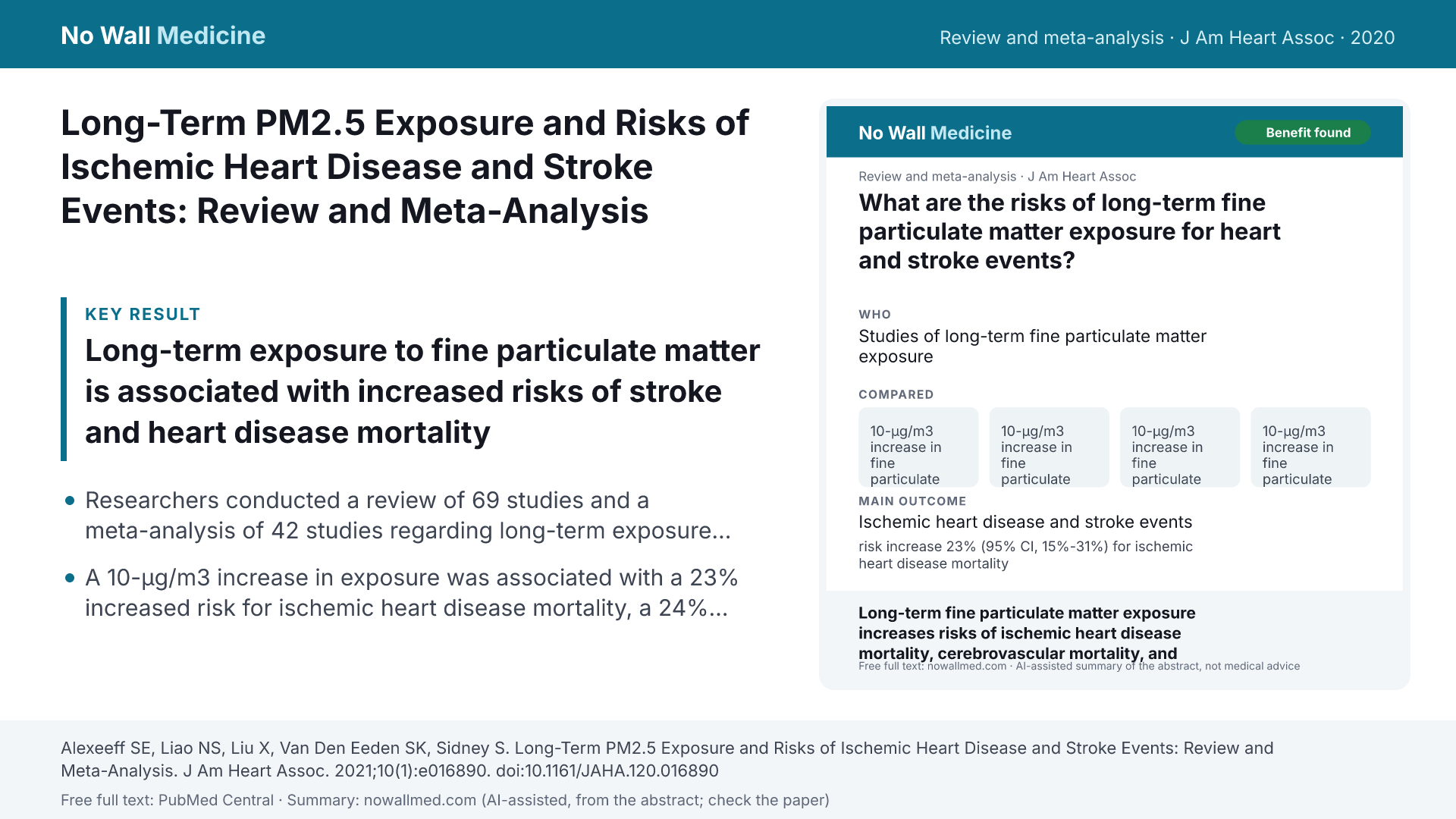
Long-term exposure to fine particulate matter is associated with increased risks of stroke and heart disease mortality
Long-Term PM2.5 Exposure and Risks of Ischemic Heart Disease and Stroke Events: Review and Meta-Analysis
Review and meta-analysisBenefit found
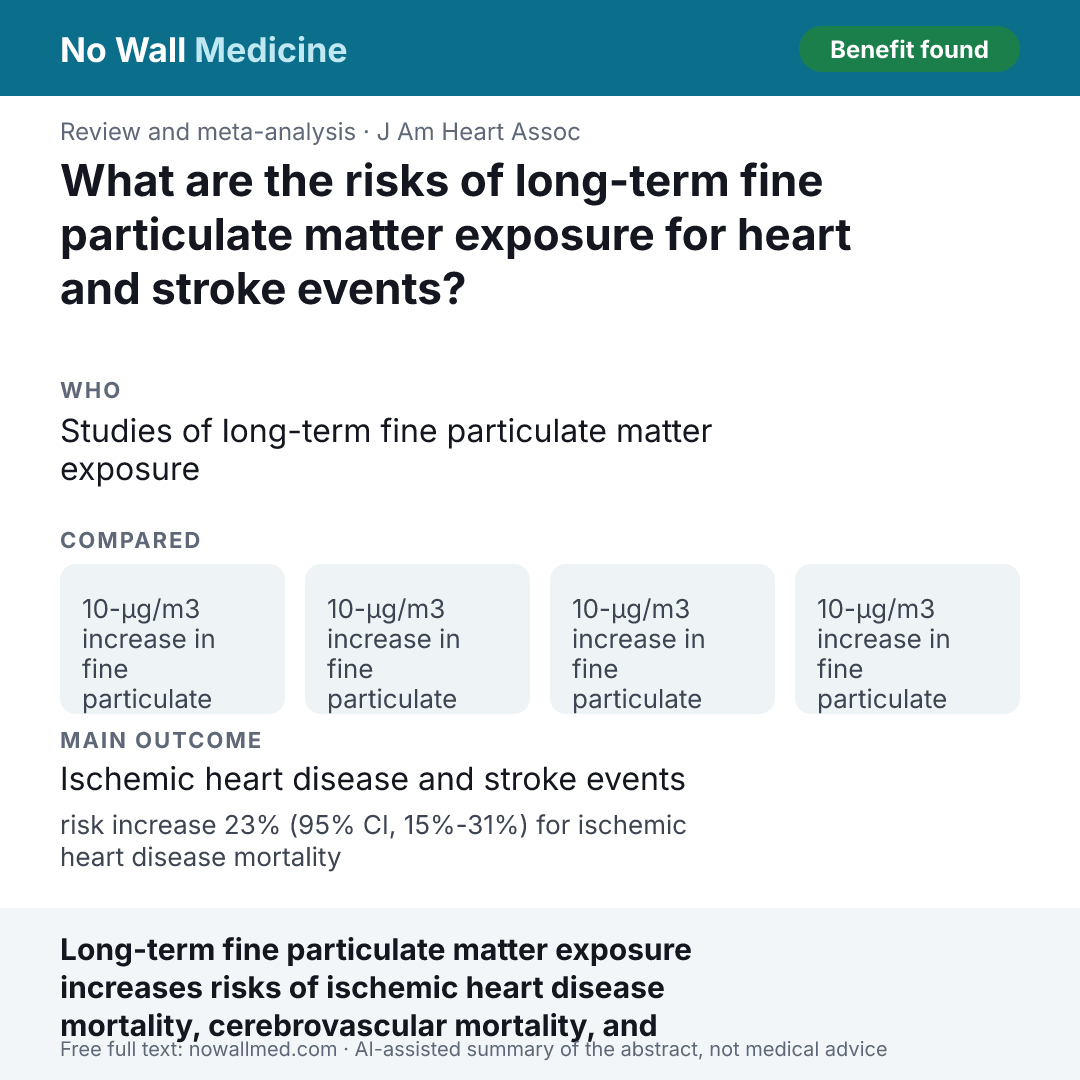
What are the risks of long-term fine particulate matter exposure for heart and stroke events?
Who
Studies of long-term fine particulate matter exposure
Compared
10-µg/m3 increase in fine particulate matter: 23% increased risk for ischemic heart disease mortality
10-µg/m3 increase in fine particulate matter: 24% increased risk for cerebrovascular mortality
10-µg/m3 increase in fine particulate matter: 13% increased risk for incident stroke
10-µg/m3 increase in fine particulate matter: 8% increased risk for incident myocardial infarction
Main outcome
Ischemic heart disease and stroke events
Result: risk increase 23% (95% CI, 15%-31%) for ischemic heart disease mortality
Bottom line: Long-term fine particulate matter exposure increases risks of ischemic heart disease mortality, cerebrovascular mortality, and incident stroke.
Limitation: Insufficient studies of recurrent stroke and recurrent myocardial infarction to conduct meta-analyses.
J Am Heart Assoc · 2020-12-31 · Save PNG
Clinical question: What are the risks of long-term fine particulate matter exposure for heart and stroke events?
Why it matters: The specific risks of incident heart attack, stroke, and mortality from ischemic heart disease or cerebrovascular causes in relation to long-term fine particulate matter exposure had not been quantified and compared.
Key points
- Researchers conducted a review of 69 studies and a meta-analysis of 42 studies regarding long-term exposure to fine particulate matter less than 2.5 micrometers in diameter.
- A 10-µg/m3 increase in exposure was associated with a 23% increased risk for ischemic heart disease mortality, a 24% risk for cerebrovascular mortality, and a 13% risk for incident stroke.
- The association between a 10-µg/m3 increase in exposure and incident myocardial infarction, or heart attack, was 8% but was not statistically conclusive.
Headline and key points written with AI from the paper’s abstract, with every number checked against it. Read the paper before relying on them.
Was this summary helpful?
Subject terms
Headline, design, result, key points, caveat and citation as plain text.
Cite this article
Alexeeff SE, Liao NS, Liu X, Van Den Eeden SK, Sidney S. Long-Term PM2.5 Exposure and Risks of Ischemic Heart Disease and Stroke Events: Review and Meta-Analysis. J Am Heart Assoc. 2021;10(1):e016890. doi:10.1161/JAHA.120.016890
Spotted a mistake? Suggest a correction