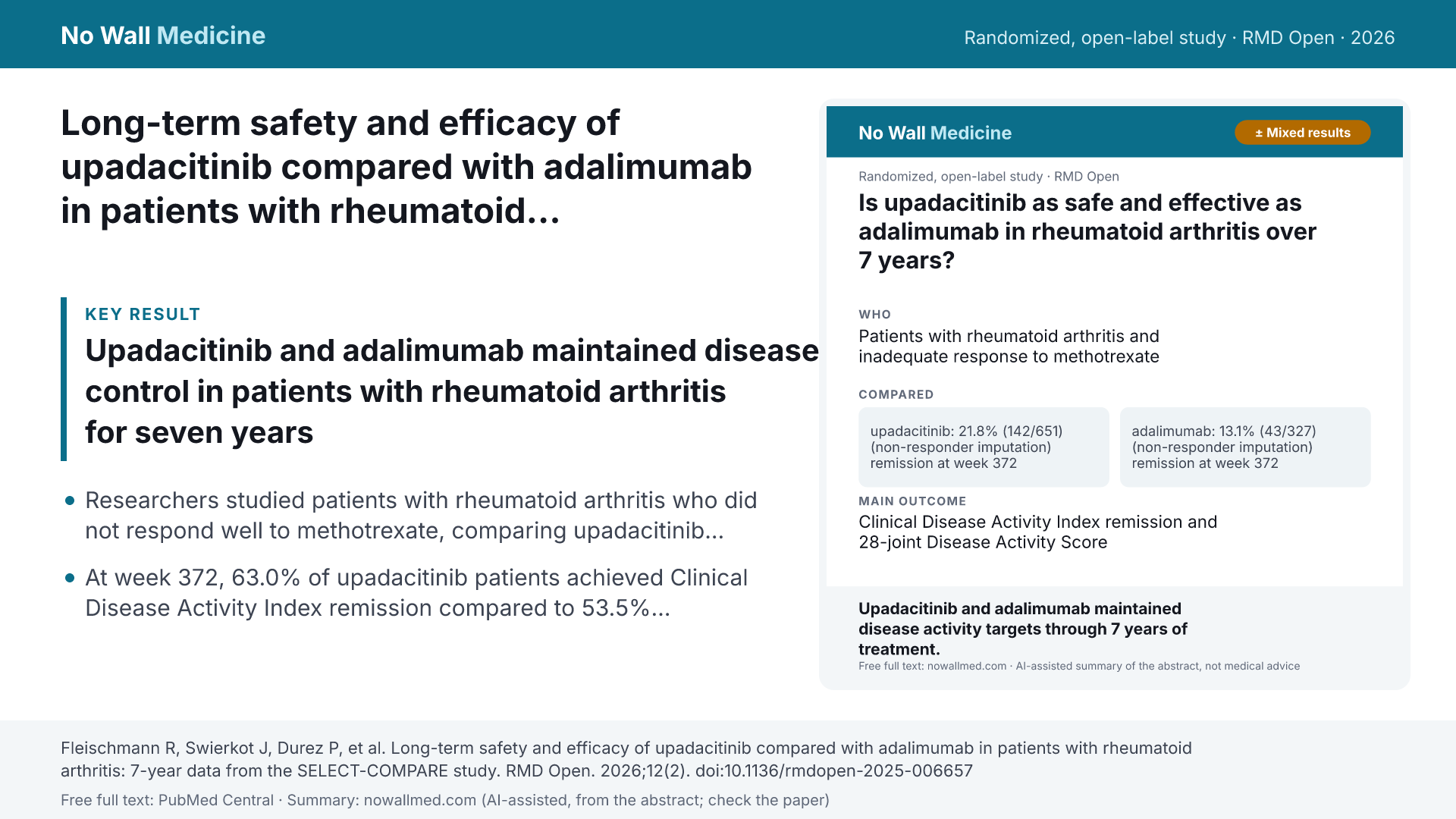
Upadacitinib and adalimumab maintained disease control in patients with rheumatoid arthritis for seven years
Long-term safety and efficacy of upadacitinib compared with adalimumab in patients with rheumatoid arthritis: 7-year data from the SELECT-COMPARE study
Randomized, open-label studyMixed results
Is upadacitinib as safe and effective as adalimumab in rheumatoid arthritis over 7 years?
Who
Patients with rheumatoid arthritis and inadequate response to methotrexate
Compared
upadacitinib: 21.8% (142/651) (non-responder imputation) remission at week 372
adalimumab: 13.1% (43/327) (non-responder imputation) remission at week 372
Main outcome
Clinical Disease Activity Index remission and 28-joint Disease Activity Score
Bottom line: Upadacitinib and adalimumab maintained disease activity targets through 7 years of treatment.
RMD Open · 2026-06-24Download image
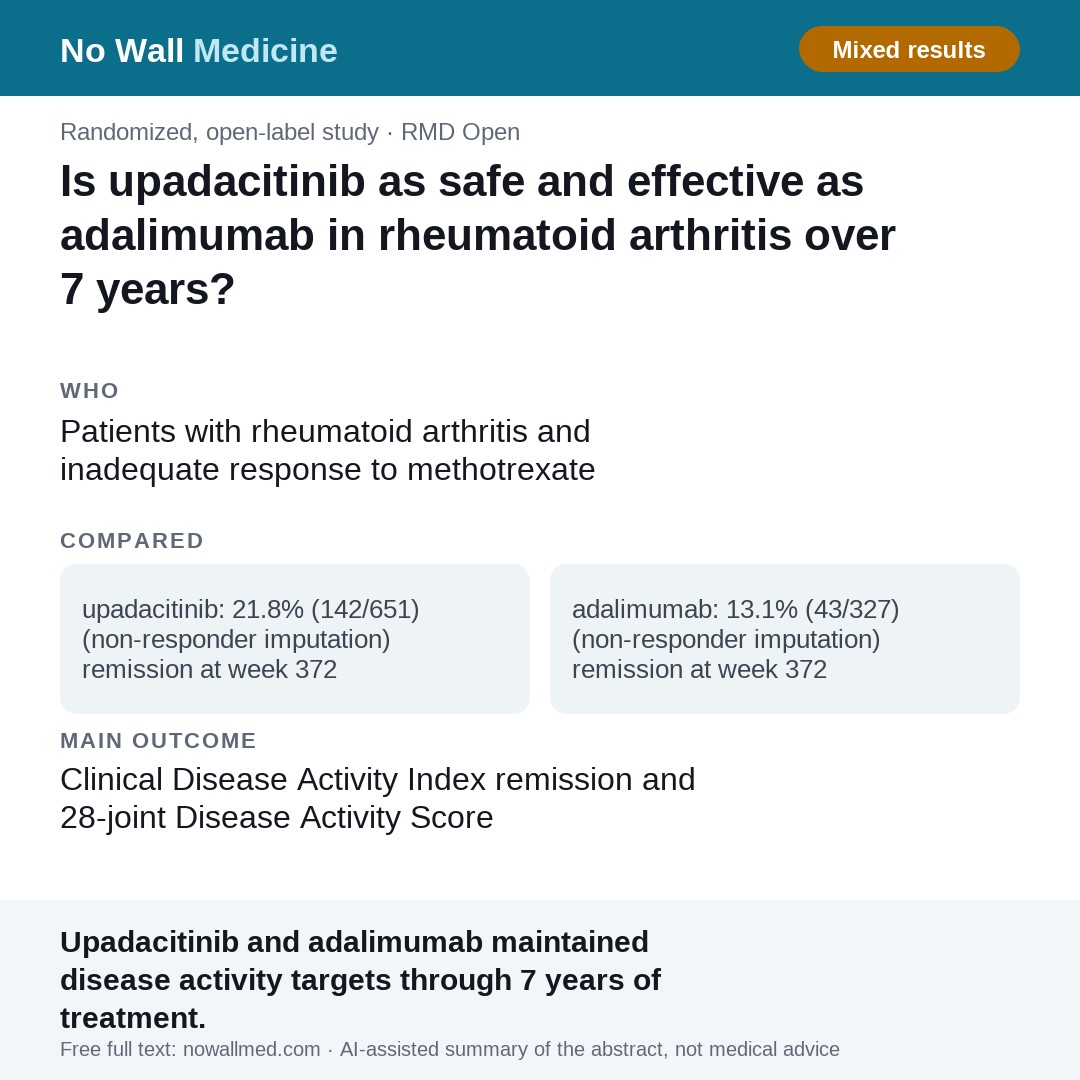
Clinical question: Is upadacitinib as safe and effective as adalimumab in rheumatoid arthritis over 7 years?
Why it matters: Long-term data is needed to assess the safety and efficacy of upadacitinib compared to adalimumab for patients with rheumatoid arthritis.
Key points
- Researchers studied patients with rheumatoid arthritis who did not respond well to methotrexate, comparing upadacitinib once daily to adalimumab every other week.
- At week 372, 63.0% of upadacitinib patients achieved Clinical Disease Activity Index remission compared to 53.5% of adalimumab patients using the as observed analysis.
- Upadacitinib showed comparable rates of treatment-emergent adverse events to adalimumab, though it had numerically higher rates of herpes zoster and skin cancer.
Headline and key points written with AI from the paper’s abstract, with every number checked against it. Read the paper before relying on them.
Was this summary helpful?
Abstract
Objectives
To assess the safety and efficacy of upadacitinib versus adalimumab through 7 years in the ongoing SELECT-COMPARE study. Methods
Patients with rheumatoid arthritis (RA) and inadequate response to methotrexate (MTX) were randomised to placebo, upadacitinib 15 mg once daily or adalimumab 40 mg every other week (on background MTX). Inadequate responders were rescued to the alternate therapy, with placebo recipients switching to upadacitinib by week 26. Patients completing 48 weeks were eligible to enter the 10-year extension. Safety was assessed as treatment-emergent adverse events (TEAEs); efficacy was analysed by randomised group (non-responder imputation [NRI]) or treatment sequence (as observed [AO]). Results
Upadacitinib was generally well tolerated, displaying TEAE rates comparable to adalimumab, but numerically higher rates of herpes zoster, creatine phosphokinase elevation, non-melanoma skin cancer, lymphopenia and hepatic disorders. Responses with continuous upadacitinib or adalimumab were maintained through 372 weeks; week 372 Clinical Disease Activity Index remission (≤2.8) and 28-joint Disease Activity Score based on C-reactive protein<2.6 were achieved by 145/230 (63.0%) and 178/204 (83.2%) (AO)/142/651 (21.8%) and 172/651 (26.4%) (NRI) of patients with upadacitinib versus 46/86 (53.5%) and 59/81 (72.8%) (AO)/43/327 (13.1%) and 55/327 (16.8%) (NRI) with adalimumab. Initial non-responders/incomplete responders benefited from switching, with improvements in efficacy endpoints maintained through week 336 post switch, without additional safety concerns. Conclusion
The safety profile of upadacitinib remained consistent with previous analyses, with no new safety concerns through 7 years. Upadacitinib and adalimumab (continuous or rescue treatment) maintained disease activity targets throughout the 7-year treatment period. Upadacitinib exhibited an acceptable benefit-risk profile for long-term RA treatment. Trial registration number
NCT02629159.
Abstract reproduced under the article’s CC BY licence.
Subject terms
Cite this article
Fleischmann R, Swierkot J, Durez P, et al. Long-term safety and efficacy of upadacitinib compared with adalimumab in patients with rheumatoid arthritis: 7-year data from the SELECT-COMPARE study. RMD Open. 2026. doi:10.1136/rmdopen-2025-006657
Spotted a mistake? Suggest a correction