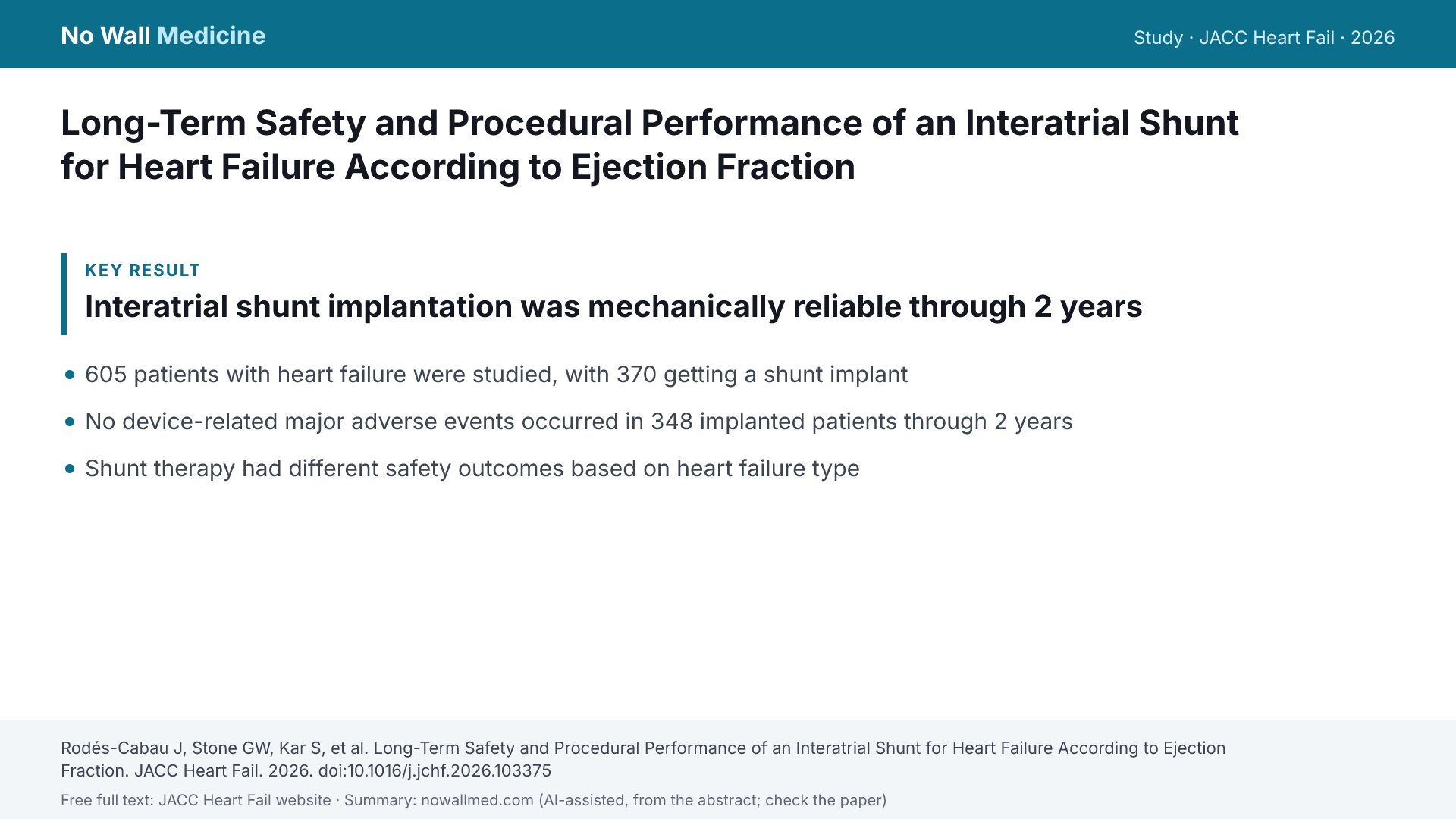
Interatrial shunt implantation was mechanically reliable through 2 years
Long-Term Safety and Procedural Performance of an Interatrial Shunt for Heart Failure According to Ejection Fraction
Why it matters: Doctors need more information on long-term device durability and safety outcomes after interatrial shunting
Key points
- 605 patients with heart failure were studied, with 370 getting a shunt implant.
- No device-related major adverse events occurred in 348 implanted patients through 2 years.
- Shunt therapy had different safety outcomes based on heart failure type.
Study type: Observational study: it can show a link, but not prove that one thing causes another.
Headline and key points written with AI from the paper’s abstract, with every number checked against it. Read the paper before relying on them.
Was this summary helpful?
Cite this article
Rodés-Cabau J, Stone GW, Kar S, et al. Long-Term Safety and Procedural Performance of an Interatrial Shunt for Heart Failure According to Ejection Fraction. JACC Heart Fail. 2026. doi:10.1016/j.jchf.2026.103375
Spotted a mistake? Suggest a correction