Sprifermin injections maintained cartilage thickness and pain relief for five years in knee osteoarthritis patients
Long-term structural and symptomatic effects of intra-articular sprifermin in patients with knee osteoarthritis: 5-year results from the FORWARD study
Randomized trialBenefit found
What are the long-term structural and symptomatic effects of intra-articular sprifermin in knee osteoarthritis?
Who
378
Patients with knee osteoarthritis
Compared
sprifermin 100 µg every 6 months: 0.05 mm mean difference versus placebo
placebo
Main outcome
total femorotibial joint cartilage thickness
Result: 0.05 mm mean difference (95% CI 0.00 to 0.10)
Bottom line: Sprifermin maintained long-term structural modification of articular cartilage over 3.5 years post-treatment.
Ann Rheum Dis · 2021-05-07Download image
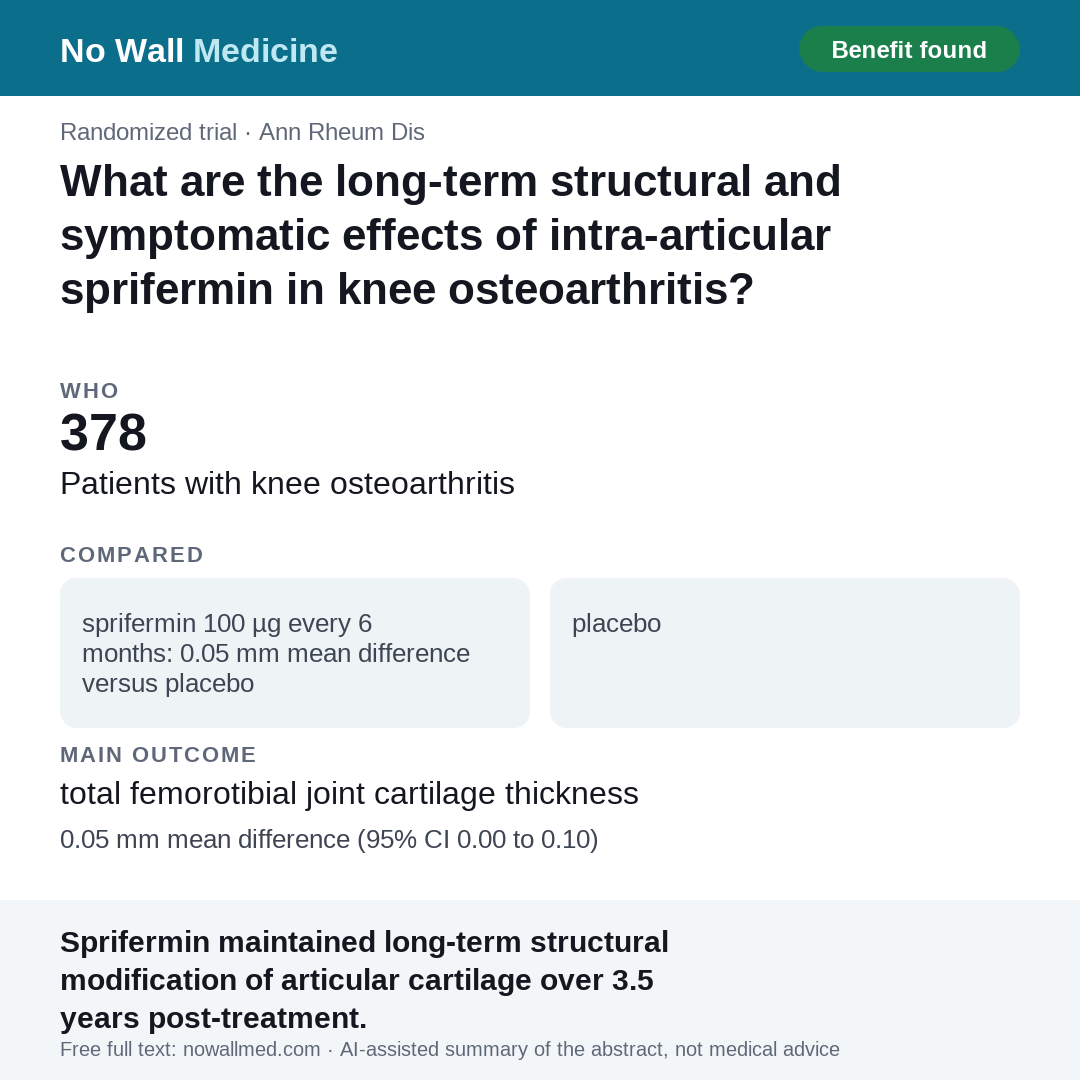
Clinical question: What are the long-term structural and symptomatic effects of intra-articular sprifermin in knee osteoarthritis?
Why it matters: It was unknown if the structural changes and symptomatic benefits of sprifermin, a potential disease-modifying osteoarthritis drug, could be sustained long-term after treatment ends.
Key points
- Researchers followed 378 patients who were randomized to receive sprifermin injections or a placebo for 18 months and monitored them for five years.
- Sprifermin 100 µg every 6 months showed a 0.05 mm mean difference in total femorotibial joint cartilage thickness compared to placebo at year 5.
- Pain scores measured by the Western Ontario and McMaster Universities Osteoarthritis Index improved approximately 50% from baseline across all study groups.
Headline and key points written with AI from the paper’s abstract, with every number checked against it. Read the paper before relying on them.
Was this summary helpful?
Abstract
Objective
The FORWARD (FGF-18 Osteoarthritis Randomized Trial with Administration of Repeated Doses) trial assessed efficacy and safety of the potential disease-modifying osteoarthritis drug (DMOAD) sprifermin in patients with knee osteoarthritis. Here, we report 5-year efficacy and safety results. Methods
Patients were randomised to intra-articular sprifermin 100 µg or 30 µg every 6 months (q6mo) or 12 months, or placebo, for 18 months. The primary analysis was at year 2, with follow-up at years 3, 4 and 5. Additional post hoc exploratory analyses were conducted in patients with baseline minimum radiographic joint space width 1.5-3.5 mm and Western Ontario and McMaster Universities Osteoarthritis Index (WOMAC) pain 40-90, a subgroup at risk (SAR) of progression. Results
378 (69%) patients completed the 5-year follow-up. A significant dose-response in total femorotibial joint cartilage thickness with sprifermin (trend test, p<0.001) and a 0.05 mm mean difference with sprifermin 100 µg q6mo versus placebo (95% CI 0.00 to 0.10; p=0.015) were sustained to year 5. WOMAC pain scores improved ~50% from baseline in all groups. No patient in the 100 µg q6mo group had replacement of the treated knee. 96%-98% of patients receiving sprifermin and 98% placebo reported adverse events, most were mild or moderate and deemed unrelated to treatment. Adverse event-related study withdrawals were <10%. Differentiation in WOMAC pain between sprifermin 100 µg q6mo and placebo in the SAR (n=161) at year 3 was maintained to year 5 (-10.08; 95% CI -25.68 to 5.53). Conclusion
In the longest DMOAD trial reported to date, sprifermin maintained long-term structural modification of articular cartilage over 3.5 years post-treatment. Potential translation to clinical benefit was observed in the SAR. Trial registration number
NCT01919164.
Abstract reproduced under the article’s CC BY NC licence.
Subject terms
Cite this article
Eckstein F, Hochberg MC, Guehring H, Moreau F, Ona V, Bihlet AR. Long-term structural and symptomatic effects of intra-articular sprifermin in patients with knee osteoarthritis: 5-year results from the FORWARD study. Ann Rheum Dis. 2021. doi:10.1136/annrheumdis-2020-219181
Spotted a mistake? Suggest a correction
Top studies every Monday
The week’s key trials and guidelines in your specialties, plus any topics you follow. By email, free.
Get the weekly digest