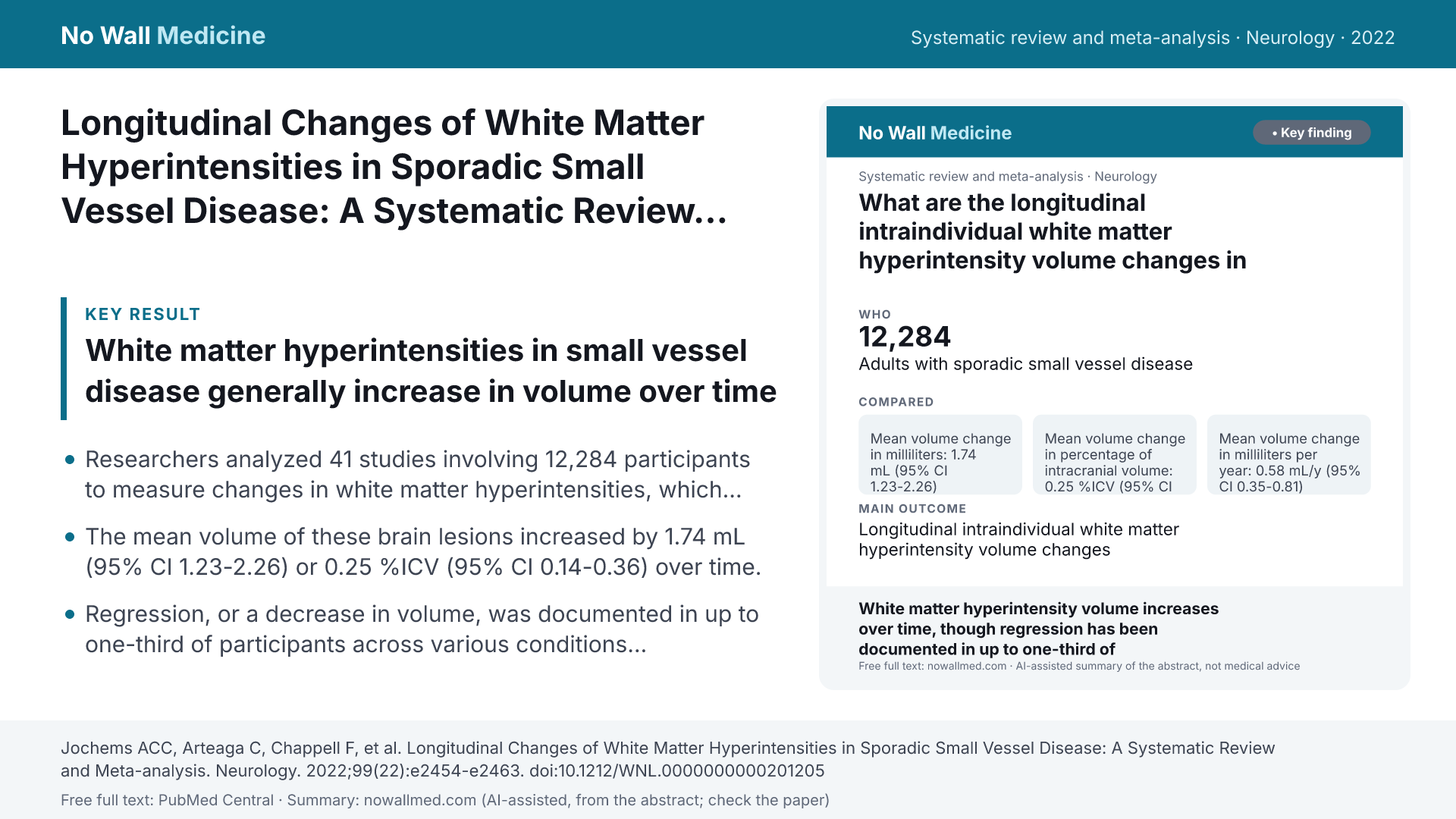
White matter hyperintensities in small vessel disease generally increase in volume over time
Longitudinal Changes of White Matter Hyperintensities in Sporadic Small Vessel Disease: A Systematic Review and Meta-analysis
Systematic review and meta-analysisBenefit found
What are the longitudinal intraindividual white matter hyperintensity volume changes in sporadic small vessel disease?
Who
12,284
Adults with sporadic small vessel disease
Compared
Mean volume change in milliliters: 1.74 mL (95% CI 1.23-2.26)
Mean volume change in percentage of intracranial volume: 0.25 %ICV (95% CI 0.14-0.36)
Mean volume change in milliliters per year: 0.58 mL/y (95% CI 0.35-0.81)
Main outcome
Longitudinal intraindividual white matter hyperintensity volume changes
Result: 1.74 mL (95% CI 1.23-2.26)
Bottom line: White matter hyperintensity volume increases over time, though regression has been documented in up to one-third of participants.
Limitation: More knowledge on underlying mechanisms, associated factors, and clinical correlates is needed.
Neurology · 2022-09-19Download image
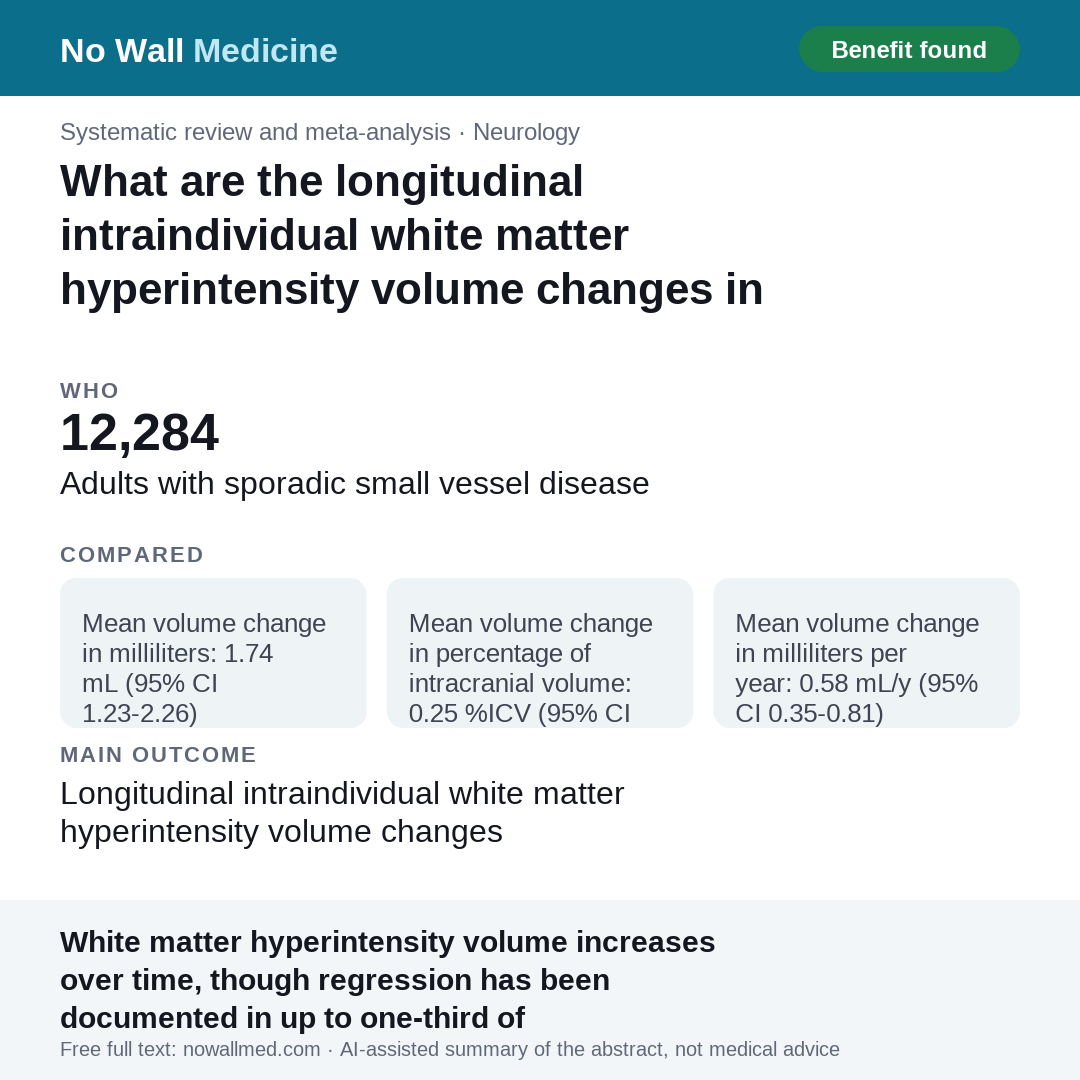
Clinical question: What are the longitudinal intraindividual white matter hyperintensity volume changes in sporadic small vessel disease?
Why it matters: The frequency and factors associated with the regression of white matter hyperintensities in people with sporadic small vessel disease are unknown.
Key points
- Researchers analyzed 41 studies involving 12,284 participants to measure changes in white matter hyperintensities, which are bright spots on brain scans indicating small vessel disease.
- The mean volume of these brain lesions increased by 1.74 mL (95% CI 1.23-2.26) or 0.25 %ICV (95% CI 0.14-0.36) over time.
- Regression, or a decrease in volume, was documented in up to one-third of participants across various conditions including stroke and cognitive disorders.
Headline and key points written with AI from the paper’s abstract, with every number checked against it. Read the paper before relying on them.
Was this summary helpful?
Subject terms
Cite this article
Jochems ACC, Arteaga C, Chappell F, Ritakari T, Hooley M, Doubal F. Longitudinal Changes of White Matter Hyperintensities in Sporadic Small Vessel Disease: A Systematic Review and Meta-analysis. Neurology. 2022. doi:10.1212/WNL.0000000000201205
Spotted a mistake? Suggest a correction
Top studies every Monday
The week’s key trials and guidelines in your specialties, plus any topics you follow. By email, free.
Get the weekly digest