Longitudinal effects of physical activity on sleep in association with hippocampal-amygdala subfield structure and functional connectivity in Alzheimer's disease
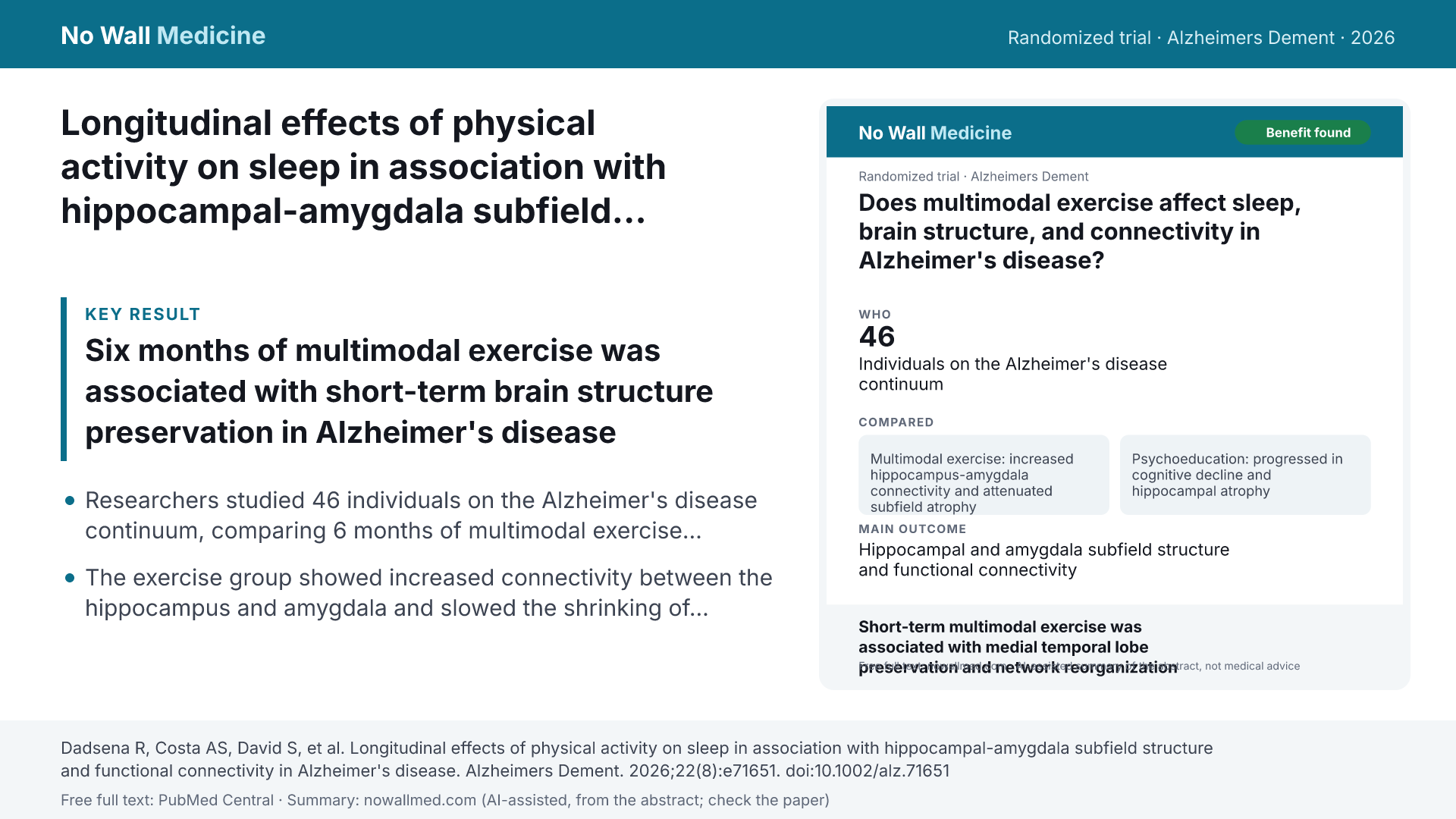
Key result: Six months of multimodal exercise was associated with short-term brain structure preservation in Alzheimer's disease
Randomized trialBenefit found
Does multimodal exercise affect sleep, brain structure, and connectivity in Alzheimer's disease?
Who
46
Individuals on the Alzheimer's disease continuum
Compared
Multimodal exercise: increased hippocampus-amygdala connectivity and attenuated subfield atrophy
Psychoeducation: progressed in cognitive decline and hippocampal atrophy
Main outcome
Hippocampal and amygdala subfield structure and functional connectivity
Bottom line: Short-term multimodal exercise was associated with medial temporal lobe preservation and network reorganization linked to sleep.
Alzheimers Dement · 2026-08-25
Key points
- Researchers studied 46 individuals on the Alzheimer's disease continuum, comparing 6 months of multimodal exercise to psychoeducation over an 18-month period.
- The exercise group showed increased connectivity between the hippocampus and amygdala and slowed the shrinking of specific brain subfields after the 6-month intervention.
- One year after the intervention, both groups experienced cognitive decline and shrinking of the hippocampus.
Discussion prompts
- Would these patients look like yours? Who was left out?
- Is the main outcome one that matters to patients?
- Is the difference large enough to change what you do?
Cite: Dadsena R, Costa AS, David S, et al. Longitudinal effects of physical activity on sleep in association with hippocampal-amygdala subfield structure and functional connectivity in Alzheimer's disease. Alzheimers Dement. 2026;22(8):e71651. doi:10.1002/alz.71651
Free full text: PubMed Central · Summary and visual abstract: nowallmed.com/a/longitudinal-effects-of-physical-activity-on-sleep-in-association-11qgh91/ (AI-assisted from the abstract; check the paper before relying on it).