Genetic variant associated with faster decline in lung capacity in people with idiopathic pulmonary fibrosis
Longitudinal lung function and gas transfer in individuals with idiopathic pulmonary fibrosis: a genome-wide association study
Genome-wide meta-analysisBenefit found
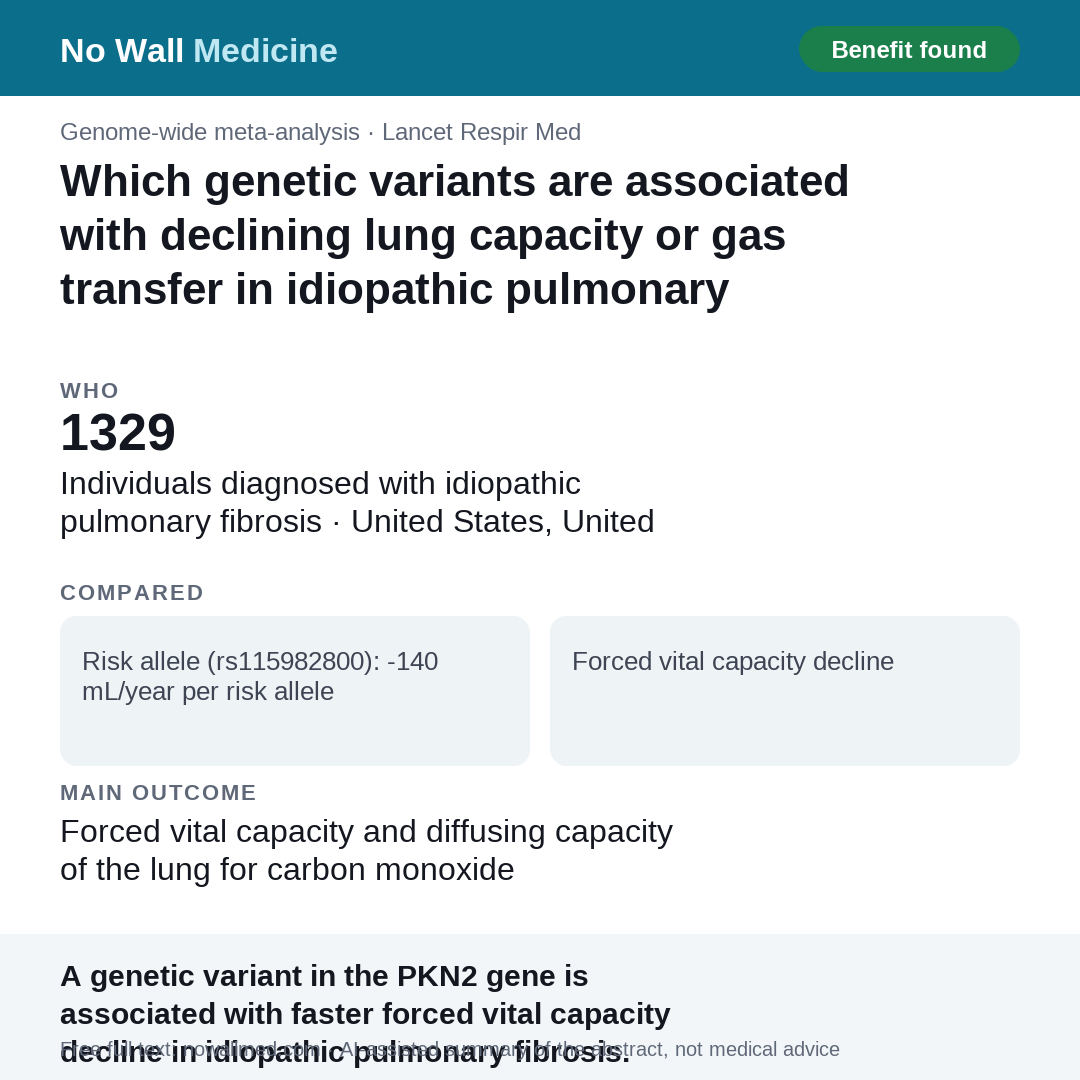
Which genetic variants are associated with declining lung capacity or gas transfer in idiopathic pulmonary fibrosis?
Who
1329
Individuals diagnosed with idiopathic pulmonary fibrosis · United States, United Kingdom, and Spain
Compared
Risk allele (rs115982800): -140 mL/year per risk allele
Forced vital capacity decline
Main outcome
Forced vital capacity and diffusing capacity of the lung for carbon monoxide
Result: -140 mL/year per risk allele [95% CI -180 to -100]
Bottom line: A genetic variant in the PKN2 gene is associated with faster forced vital capacity decline in idiopathic pulmonary fibrosis.
Funded by: Action for Pulmonary Fibrosis, Medical Research Council, Wellcome Trust, and NIH
Lancet Respir Med · 2022-08-16Download image
Clinical question: Which genetic variants are associated with declining lung capacity or gas transfer in idiopathic pulmonary fibrosis?
Why it matters: It was unknown which genetic variants are associated with the decline of lung capacity or gas transfer after an idiopathic pulmonary fibrosis diagnosis.
Key points
- Researchers analyzed 1329 individuals for forced vital capacity, which measures lung volume, and 975 individuals for diffusing capacity of the lung for carbon monoxide, which measures gas transfer.
- One genetic variant in the PKN2 gene was associated with a forced vital capacity decline of -140 mL/year per risk allele (95% CI -180 to -100; p=9·14 × 10-12).
- The study included 5216 measures for lung volume and 3361 measures for gas transfer across four different studies.
Headline and key points written with AI from the paper’s abstract, with every number checked against it. Read the paper before relying on them.
Was this summary helpful?
Abstract
Background
Idiopathic pulmonary fibrosis (IPF) is an incurable lung disease characterised by progressive scarring leading to alveolar stiffness, reduced lung capacity, and impeded gas transfer. We aimed to identify genetic variants associated with declining lung capacity or declining gas transfer after diagnosis of IPF. Methods
We did a genome-wide meta-analysis of longitudinal measures of forced vital capacity (FVC) and diffusing capacity of the lung for carbon monoxide (DLCO) in individuals diagnosed with IPF. Individuals were recruited to three studies between June, 1996, and August, 2017, from across centres in the US, UK, and Spain. Suggestively significant variants were investigated further in an additional independent study (CleanUP-IPF). All four studies diagnosed cases following American Thoracic Society/European Respiratory Society guidelines. Variants were defined as significantly associated if they had a meta-analysis p<5 × 10⁻⁸ when meta-analysing across all discovery and follow-up studies, had consistent direction of effects across all four studies, and were nominally significant (p<0·05) in each study. Findings
1329 individuals with a total of 5216 measures were included in the FVC analysis. 975 individuals with a total of 3361 measures were included in the DLCO analysis. For the discovery genome-wide analyses, 7 611 174 genetic variants were included in the FVC analysis and 7 536 843 in the DLCO analysis. One variant (rs115982800) located in an antisense RNA gene for protein kinase N2 (PKN2) showed a genome-wide significant association with FVC decline (-140 mL/year per risk allele [95% CI -180 to -100]; p=9·14 × 10-12). Interpretation
Our analysis identifies a genetic variant associated with disease progression, which might highlight a new biological mechanism for IPF. We found that PKN2, a Rho and Rac effector protein, is the most likely gene of interest from this analysis. PKN2 inhibitors are currently in development and signify a potential novel therapeutic approach for IPF. Funding
Action for Pulmonary Fibrosis, Medical Research Council, Wellcome Trust, and National Institutes of Health National Heart, Lung, and Blood Institute.
Abstract reproduced under the article’s CC BY licence.
Subject terms
Cite this article
Allen RJ, Oldham JM, Jenkins DA, Leavy OC, Guillen-Guio B, Melbourne CA. Longitudinal lung function and gas transfer in individuals with idiopathic pulmonary fibrosis: a genome-wide association study. Lancet Respir Med. 2022. doi:10.1016/S2213-2600(22)00251-X
Spotted a mistake? Suggest a correction
Top studies every Monday
The week’s key trials and guidelines in your specialties, plus any topics you follow. By email, free.
Get the weekly digest