High loop gain predicts residual sleep apnoea in patients using positive airway pressure therapy
Loop gain predicts residual sleep apnoea among people using positive airway pressure
Meta-analysis of 2 trialsHarm found
Does loop gain predict residual sleep apnoea?
Who
obstructive sleep apnoea patients
Compared
High loop gain
Low loop gain
Main outcome
residual sleep apnoea
Result: odds ratio 2.17 (1.24-3.78) and 3.31 (1.33-8.24)
Bottom line: High loop gain predicts residual sleep apnoea
Thorax · 2026-06-15Download image
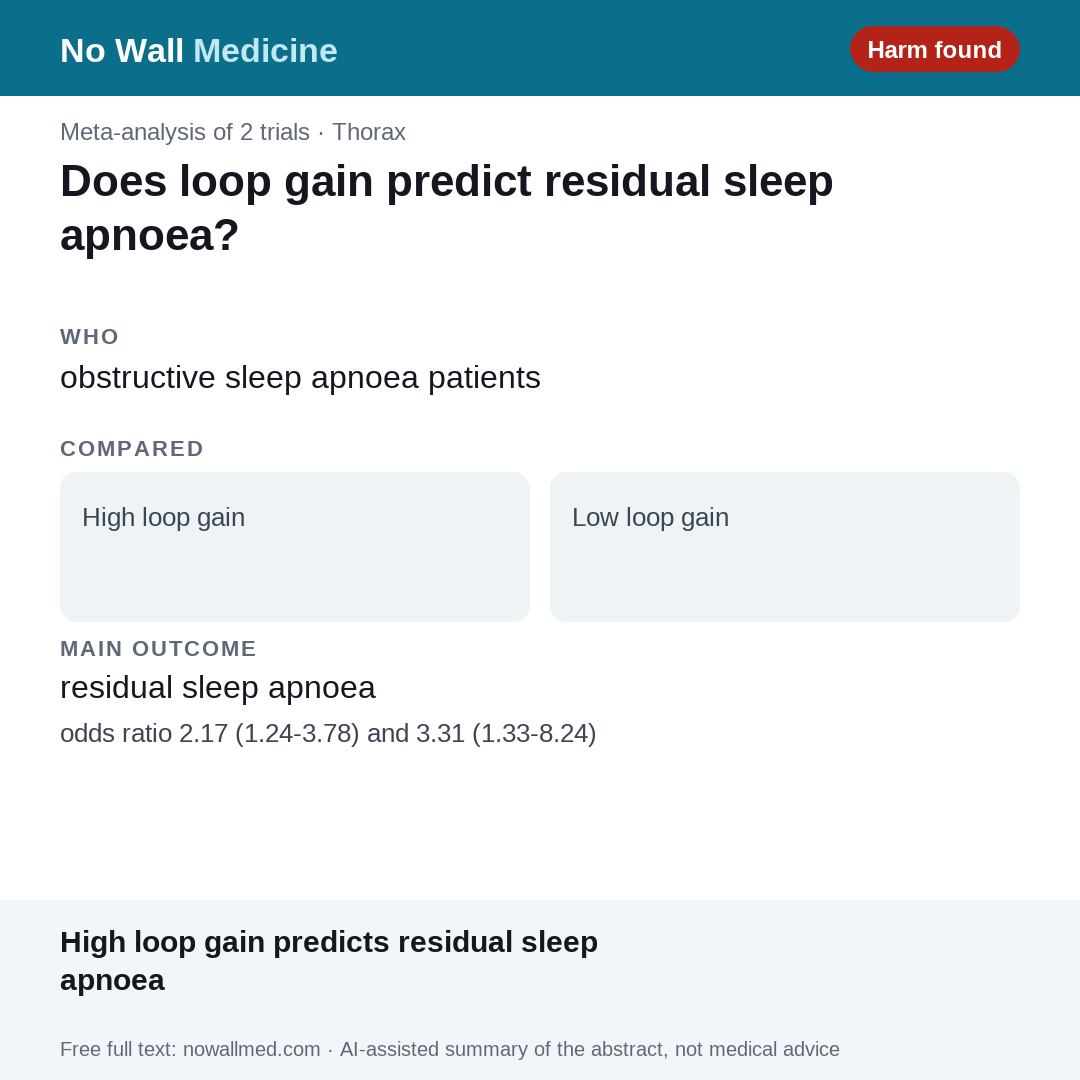
Clinical question: Does loop gain predict residual sleep apnoea?
Why it matters: About 20% of patients with obstructive sleep apnoea still experience residual sleep apnoea while using positive airway pressure therapy.
Key points
- Researchers analyzed data from two large randomized controlled trials, APPLES and RICCADSA, to see if loop gain predicts remaining sleep apnoea during treatment.
- High loop gain, a measure of breathing instability, was associated with 2.17 times higher odds in the APPLES study and 3.31 times higher odds in the RICCADSA study.
- The association between high loop gain and residual sleep apnoea remained even after accounting for central sleep apnoea, which is breathing pauses not caused by airway blockage.
Headline and key points written with AI from the paper’s abstract, with every number checked against it. Read the paper before relying on them.
Topics
Spotted a mistake? Suggest a correction