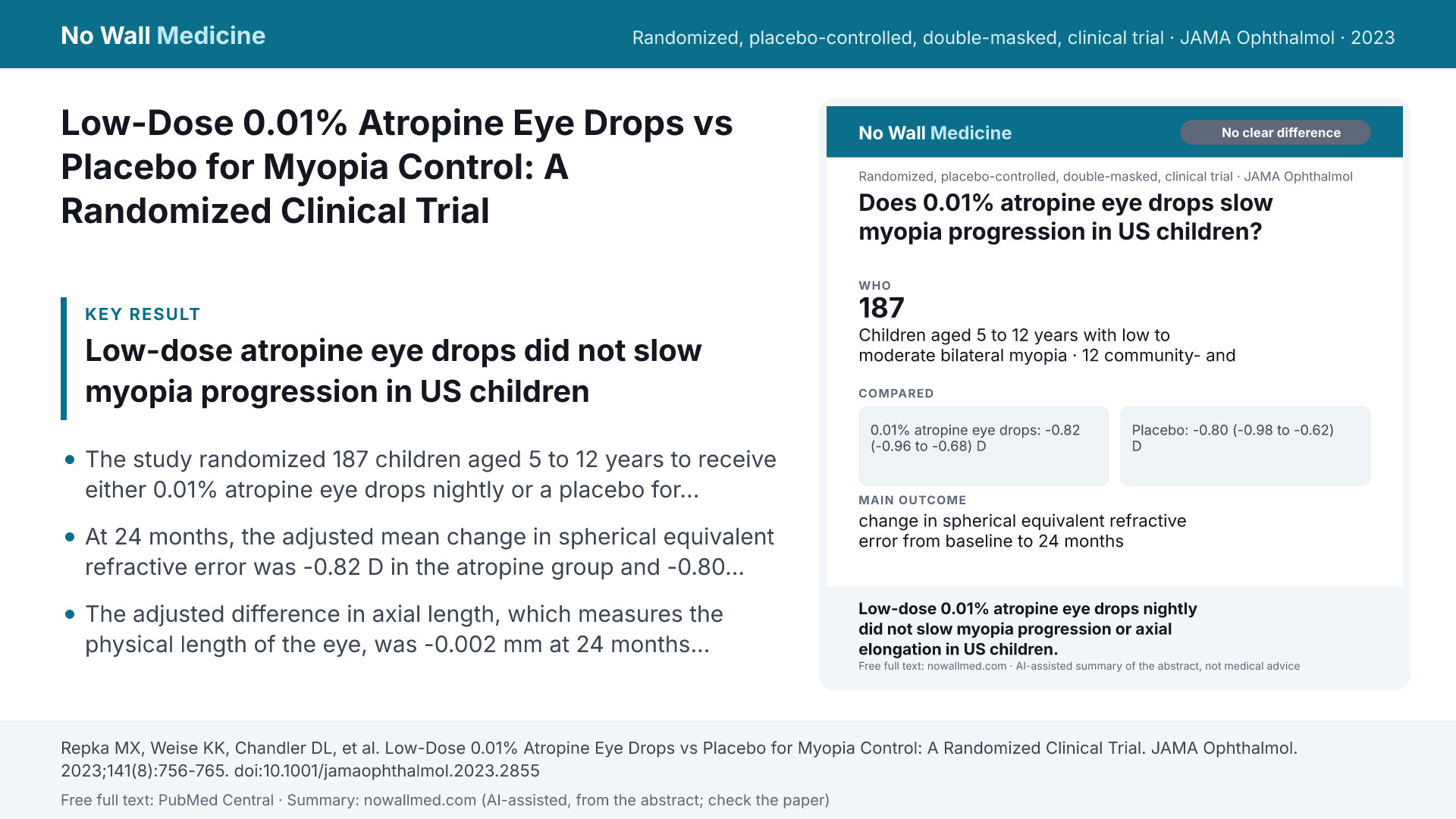
Low-Dose 0.01% Atropine Eye Drops vs Placebo for Myopia Control: A Randomized Clinical Trial
Key result: Low-dose atropine eye drops did not slow myopia progression in US children
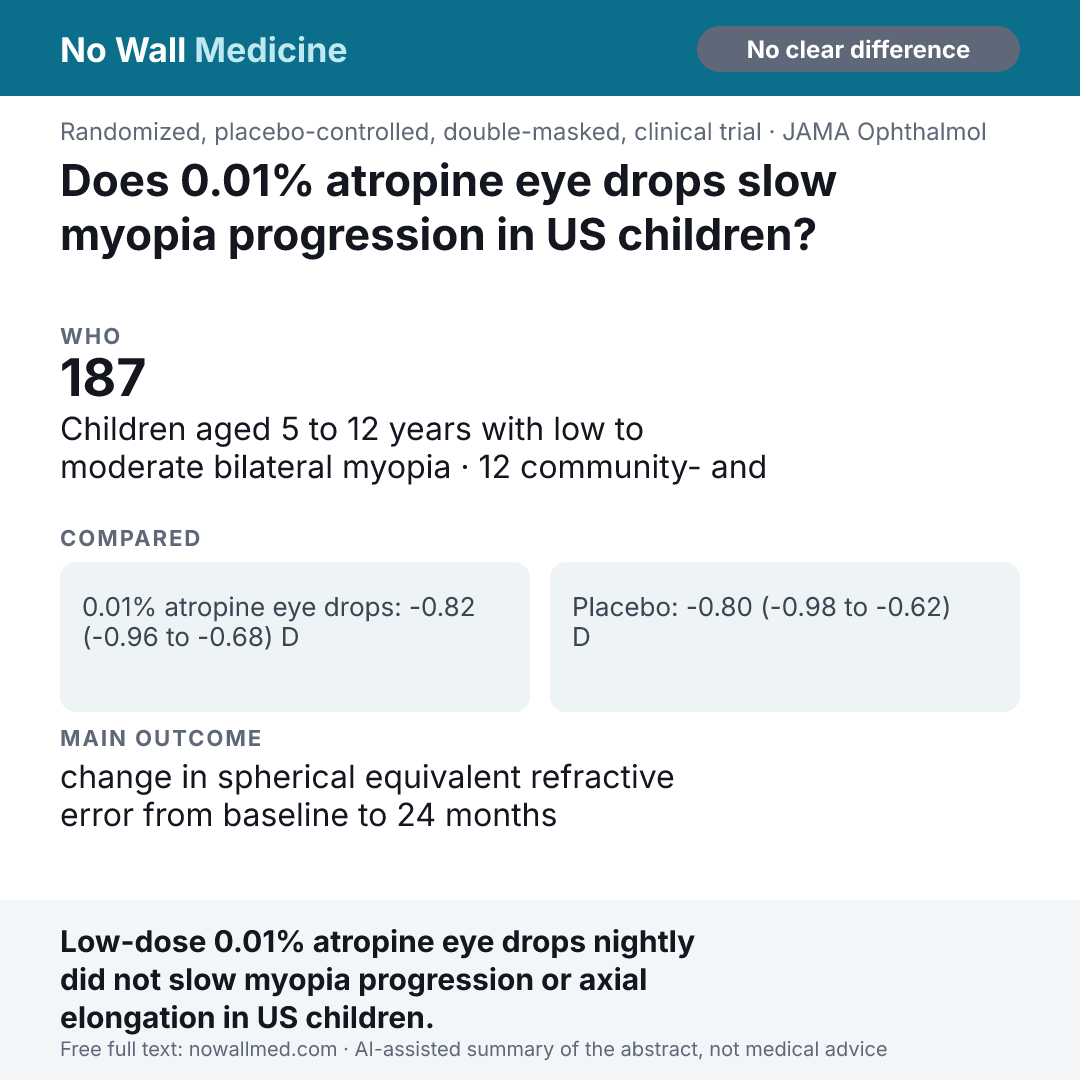
Randomized, placebo-controlled, double-masked, clinical trialNo clear difference
Does 0.01% atropine eye drops slow myopia progression in US children?
Who
187
Children aged 5 to 12 years with low to moderate bilateral myopia · 12 community- and institution-based practices in the US
Compared
0.01% atropine eye drops: -0.82 (-0.96 to -0.68) D
Placebo: -0.80 (-0.98 to -0.62) D
Main outcome
change in spherical equivalent refractive error from baseline to 24 months
Result: adjusted difference = -0.02 D (95% CI, -0.19 to +0.15 D)
Bottom line: Low-dose 0.01% atropine eye drops nightly did not slow myopia progression or axial elongation in US children.
JAMA Ophthalmol · 2023-07-13 · Save PNG
Key points
- The study randomized 187 children aged 5 to 12 years to receive either 0.01% atropine eye drops nightly or a placebo for 24 months.
- At 24 months, the adjusted mean change in spherical equivalent refractive error was -0.82 D in the atropine group and -0.80 D in the placebo group.
- The adjusted difference in axial length, which measures the physical length of the eye, was -0.002 mm at 24 months and +0.009 mm at 30 months.
Discussion prompts
- Would these patients look like yours? Who was left out?
- Is the main outcome one that matters to patients?
- Is the difference large enough to change what you do?
Cite: Repka MX, Weise KK, Chandler DL, et al. Low-Dose 0.01% Atropine Eye Drops vs Placebo for Myopia Control: A Randomized Clinical Trial. JAMA Ophthalmol. 2023;141(8):756-765. doi:10.1001/jamaophthalmol.2023.2855
Free full text: PubMed Central · Summary and visual abstract: nowallmed.com/a/low-dose-0-01-atropine-eye-drops-vs-placebo-for-myopia-control-a-1gh5ngd/ (AI-assisted from the abstract; check the paper before relying on it).