Low-dose morphine reduces airway sensations and cough frequency in patients with refractory chronic cough
Low-dose morphine and airway sensations in refractory chronic cough: a randomised control trial
Double-blinded, randomised, placebo-controlled, crossover trialBenefit found
Does low-dose morphine improve airway sensations and cough in refractory chronic cough?
Who
22
Refractory chronic cough patients reporting clinical response to morphine
Compared
Low-dose morphine: 71.8% reduction in 24-hour cough frequency
Placebo
Main outcome
24-hour cough frequency and sensations provoked by citric acid inhalation
Bottom line: Low-dose morphine reduces 24-hour cough frequency and improves noxious airway sensations in refractory chronic cough.
ERJ Open Res · 2026-09-01 · Save PNG
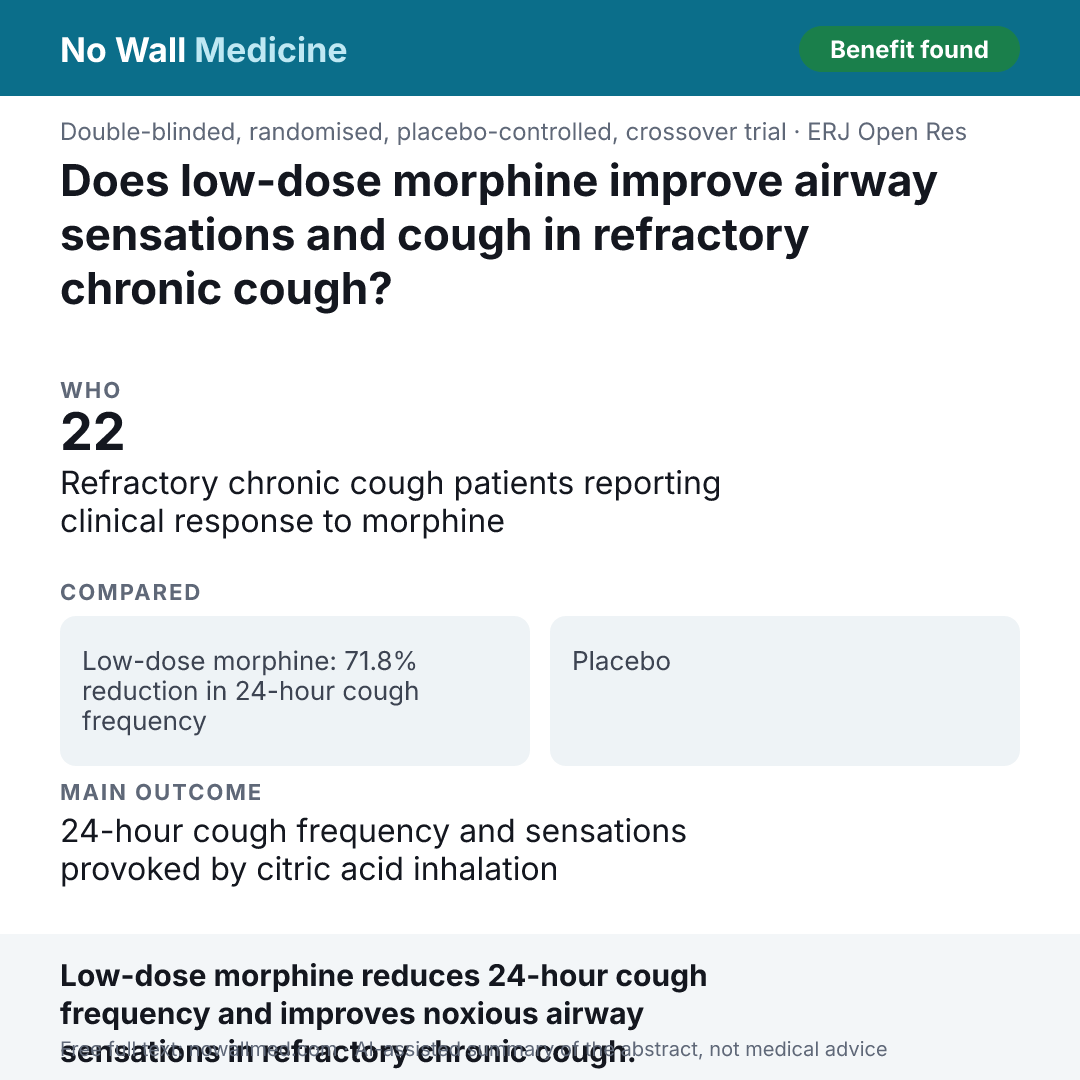
Clinical question: Does low-dose morphine improve airway sensations and cough in refractory chronic cough?
Key points
- Researchers studied 22 patients with refractory chronic cough, most of whom were female, using a double-blinded, randomized, placebo-controlled, crossover trial.
- Low-dose morphine reduced 24-hour cough frequency by 71.8% compared to placebo, though it did not change the cough threshold.
- Morphine improved the rating of all sensations, such as throat irritation or tickles, provoked by citric acid inhalation compared to placebo.
Headline and key points written with AI from the paper’s abstract, with every number checked against it. Read the paper before relying on them.
Was this summary helpful?
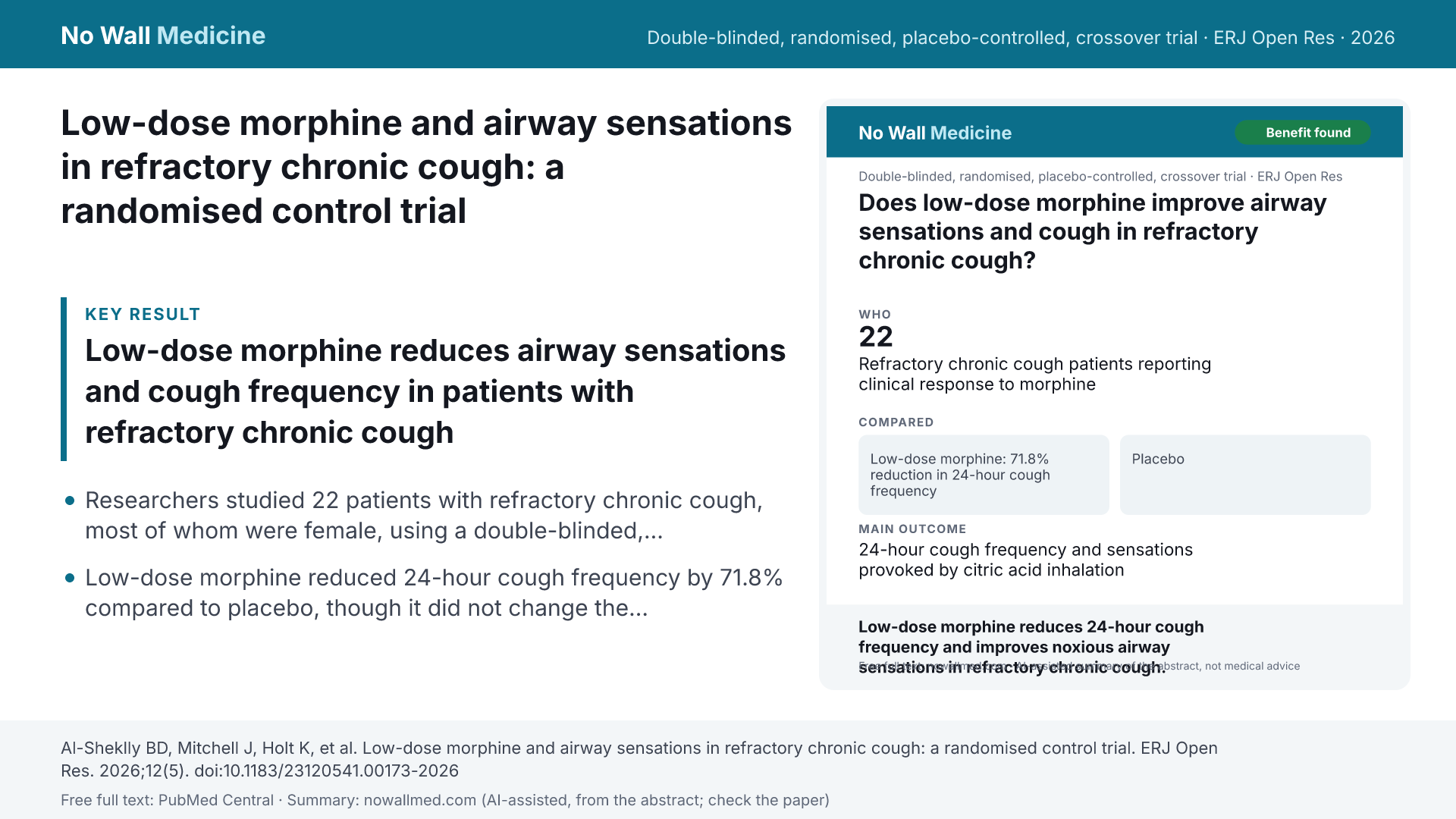
Headline, design, result, key points, caveat and citation as plain text.
Cite this article
Al-Sheklly BD, Mitchell J, Holt K, et al. Low-dose morphine and airway sensations in refractory chronic cough: a randomised control trial. ERJ Open Res. 2026;12(5). doi:10.1183/23120541.00173-2026
Spotted a mistake? Suggest a correction