Low fermentable oligosaccharides, disaccharides, monosaccharides, and polyols diet compared with traditional dietary advice for diarrhea-predominant irritable bowel syndrome: a parallel-group, randomized controlled trial with analysis of clinical and microbiological factors associated with patient outcomes
Parallel-group, randomized controlled trialNo clear difference
Is a low fermentable diet more effective than traditional dietary advice for IBS-D?
Who
100
Chinese patients with diarrhea-predominant irritable bowel syndrome
Compared
Low fermentable oligosaccharides, disaccharides, monosaccharides, and polyols diet: 30 of 51, 59%
Traditional dietary advice: 26 of 49, 53%
Main outcome
Reduction in IBS Severity Scoring System by at least 50 points
Result: ∆6%; 95% CI: -13%, 24%
Bottom line: Both diets reduced symptoms similarly, though the low fermentable diet provided earlier improvement in stool frequency and wind.
Am J Clin Nutr · 2021-03-20Download image
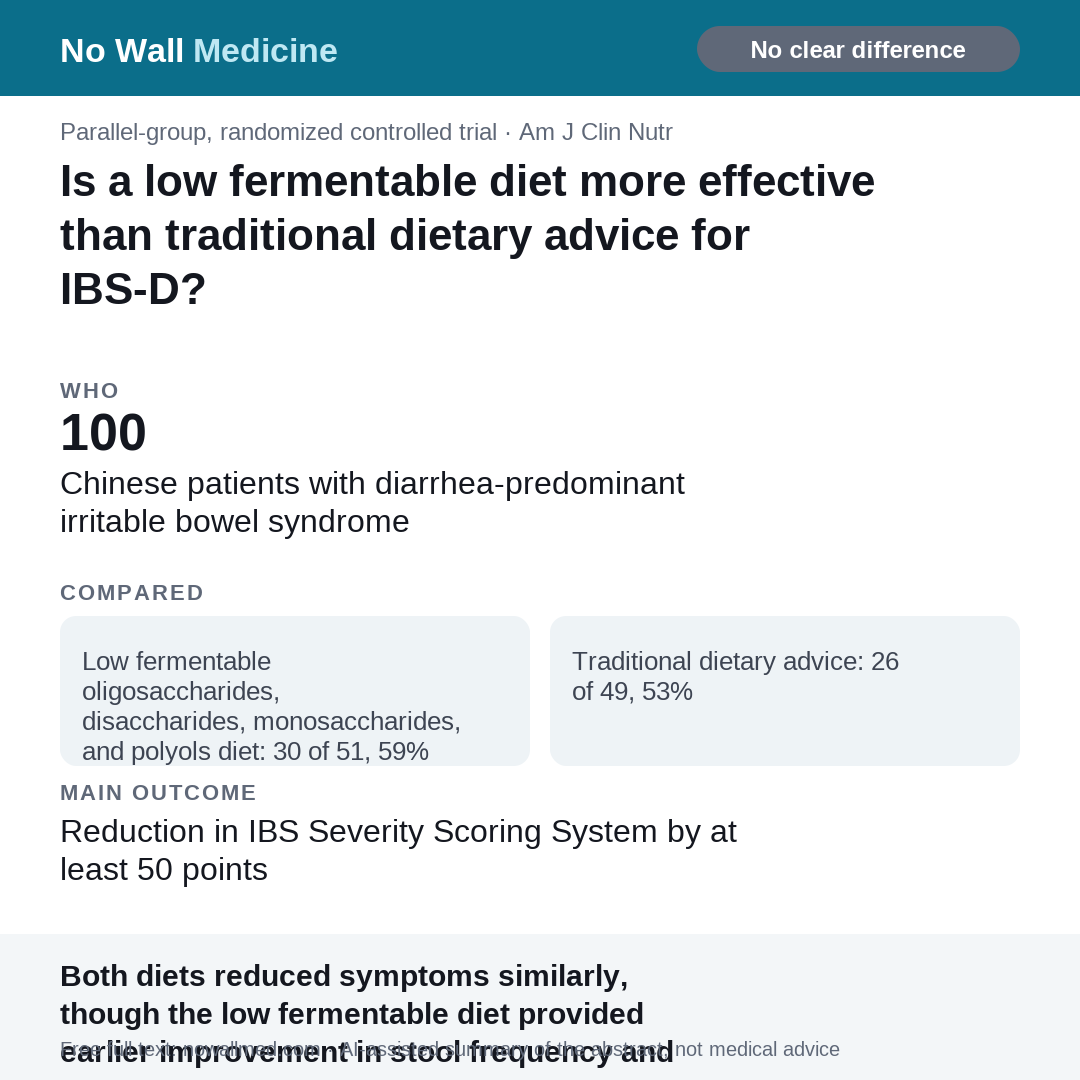
Clinical question: Is a low fermentable diet more effective than traditional dietary advice for IBS-D?
Abstract
Background
The efficacy and factors associated with patient outcomes for a diet low in fermentable oligosaccharides, disaccharides, monosaccharides, and polyols (LFD) compared with traditional dietary advice (TDA) based on modified National Institute for Clinical Excellence guidelines for irritable bowel syndrome with diarrhea (IBS-D) in regions consuming a non-Western diet are unclear. Objectives
We aimed to determine the efficacy of an LFD compared with TDA for the treatment of IBS-D in Chinese patients and to investigate the factors associated with favorable outcomes. Methods
One hundred and eight Chinese IBS-D patients (Rome III criteria) were randomly assigned to an LFD or TDA. The primary endpoint was a ≥50-point reduction in the IBS Severity Scoring System at 3 wk. Fecal samples collected before and after the dietary intervention were assessed for changes in SCFAs and microbiota profiles. A logistic regression model was used to identify predictors of outcomes. Results
Among the 100 patients who completed the study, the primary endpoint was met in a similar number of LFD (30 of 51, 59%) and TDA (26 of 49, 53%) patients (∆6%; 95% CI: -13%, 24%). Patients in the LFD group achieved earlier symptomatic improvement in stool frequency and excessive wind than those following TDA. LFD reduced carbohydrate-fermenting bacteria such as Bifidobacterium and Bacteroides, and decreased saccharolytic fermentation activity. This was associated with symptomatic improvement in the responders. High saccharolytic fermentation activity at baseline was associated with a higher symptom burden (P = 0.01) and a favorable therapeutic response to the LFD (log OR: 4.9; 95% CI: -0.1, 9.9; P = 0.05). Conclusions
An LFD and TDA each reduced symptoms in Chinese IBS-D patients; however, the LFD achieved earlier symptomatic improvements in stool frequency and excessive wind. The therapeutic effect of the LFD was associated with changes in the fecal microbiota and the fecal fermentation index. At baseline, the presence of severe symptoms and microbial metabolic dysbiosis characterized by high saccharolytic capability predicted favorable outcomes to LFD intervention.This trial was registered at clinicaltrials.gov as NCT03304041.
Subject terms
Cite this article
Zhang Y, Feng L, Wang X, Fox M, Luo L, Du L. Low fermentable oligosaccharides, disaccharides, monosaccharides, and polyols diet compared with traditional dietary advice for diarrhea-predominant irritable bowel syndrome: a parallel-group, randomized controlled trial with analysis of clinical and microbiological factors associated with patient outcomes. Am J Clin Nutr. 2021. doi:10.1093/ajcn/nqab005
Spotted a mistake? Suggest a correction
Top studies every Monday
The week’s key trials and guidelines in your specialties, plus any topics you follow. By email, free.
Get the weekly digest