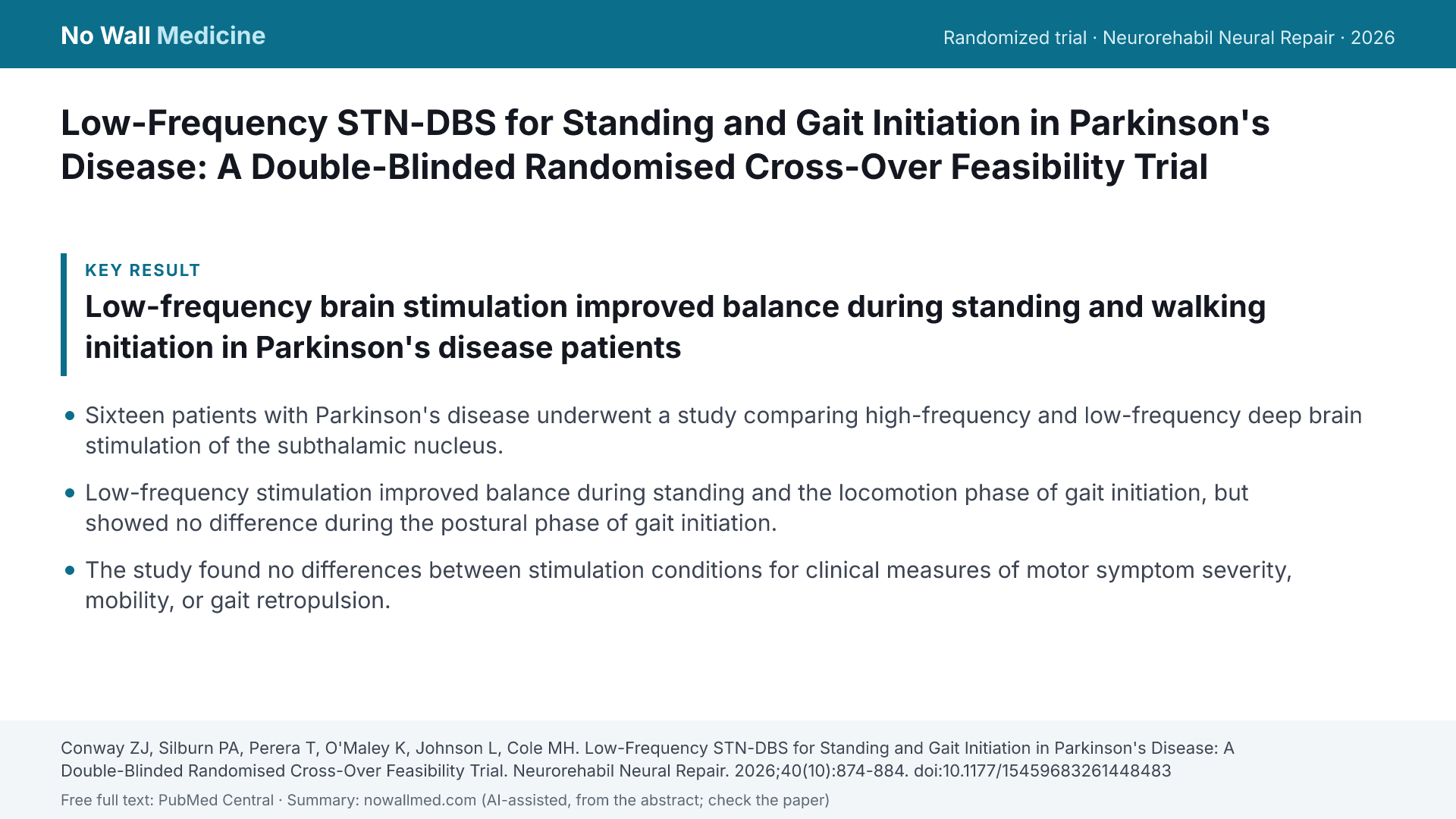
Low-frequency brain stimulation improved balance during standing and walking initiation in Parkinson's disease patients
Low-Frequency STN-DBS for Standing and Gait Initiation in Parkinson's Disease: A Double-Blinded Randomised Cross-Over Feasibility Trial
Same trial (ACTRN12618000944235)
Papers we list that report this registered trial, oldest first. Read a secondary analysis alongside the main results.
- Main results
Low-frequency brain stimulation improves walking rhythmicity in people with Parkinson's disease J Neuroeng Rehabil 2021-08 - Related analysis
This paper Neurorehabil Neural Repair 2026-06
Why it matters: High-frequency deep brain stimulation of the subthalamic nucleus may cause poorer balance and increased fall risk in people with Parkinson's disease.
Key points
- Sixteen patients with Parkinson's disease underwent a study comparing high-frequency and low-frequency deep brain stimulation of the subthalamic nucleus.
- Low-frequency stimulation improved balance during standing and the locomotion phase of gait initiation, but showed no difference during the postural phase of gait initiation.
- The study found no differences between stimulation conditions for clinical measures of motor symptom severity, mobility, or gait retropulsion.
Headline and key points written with AI from the paper’s abstract, with every number checked against it. Read the paper before relying on them.
Was this summary helpful?
Subject terms
Headline, design, result, key points, caveat and citation as plain text.
Cite this article
Conway ZJ, Silburn PA, Perera T, O'Maley K, Johnson L, Cole MH. Low-Frequency STN-DBS for Standing and Gait Initiation in Parkinson's Disease: A Double-Blinded Randomised Cross-Over Feasibility Trial. Neurorehabil Neural Repair. 2026;40(10):874-884. doi:10.1177/15459683261448483
Spotted a mistake? Suggest a correction