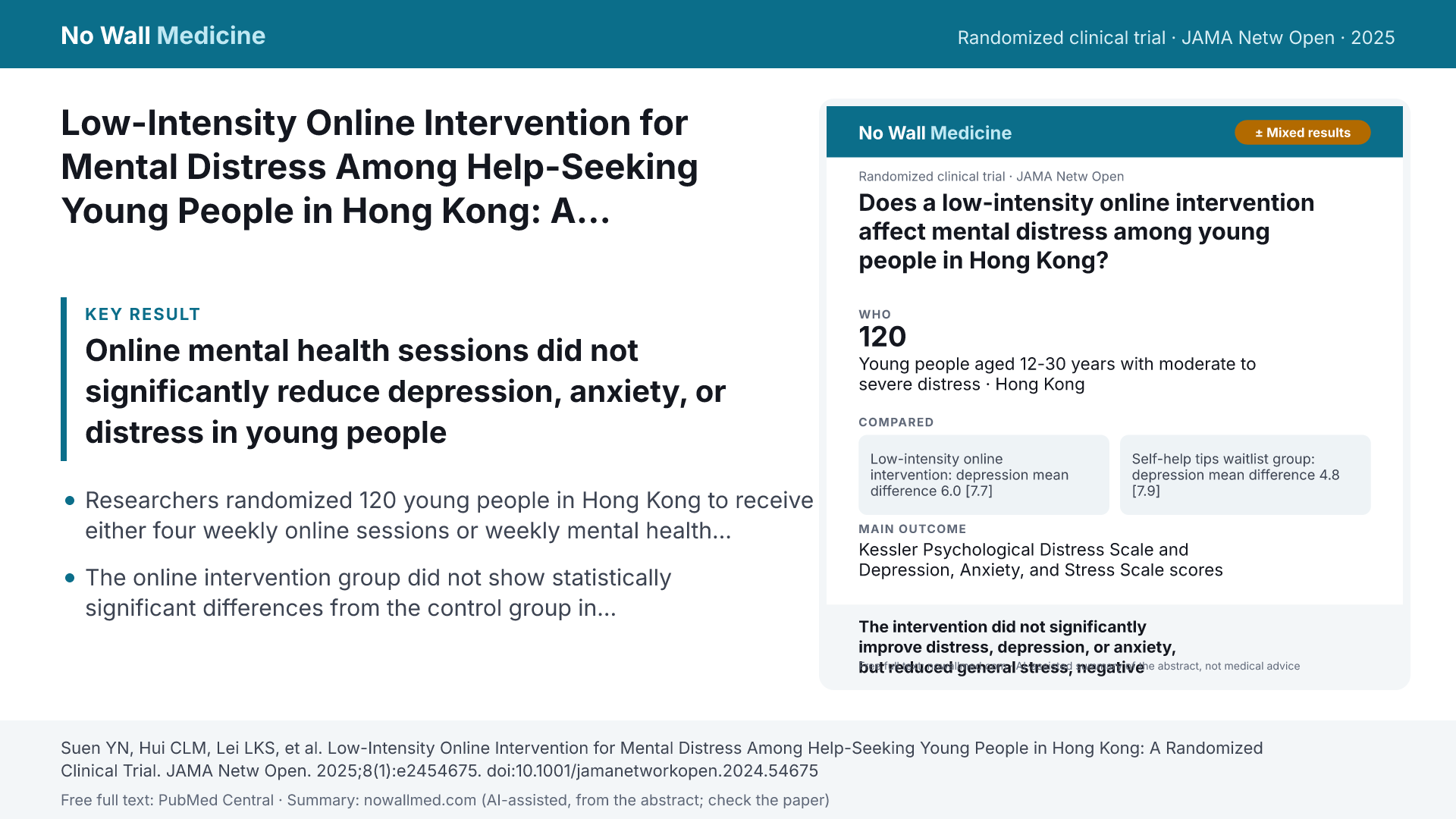
Low-Intensity Online Intervention for Mental Distress Among Help-Seeking Young People in Hong Kong: A Randomized Clinical Trial
Key result: Online mental health sessions did not significantly reduce depression, anxiety, or distress in young people
Key points
- Researchers randomized 120 young people in Hong Kong to receive either four weekly online sessions or weekly mental health text messages.
- The online intervention group did not show statistically significant differences from the control group in depression, anxiety, or psychological distress scores.
- The intervention group was associated with greater reductions in general stress, negative emotions, and increased resilience compared to the waitlist group.
Why it matters: Conventional psychological interventions face challenges such as limited staffing, time commitment, and low completion rates for young people experiencing mental distress.
Limitation the authors note: The authors noted that caution is needed due to missing data.
Discussion prompts
- Would these patients look like yours? Who was left out?
- Is the main outcome one that matters to patients?
- Is the difference large enough to change what you do?
Cite: Suen YN, Hui CLM, Lei LKS, et al. Low-Intensity Online Intervention for Mental Distress Among Help-Seeking Young People in Hong Kong: A Randomized Clinical Trial. JAMA Netw Open. 2025;8(1):e2454675. doi:10.1001/jamanetworkopen.2024.54675
Free full text: PubMed Central · Summary and visual abstract: nowallmed.com/a/low-intensity-online-intervention-for-mental-distress-among-help-y3457t/ (AI-assisted from the abstract; check the paper before relying on it).