Low reporting quality in human organ model studies limits research on COVID-19
Low reporting quality limits the contribution of human organ models to COVID-19 research: a systematic review
Systematic reviewMixed results
How were human organ models applied to investigate SARS-CoV-2 and what was their reporting quality?
Who
558
Human organ models used to investigate SARS-CoV-2
Compared
Pandemic period studies
Post-pandemic period studies
Main outcome
Reporting quality and application of human organ models
Bottom line: Low reporting quality and heterogeneity in human organ models limit their contribution to COVID-19 research.
Limitation: Substantial limitations included heterogeneity of outcome measures and incomplete documentation of model characteristics.
eBioMedicine · 2026-07-28Download image
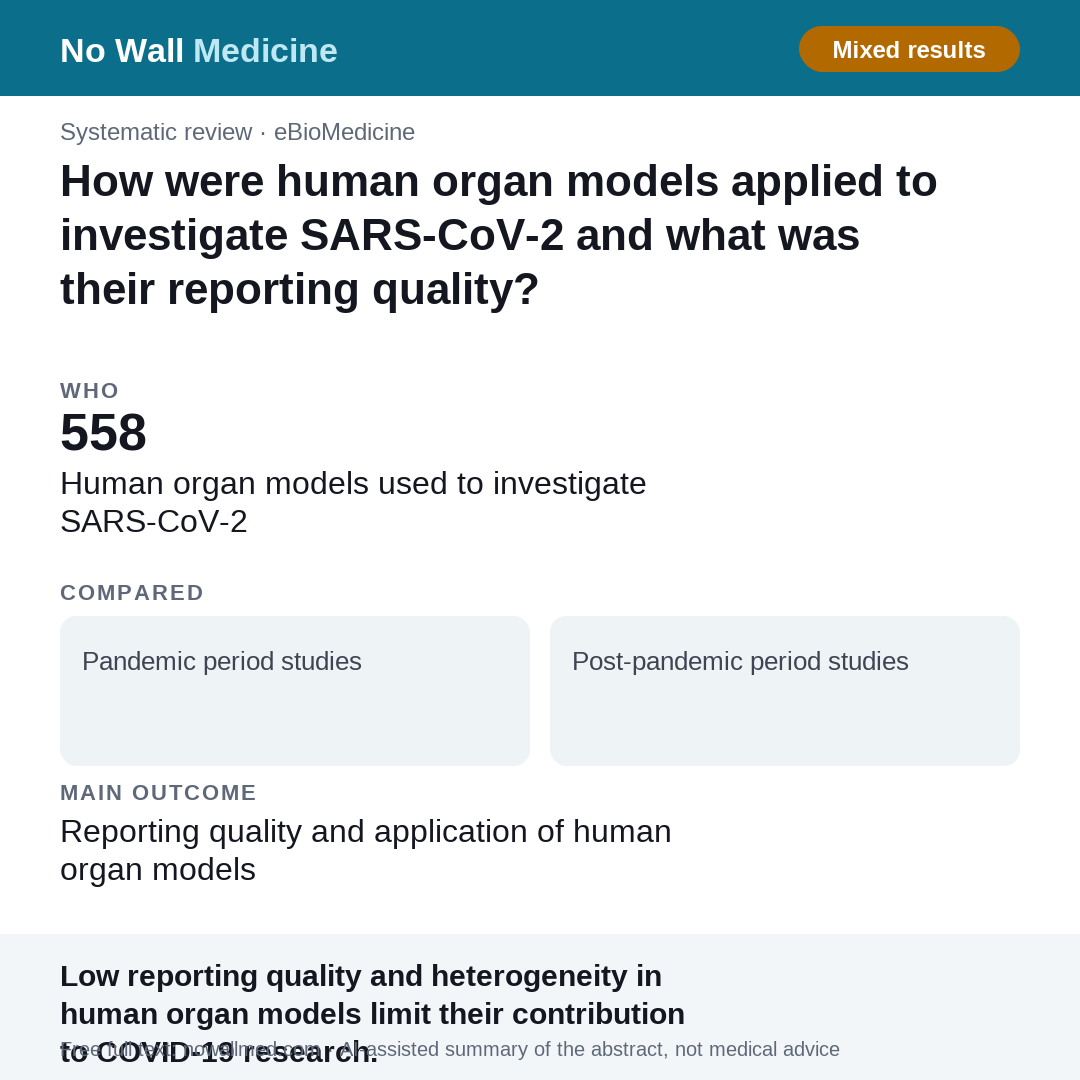
Clinical question: How were human organ models applied to investigate SARS-CoV-2 and what was their reporting quality?
Why it matters: Researchers needed to understand how human organ models contributed to COVID-19 research and whether the quality of their reporting was sufficient for evidence synthesis.
Key points
- Researchers conducted a systematic review of 558 studies that used human organ models to investigate SARS-CoV-2 during and after the pandemic.
- The analysis found inconsistent outcome measures, incomplete documentation of experimental procedures, and variable reporting quality across the reviewed studies.
- These reporting issues made it difficult to compare studies, assess the risk of bias, and reliably synthesize evidence or perform meta-analyses.
Headline and key points written with AI from the paper’s abstract, with every number checked against it. Read the paper before relying on them.
Topics
Cite this article
Hülsemann M, Kniffert S, Löwa A, Baumgardt M, Hönzke K, Vallone VF. Low reporting quality limits the contribution of human organ models to COVID-19 research: a systematic review. eBioMedicine. 2026. doi:10.1016/j.ebiom.2026.106392
Spotted a mistake? Suggest a correction