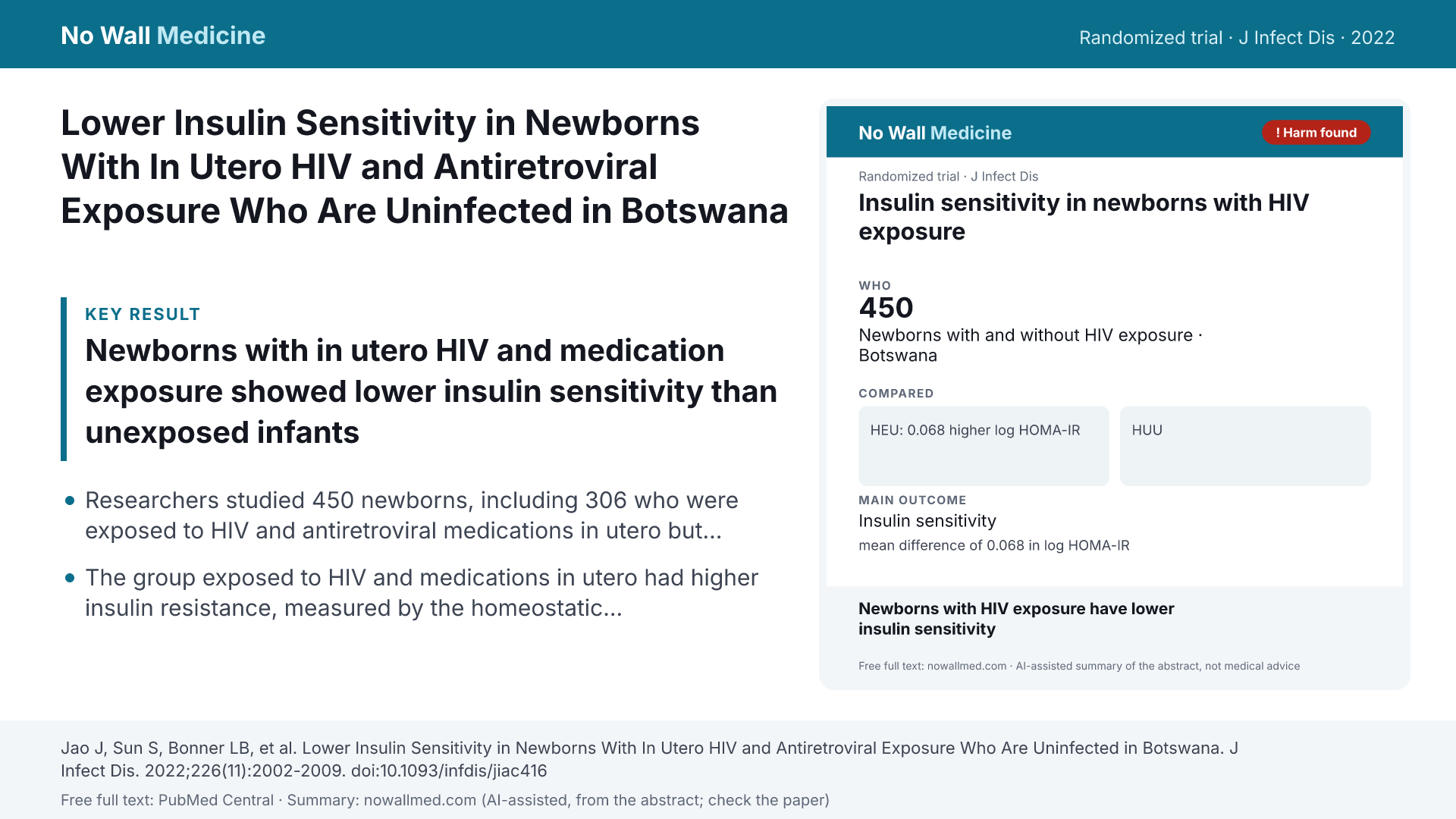
Newborns with in utero HIV and medication exposure showed lower insulin sensitivity than unexposed infants
Lower Insulin Sensitivity in Newborns With In Utero HIV and Antiretroviral Exposure Who Are Uninfected in Botswana
Randomized trialHarm found
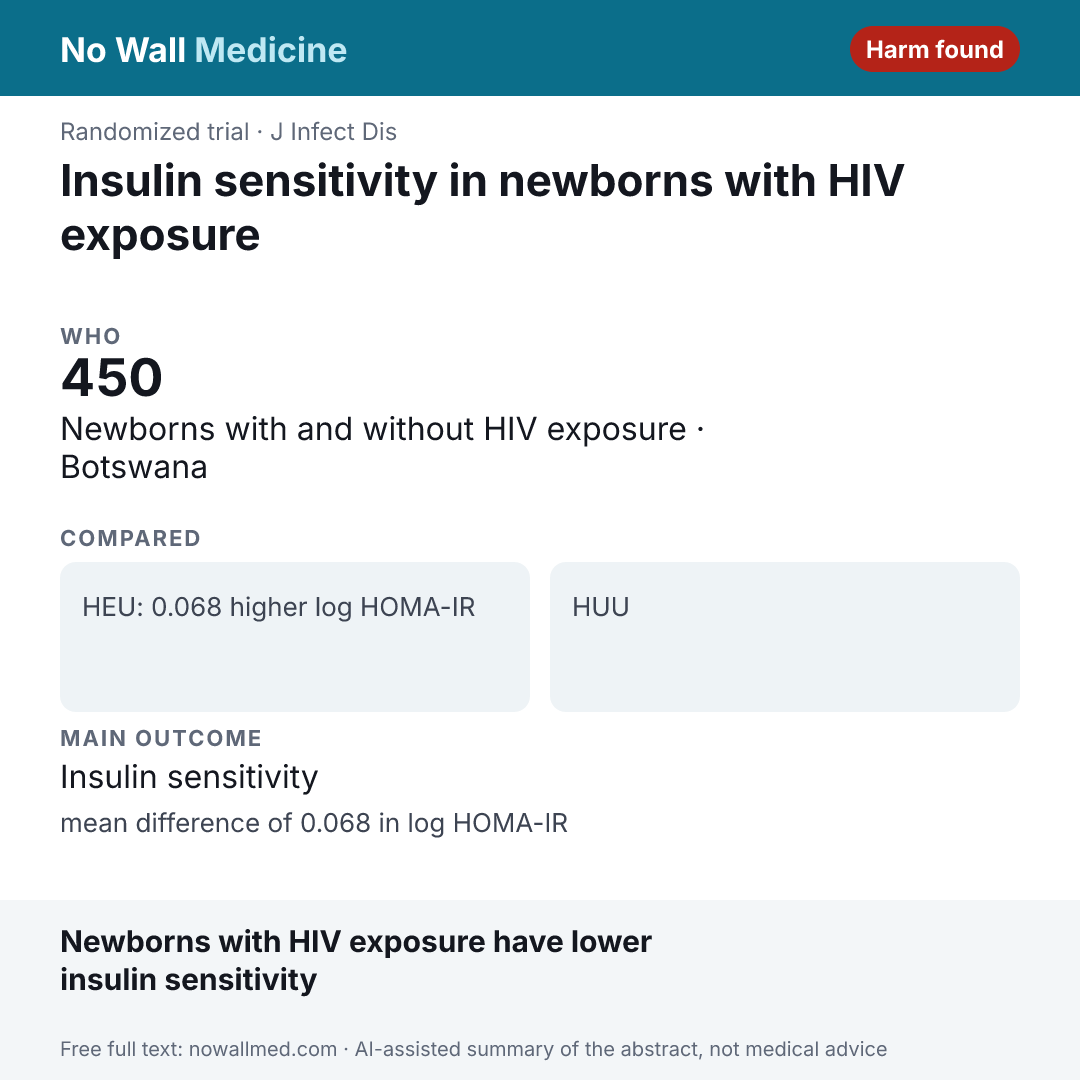
Insulin sensitivity in newborns with HIV exposure
Who
450
Newborns with and without HIV exposure · Botswana
Compared
HEU: 0.068 higher log HOMA-IR
HUU
Main outcome
Insulin sensitivity
Result: mean difference of 0.068 in log HOMA-IR
Bottom line: Newborns with HIV exposure have lower insulin sensitivity
J Infect Dis · 2022-10-15 · Save PNG
Key points
- Researchers studied 450 newborns, including 306 who were exposed to HIV and antiretroviral medications in utero but were themselves uninfected.
- The group exposed to HIV and medications in utero had higher insulin resistance, measured by the homeostatic model assessment for insulin resistance, compared to unexposed infants.
- Among the uninfected infants exposed to HIV in utero, the type of medication used during pregnancy or after birth did not significantly change insulin resistance levels.
Headline and key points written with AI from the paper’s abstract, with every number checked against it. Read the paper before relying on them.
Was this summary helpful?
Subject terms
Headline, design, result, key points, caveat and citation as plain text.
Cite this article
Jao J, Sun S, Bonner LB, et al. Lower Insulin Sensitivity in Newborns With In Utero HIV and Antiretroviral Exposure Who Are Uninfected in Botswana. J Infect Dis. 2022;226(11):2002-2009. doi:10.1093/infdis/jiac416
Spotted a mistake? Suggest a correction