Soft lumbar belts improved pain and disability in adults with nonspecific low back pain
Lumbar Belt for Nonspecific Low Back Pain: A Randomized Clinical Trial
Multicenter, open-label, randomized clinical trialBenefit found
Does a soft and extensible lumbar belt reduce functional disability and pain in nonspecific low back pain?
Who
168
Adults with nonspecific low back pain lasting 1 to 6 months · 17 medical centers across France
Compared
Nonrigid lumbar belt plus usual care: change, -10.0 [95% CI, -13.0 to -7.0] points
Usual care without a device: change, -5.3 [95% CI, -8.6 to -2.1] points
Main outcome
Mean change in the Oswestry Disability Index score
Result: -4.7 (95% CI, -8.4 to -0.9) points
Bottom line: Adding a nonrigid lumbar belt to usual care improved pain and functional disability in patients with nonspecific low back pain.
JAMA Netw Open · 2026-08-03Download image
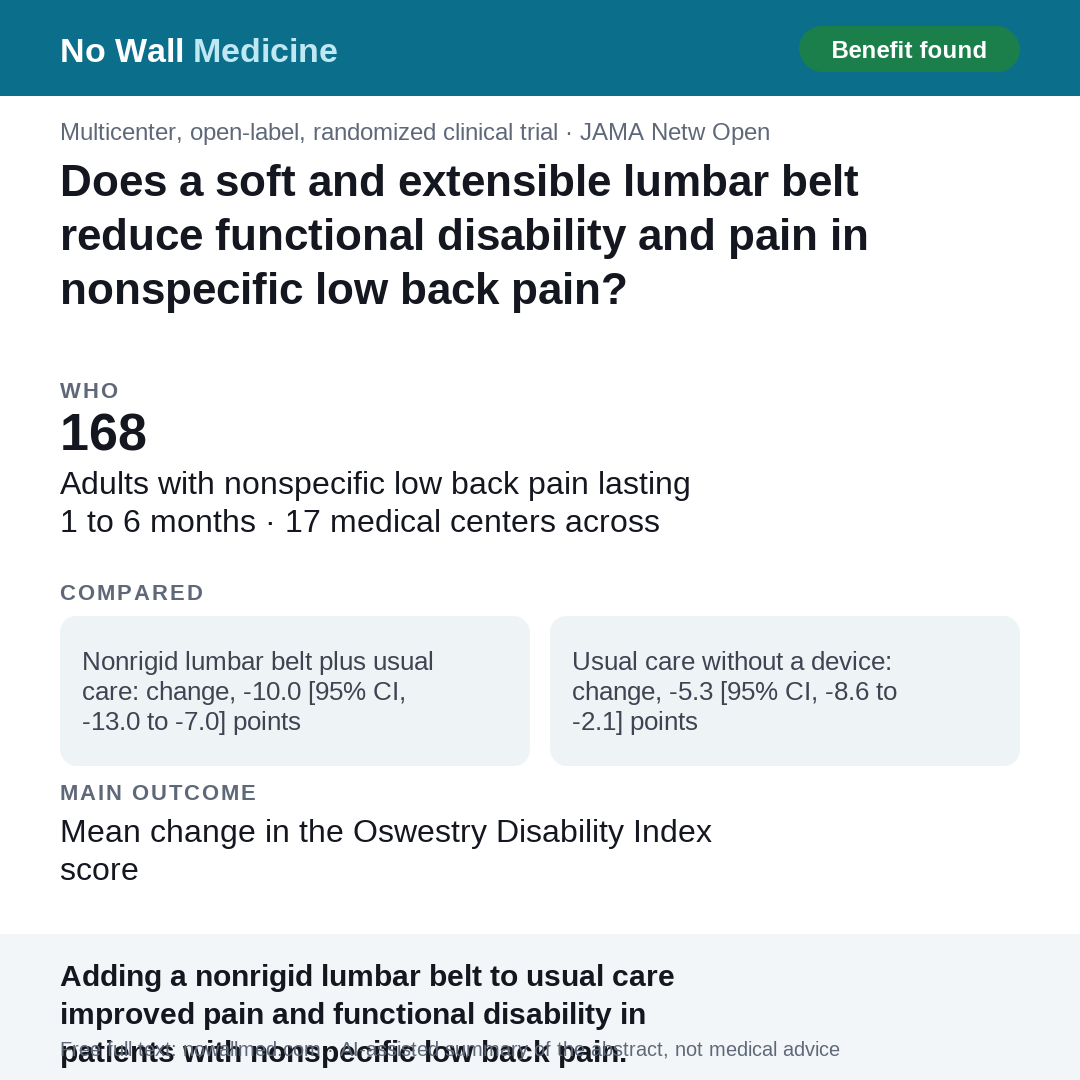
Clinical question: Does a soft and extensible lumbar belt reduce functional disability and pain in nonspecific low back pain?
Why it matters: Current medical guidelines state that evidence is insufficient to recommend lumbar belts for treating nonspecific low back pain.
Key points
- Researchers studied 168 adults with nonspecific low back pain lasting 1 to 6 months, comparing a nonrigid lumbar belt to usual care alone.
- The belt group showed a greater improvement in the Oswestry Disability Index score of -10.0 points compared to -5.3 points in the control group.
- Patients using the belt reported greater reductions in pain at rest and during activity, and used less medication over 12 weeks.
Headline and key points written with AI from the paper’s abstract, with every number checked against it. Read the paper before relying on them.
Topics
Cite this article
Grange L, Calmels P, Pers YM, Laustriat G, Wieczorek V, Saih N. Lumbar Belt for Nonspecific Low Back Pain: A Randomized Clinical Trial. JAMA Netw Open. 2026. doi:10.1001/jamanetworkopen.2026.29793
Spotted a mistake? Suggest a correction