Sublobar resection was associated with lower odds of acute exacerbations in lung cancer patients with UIP
Lung cancer resection in patients with underlying usual interstitial pneumonia: a meta-analysis
Meta-analysis of 10 studiesMixed results
What are the acute postoperative outcomes of lung cancer resection in patients with underlying usual interstitial pneumonia?
Who
2202
Patients with lung cancer and underlying usual interstitial pneumonia
Compared
14.6%Overall incidence of acute exacerbations
Sublobar resection vs other resection: OR 0.521 (fixed effects model), 95% CI 0.339 to 0.803
Main outcome
Incidence of postoperative usual interstitial pneumonia acute exacerbations
Result: OR 0.521 (95% CI 0.339 to 0.803)
Bottom line: Sublobar resection reduces acute exacerbation odds, but resection extent does not significantly affect overall survival.
BMJ Open Respir Res · 2023-03-21Download image
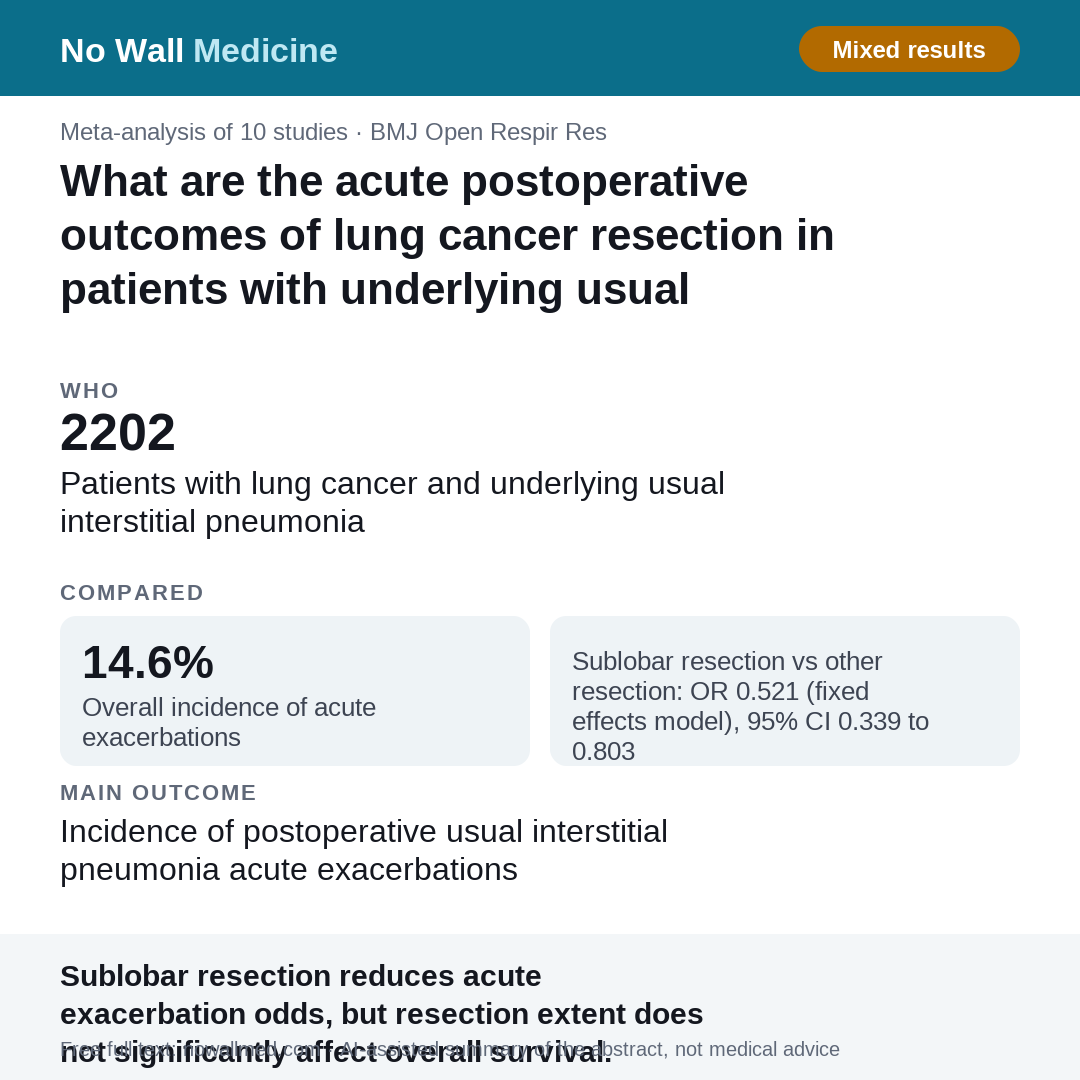
Clinical question: What are the acute postoperative outcomes of lung cancer resection in patients with underlying usual interstitial pneumonia?
Why it matters: It is unknown how the extent of surgical lung removal affects acute exacerbations and long-term survival in patients with lung cancer and underlying usual interstitial pneumonia.
Key points
- Researchers analyzed 10 studies involving 2202 patients undergoing lung cancer surgery with underlying usual interstitial pneumonia, a pattern of lung scarring.
- The overall incidence of postoperative acute exacerbations, which are sudden worsenings of lung scarring, was 14.6%.
- Sublobar resection, or removing only a part of the lung, was associated with lower odds of acute exacerbations, but the extent of resection was not significantly associated with overall survival.
Headline and key points written with AI from the paper’s abstract, with every number checked against it. Read the paper before relying on them.
Was this summary helpful?
Abstract
Objective
Patients with lung cancer with underlying idiopathic pulmonary fibrosis and usual interstitial pneumonia (UIP) pattern on CT represent a very high-risk group in terms of postoperative UIP acute exacerbations (AEs) and in-hospital mortality. We sought to investigate the outcomes in these patients. Methods
We carried out a meta-analysis, searching four international databases from 1 January 1947 to 27 April 2022, for studies in any language reporting on the acute postoperative outcomes of patients with lung cancer undergoing surgical resection with underlying UIP (the primary outcome). Random effects meta-analyses (DerSimonian and Laird) were conducted. We analysed the difference in incidence of postoperative AE as well as the difference in long-term overall survival among subpopulations. These were stratified by the extent of surgical resection, with meta-regression testing (uniivariate and multivariate) according to the stage of disease, operative decision making and country of origin. This study was registered with PROSPERO (CRD42022319245). Results
The overall incidence of AE of UIP postoperatively from 10 studies (2202 patients) was 14.6% (random effects model, 95% CI 9.8 to 20.1, I2=74%). Sublobar resection was significantly associated with a reduced odds of postoperative AE (OR 0.521 (fixed effects model), 95% CI 0.339 to 0.803, p=0.0031, I2=0%). The extent of resection was not significantly associated with overall survival following lung cancer resection in UIP patients (HR for sublobar resection 0.978 (random effects model), 95% CI 0.521 to 1.833, p=0.9351, I2=71%). Conclusions
With appropriate implementation of perioperative measures such as screening for high-risk cases, appropriate use of steroids, antifibrotics and employing sublobar resection in select cases, the risk of local recurrence versus in-hospital mortality from AEUIP can be balanced and long-term survival can be achieved in a super-selected group of patients. Further investigation in the form of a randomised study is warranted.
Abstract reproduced under the article’s CC BY NC licence.
Subject terms
Cite this article
Patel AJ, Walters GI, Watkins S, Rogers V, Fallouh H, Kalkat M. Lung cancer resection in patients with underlying usual interstitial pneumonia: a meta-analysis. BMJ Open Respir Res. 2023. doi:10.1136/bmjresp-2022-001529
Spotted a mistake? Suggest a correction
Top studies every Monday
The week’s key trials and guidelines in your specialties, plus any topics you follow. By email, free.
Get the weekly digest