Lung Cancer Screening Adherence in Centralized vs Decentralized Screening Programs: A Meta-Analysis of US Cohort Studies Among Individuals With Negative Baseline Results
Meta-analysis of cohort studiesBenefit found
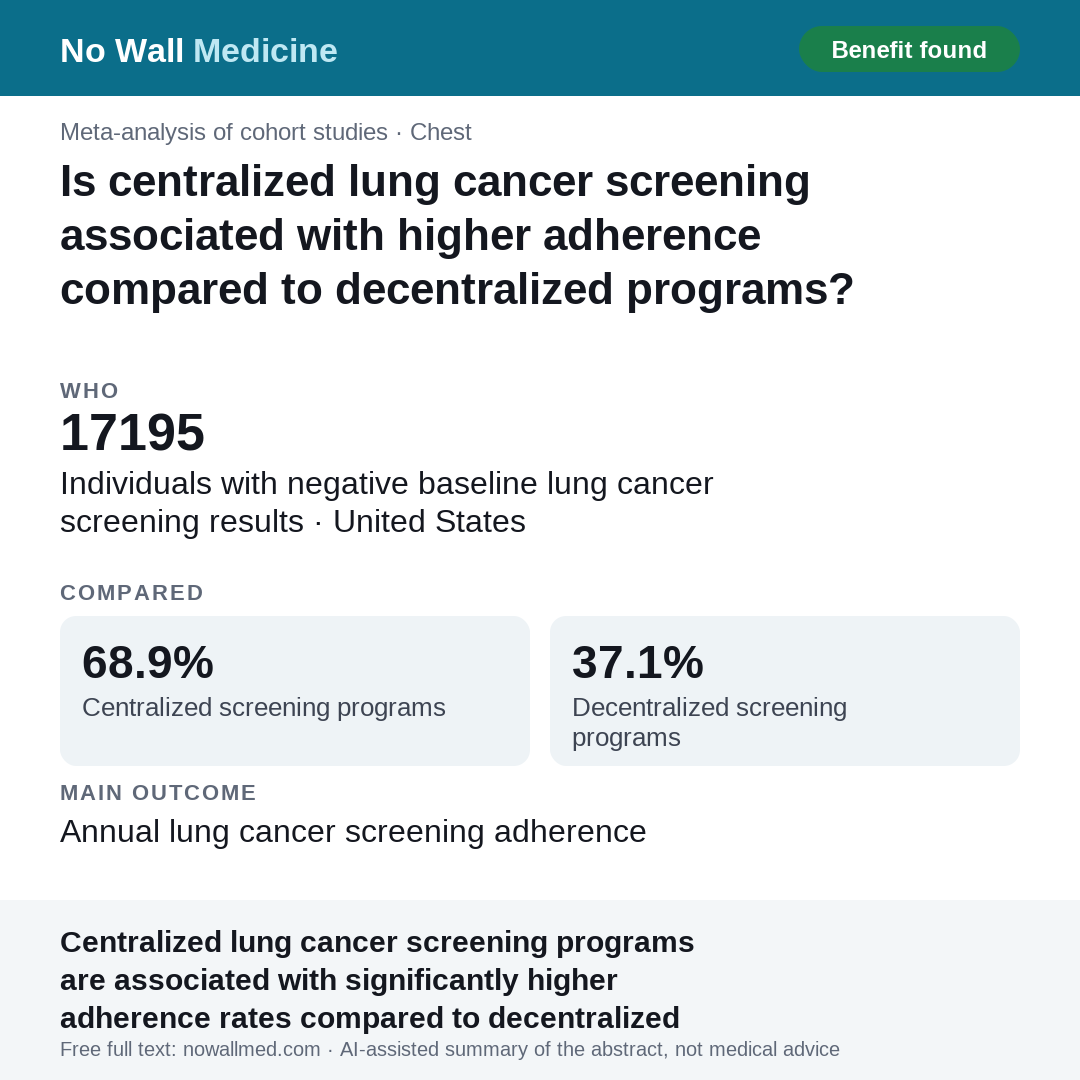
Is centralized lung cancer screening associated with higher adherence compared to decentralized programs?
Who
17195
Individuals with negative baseline lung cancer screening results · United States
Compared
68.9%Centralized screening programs
37.1%Decentralized screening programs
Main outcome
Annual lung cancer screening adherence
Result: odds ratio 3.33 (95% CI 1.92-5.78)
Bottom line: Centralized lung cancer screening programs are associated with significantly higher adherence rates compared to decentralized programs.
Limitation: Substantial heterogeneity was observed across the studies in the pairwise meta-analysis.
Chest · 2025-05-07Download image
Clinical question: Is centralized lung cancer screening associated with higher adherence compared to decentralized programs?
Abstract
Background
With rising interest in centralized lung cancer screening (LCS), synthesizing evidence to estimate its impact on annual adherence is critical for aligning practice with guideline recommendations. Research question
Is participation in a centralized screening program associated with higher adherence rates compared with decentralized programs among individuals with negative baseline LCS results? Study design and methods
Seven bibliographic databases were searched for cohort studies published following January 1, 2011, reporting adherence outcomes for centralized vs decentralized LCS (primary outcome). Quality appraisal followed the Newcastle-Ottawa Scale for appraising observational studies. Random-effects meta-analysis was used to pool studies. Meta-regression examined patient- and institution-level characteristics associated with adherence in centralized programs. Results
Twelve studies involving 17,195 patients with negative baseline results were included in this meta-analysis. The overall pooled adherence rate in centralized programs was 55% (95% CI, 42%-58%; 12 studies, 11,302 patients) with 10 to 18 months of follow-up. Adherence was significantly higher in centralized compared with decentralized screening programs (68.9% vs 37.1%; P < .0001), with a pooled OR of 3.33 (95% CI, 1.92-5.78; 4 studies, 17,195 patients; moderate certainty). Substantial heterogeneity was observed across the 4 studies in the pairwise meta-analysis (I2 = 98.3%; P < .0001). The Egger regression test showed no significant funnel plot asymmetry (z = -0.374; P = .71), suggesting no evidence of publication bias. No association was found between adherence in centralized LCS and Lung CT Screening Reporting & Data System category, follow-up duration, age, sex, race/ethnicity, smoking status, or institutional setting (P > .05; very low certainty). Interpretation
Our results indicate that adherence to LCS remains low but is significantly higher in centralized screening programs compared with decentralized ones. Centralization may improve equity by addressing disparities associated with patient- and institution-level characteristics. These study findings support the expansion of centralized approaches and targeted quality improvement efforts to strengthen adherence to guideline-recommended LCS.
Topics
Cite this article
Ezenwankwo E, Jones C, Nguyen DT, Eberth JM. Lung Cancer Screening Adherence in Centralized vs Decentralized Screening Programs: A Meta-Analysis of US Cohort Studies Among Individuals With Negative Baseline Results. Chest. 2025. doi:10.1016/j.chest.2025.04.033
Spotted a mistake? Suggest a correction
Top studies every Monday
The week’s key trials and guidelines in your specialties, by email. Free.
Get the weekly digest