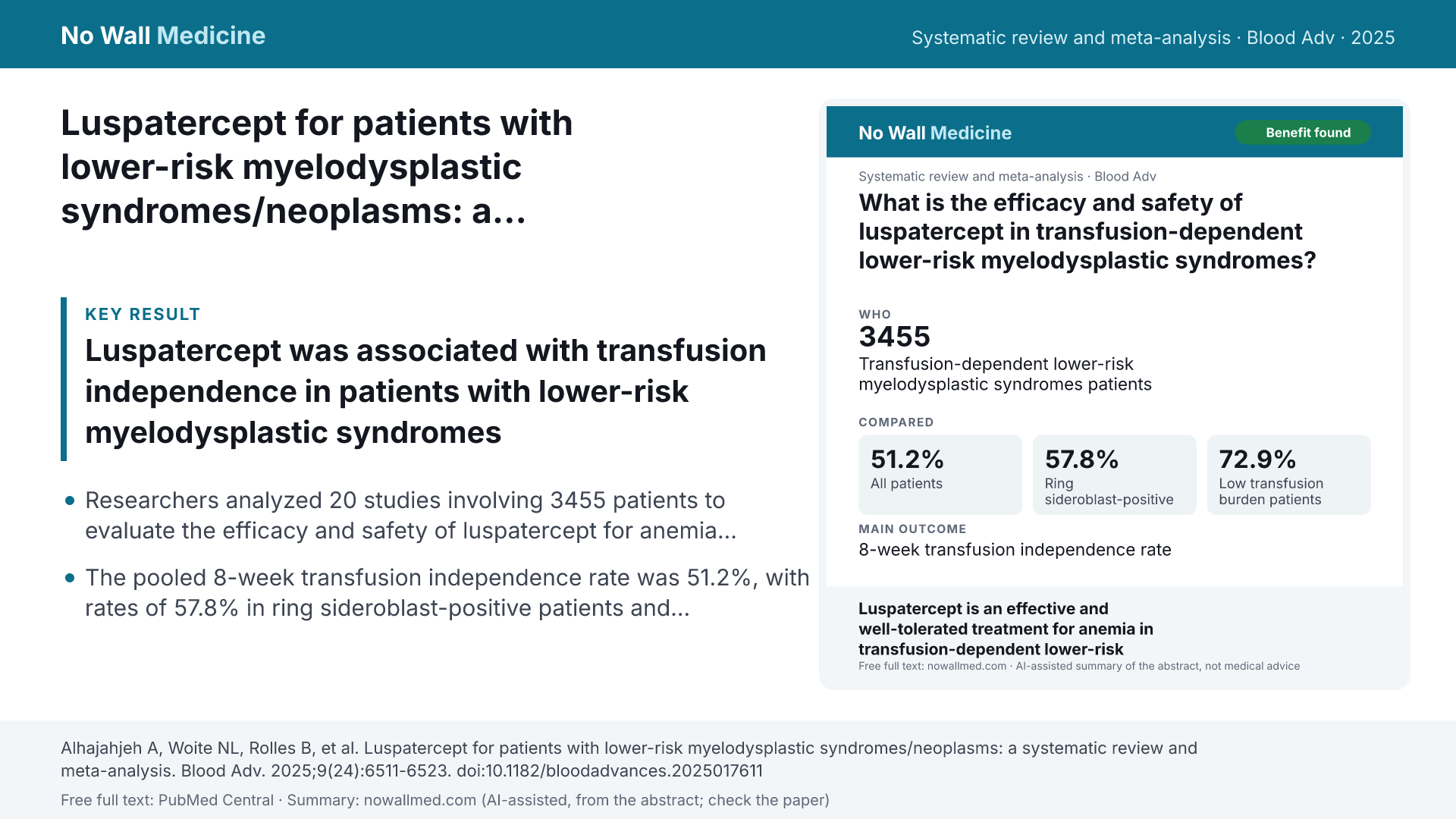
Luspatercept was associated with transfusion independence in patients with lower-risk myelodysplastic syndromes
Luspatercept for patients with lower-risk myelodysplastic syndromes/neoplasms: a systematic review and meta-analysis
Systematic review and meta-analysisBenefit found
What is the efficacy and safety of luspatercept in transfusion-dependent lower-risk myelodysplastic syndromes?
Who
3455
Transfusion-dependent lower-risk myelodysplastic syndromes patients
Compared
51.2%All patients (95% confidence interval 39.9-60.4)
57.8%Ring sideroblast-positive patients (95% CI, 47.4-67.7)
72.9%Low transfusion burden patients (95% CI, 60.4-82.6)
Main outcome
8-week transfusion independence rate
Bottom line: Luspatercept is an effective and well-tolerated treatment for anemia in transfusion-dependent lower-risk myelodysplastic syndromes.
Blood Adv · 2025-09-18 · Save PNG
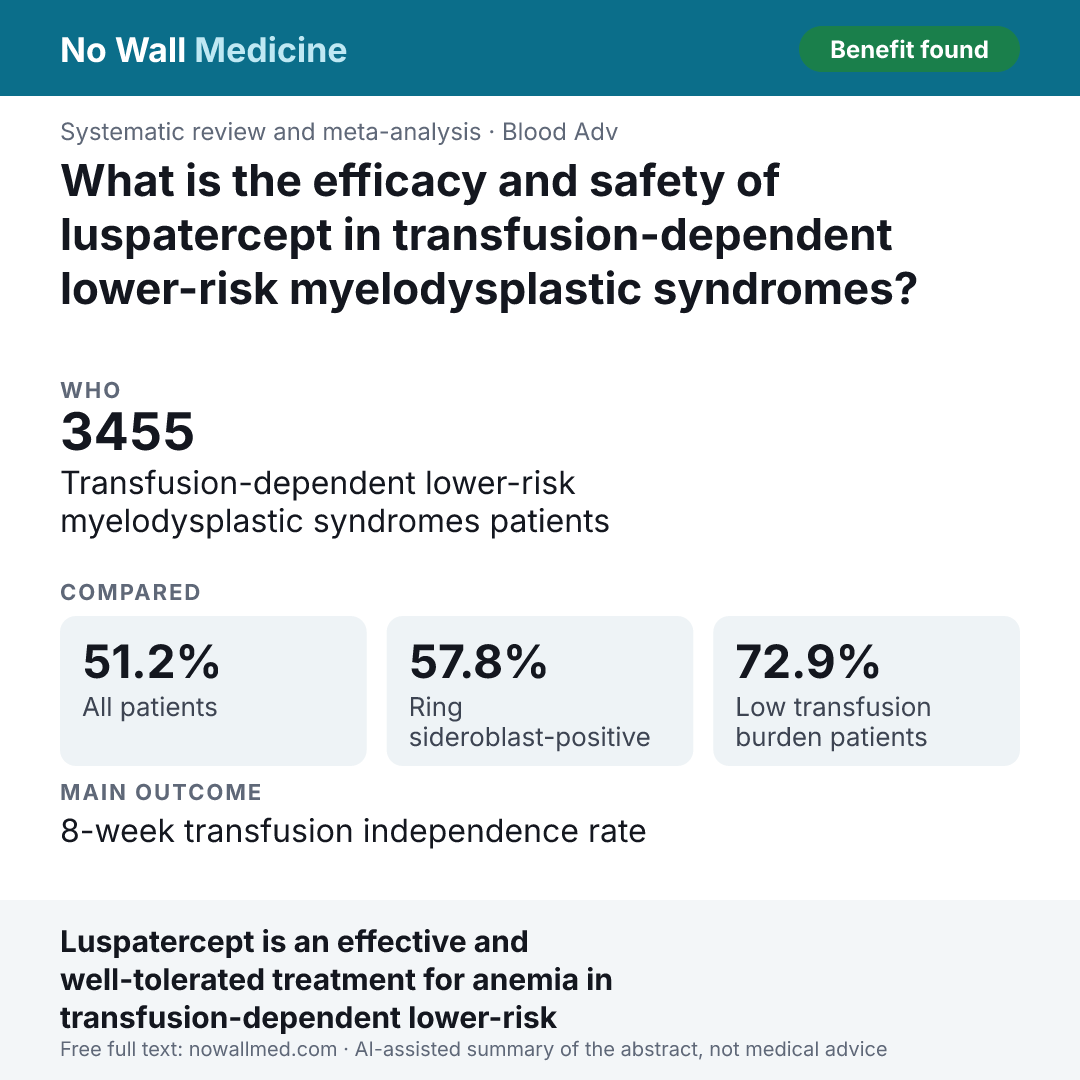
Clinical question: What is the efficacy and safety of luspatercept in transfusion-dependent lower-risk myelodysplastic syndromes?
Why it matters: The efficacy and safety of luspatercept for treating anemia in transfusion-dependent lower-risk myelodysplastic syndromes needed evaluation.
Key points
- Researchers analyzed 20 studies involving 3455 patients to evaluate the efficacy and safety of luspatercept for anemia in transfusion-dependent lower-risk myelodysplastic syndromes.
- The pooled 8-week transfusion independence rate was 51.2%, with rates of 57.8% in ring sideroblast-positive patients and 72.9% in those with low transfusion burden.
- The most frequent adverse events were peripheral edema at 17.8%, diarrhea at 15.6%, and fatigue at 11.4%, while serious adverse events occurred in 28.0% of patients.
Headline and key points written with AI from the paper’s abstract, with every number checked against it. Read the paper before relying on them.
Was this summary helpful?
Abstract
Luspatercept has emerged as a novel therapy for anemia in transfusion-dependent (TD) lower-risk myelodysplastic syndromes (LR-MDS). This systematic review and meta-analysis aimed to evaluate the efficacy and safety of luspatercept in TD LR-MDS. Six databases were searched through March 2025 to find relevant material. Studies were screened and extracted by 2 independent authors. A total of 20 studies encompassing 3455 patients were included in the analysis. The pooled 8-week transfusion independence (TI) rate was 51.2% (95% confidence interval [CI], 39.9-60.4; I2 = 94.9%), with higher rates observed among ring sideroblast-positive (RS+) patients (57.8%; 95% CI, 47.4-67.7; I2 = 86%) and those with low transfusion burden (LTB; 72.9%; 95% CI, 60.4-82.6; I2 = 0%). The 12-week and 24-week TI rates were 57.0% (95% CI, 48.1-65.5; I2 = 90%) and 35.8% (95% CI, 28.7-43.6; I2 = 82.1%), respectively. Hematologic improvement-erythroid was achieved in 51.3% of patients (95% CI, 41.3%-61.2%; I2 = 93%). The most frequent adverse events were peripheral edema (17.8%; 95% CI, 11.4-26.8), diarrhea (15.6%; 95% CI, 8.2-27.7), and fatigue (11.4%; 95% CI, 5.4-22.6). Serious adverse events occurred in 28.0% of patients (95% CI, 12.8-50.7; I2 = 97.2%). Luspatercept is an effective and well-tolerated treatment for anemia in TD LR-MDS, especially in patients with RS+ and LTB. Its favorable safety profile and high TI rates, particularly in erythropoiesis-stimulating agent-naïve populations, support its use in the frontline setting.
Abstract reproduced under the article’s CC BY NC ND licence.
Subject terms
Headline, design, result, key points, caveat and citation as plain text.
Cite this article
Alhajahjeh A, Woite NL, Rolles B, et al. Luspatercept for patients with lower-risk myelodysplastic syndromes/neoplasms: a systematic review and meta-analysis. Blood Adv. 2025;9(24):6511-6523. doi:10.1182/bloodadvances.2025017611
Spotted a mistake? Suggest a correction