Artificial intelligence models show high diagnostic accuracy for lumbar spinal stenosis in meta-analysis
Machine Learning and Deep Learning for Diagnosis of Lumbar Spinal Stenosis: Systematic Review and Meta-Analysis
Meta-analysis of 12 studiesBenefit found
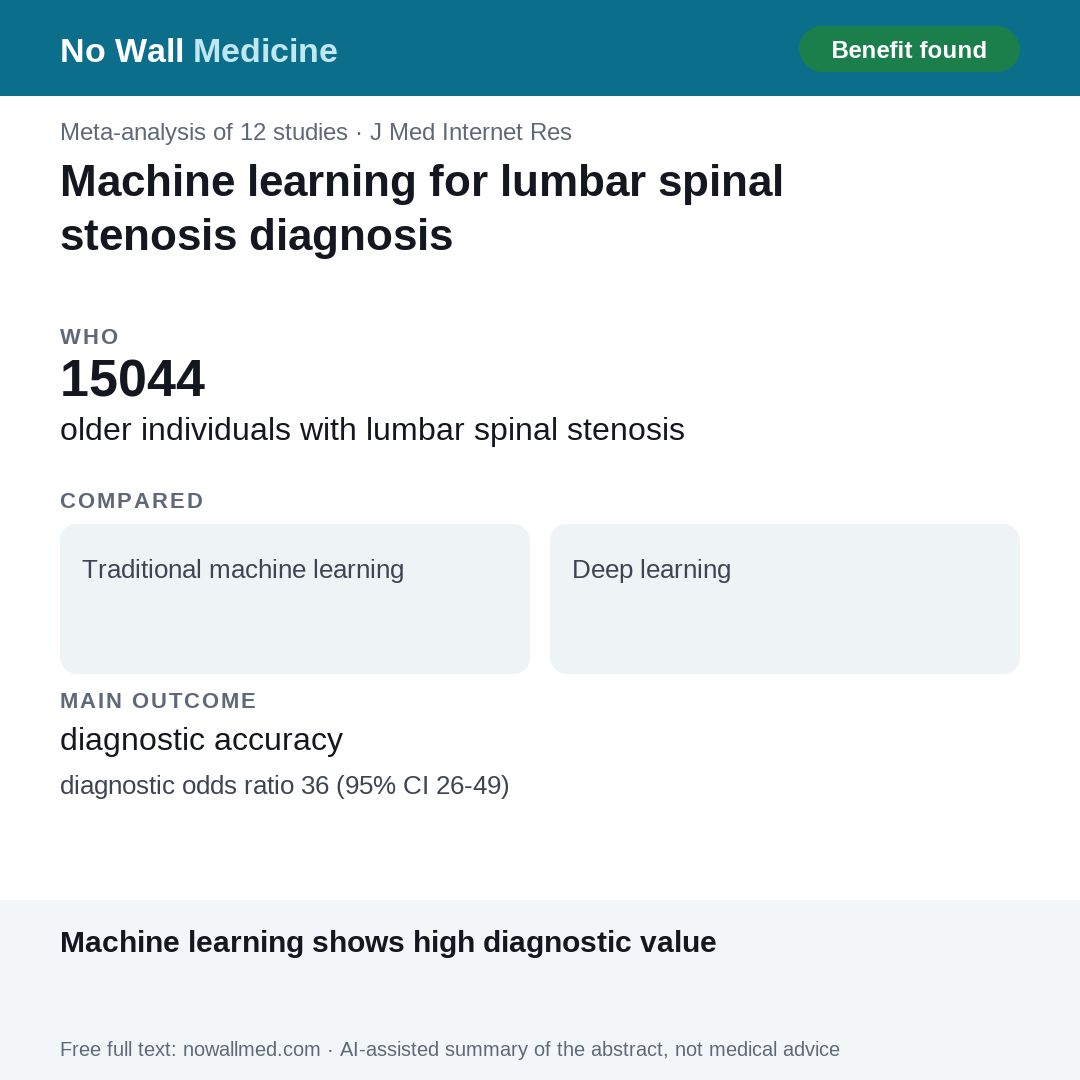
Machine learning for lumbar spinal stenosis diagnosis
Who
15044
older individuals with lumbar spinal stenosis
Compared
Traditional machine learning
Deep learning
Main outcome
diagnostic accuracy
Result: diagnostic odds ratio 36 (95% CI 26-49)
Bottom line: Machine learning shows high diagnostic value
Limitation: none of them reliable enough for clinical practice
J Med Internet Res · 2024-12-23Download image
Why it matters: The performance of traditional machine learning and deep learning models for diagnosing lumbar spinal stenosis has not been analyzed systematically.
Key points
- Researchers analyzed 12 studies involving 15,044 patients to evaluate traditional machine learning and deep learning models for diagnosing lumbar spinal stenosis.
- The pooled sensitivity was 0.84 and the pooled specificity was 0.87, with an area under the curve of 0.92.
- The diagnostic odds ratio was 36, the positive likelihood ratio was 6.6, and the negative likelihood ratio was 0.18.
Limitation the authors note: The authors note that current models are not reliable or practical enough for real clinical practice and require further optimization and external validation.
Headline and key points written with AI from the paper’s abstract, with every number checked against it. Read the paper before relying on them.
Topics
Cite this article
Wang T, Chen R, Fan N, Zang L, Yuan S, Du P. Machine Learning and Deep Learning for Diagnosis of Lumbar Spinal Stenosis: Systematic Review and Meta-Analysis. J Med Internet Res. 2024. doi:10.2196/54676
Spotted a mistake? Suggest a correction
Top studies every Monday
The week’s key trials and guidelines in your specialties, by email. Free.
Get the weekly digest