Machine learning for technical skill assessment in surgery: a systematic review
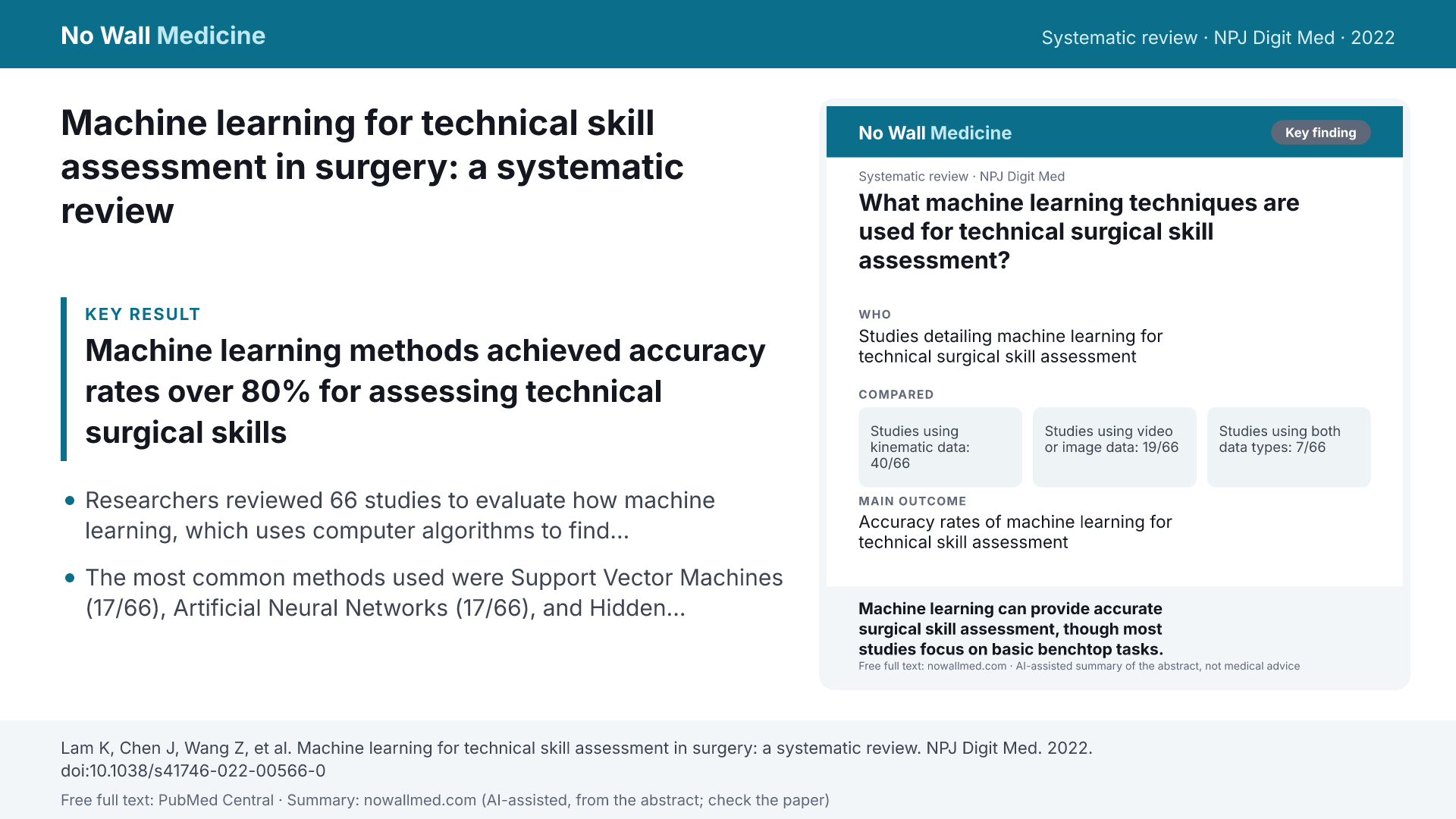
Key result: Machine learning methods achieved accuracy rates over 80% for assessing technical surgical skills
Key points
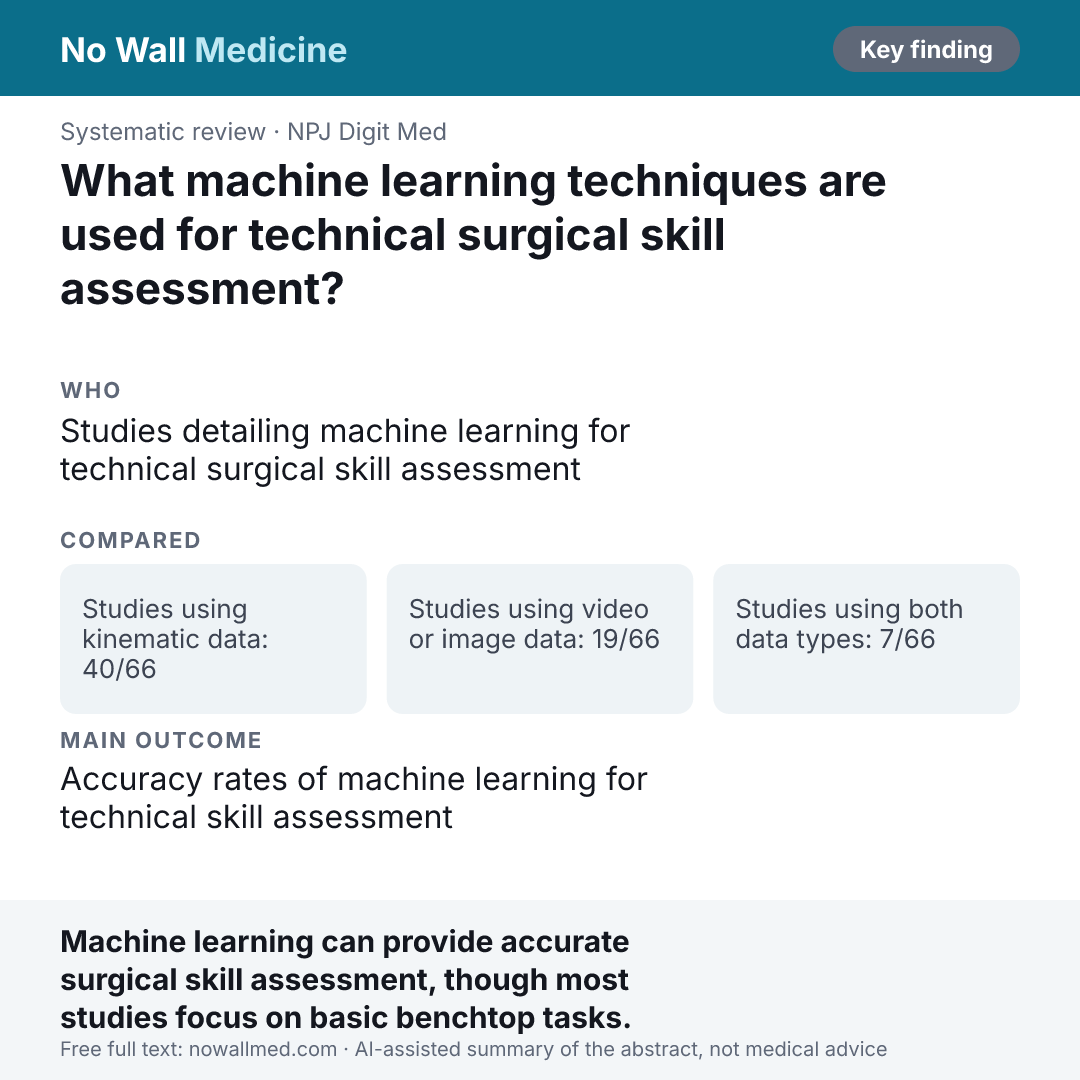
- Researchers reviewed 66 studies to evaluate how machine learning, which uses computer algorithms to find patterns, assesses surgical technical skills.
- The most common methods used were Support Vector Machines (17/66), Artificial Neural Networks (17/66), and Hidden Markov Models (14/66).
- Accuracy rates of over 80% were achieved across various tasks, though 48/66 studies focused on benchtop tasks rather than real-life surgery.
Why it matters: Existing methods for assessing surgical performance can be time consuming, labor intensive, and subject to bias.
Limitation the authors note: Barriers to progress include a focus on basic tasks, a lack of standardization between studies, and a lack of datasets.
Discussion prompts
- Would these patients look like yours? Who was left out?
- Is the main outcome one that matters to patients?
- Is the difference large enough to change what you do?
Cite: Lam K, Chen J, Wang Z, et al. Machine learning for technical skill assessment in surgery: a systematic review. NPJ Digit Med. 2022. doi:10.1038/s41746-022-00566-0
Free full text: PubMed Central · Summary and visual abstract: nowallmed.com/a/machine-learning-for-technical-skill-assessment-in-surgery-a-1cunj8q/ (AI-assisted from the abstract; check the paper before relying on it).