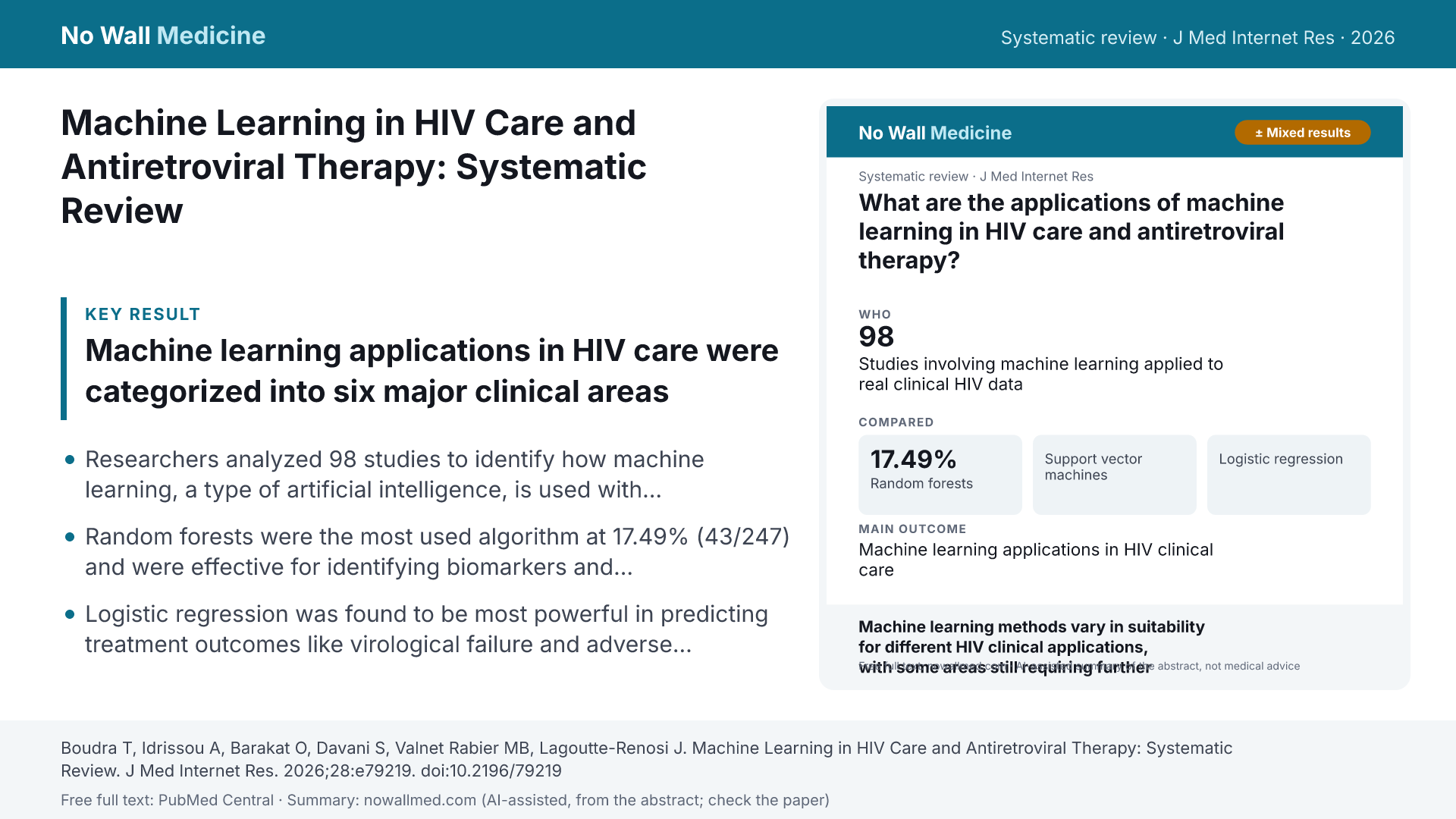
Machine learning applications in HIV care were categorized into six major clinical areas
Machine Learning in HIV Care and Antiretroviral Therapy: Systematic Review
Systematic reviewMixed results
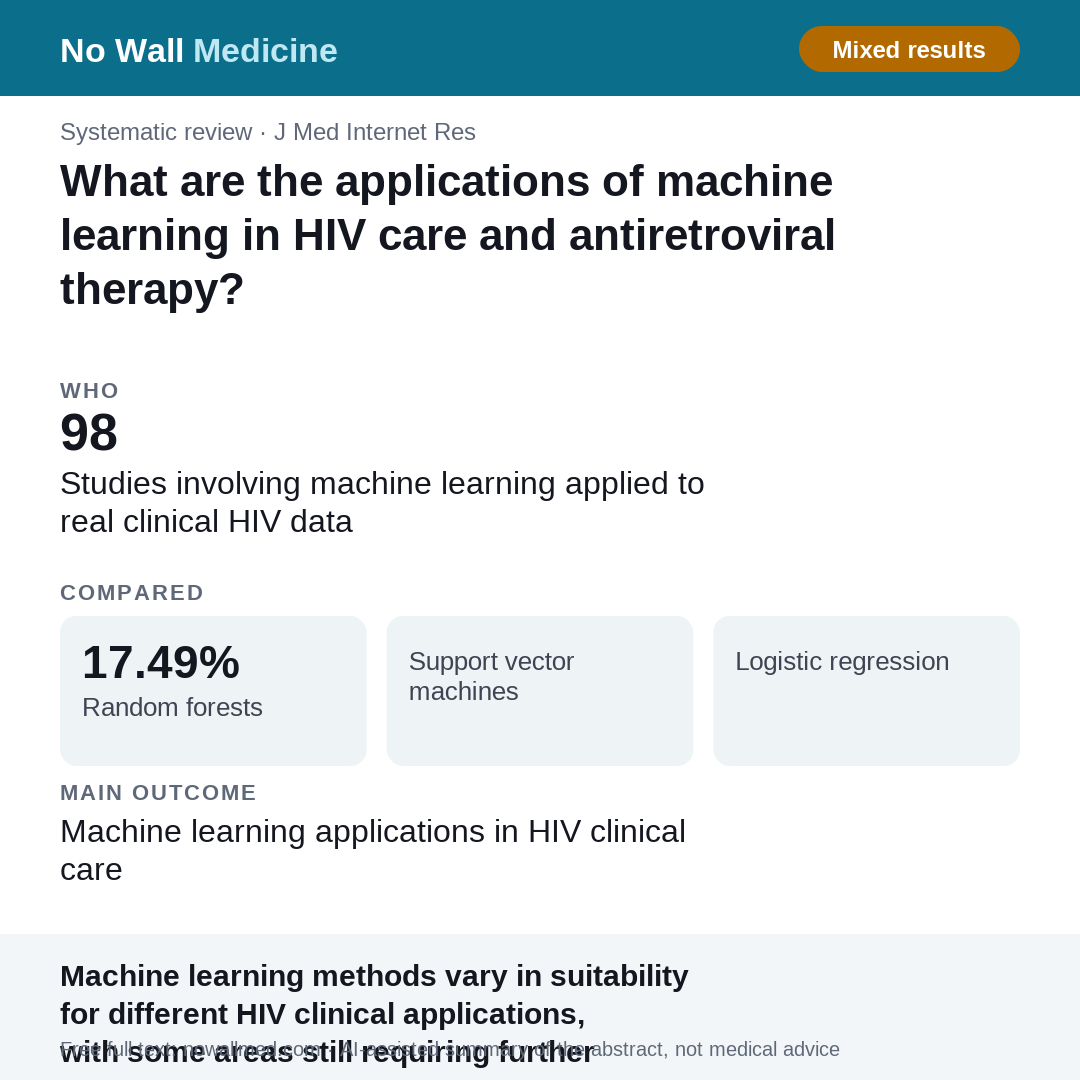
What are the applications of machine learning in HIV care and antiretroviral therapy?
Who
98
Studies involving machine learning applied to real clinical HIV data
Compared
17.49%Random forests (43/247)
Support vector machines
Logistic regression
Main outcome
Machine learning applications in HIV clinical care
Bottom line: Machine learning methods vary in suitability for different HIV clinical applications, with some areas still requiring further exploration.
Limitation: Some areas like treatment recommendations and adherence still lack artificial intelligence algorithms.
J Med Internet Res · 2026-04-28Download image
Clinical question: What are the applications of machine learning in HIV care and antiretroviral therapy?
Key points
- Researchers analyzed 98 studies to identify how machine learning, a type of artificial intelligence, is used with real clinical data in HIV care.
- Random forests were the most used algorithm at 17.49% (43/247) and were effective for identifying biomarkers and predicting neurocognitive impairment.
- Logistic regression was found to be most powerful in predicting treatment outcomes like virological failure and adverse events in people receiving antiretrovirals.
Headline and key points written with AI from the paper’s abstract, with every number checked against it. Read the paper before relying on them.
Was this summary helpful?
Subject terms
Cite this article
Boudra T, Idrissou A, Barakat O, Davani S, Valnet Rabier MB, Lagoutte-Renosi J. Machine Learning in HIV Care and Antiretroviral Therapy: Systematic Review. J Med Internet Res. 2026. doi:10.2196/79219
Spotted a mistake? Suggest a correction