Machine learning methods for functional recovery prediction and prognosis in post-stroke rehabilitation: a systematic review
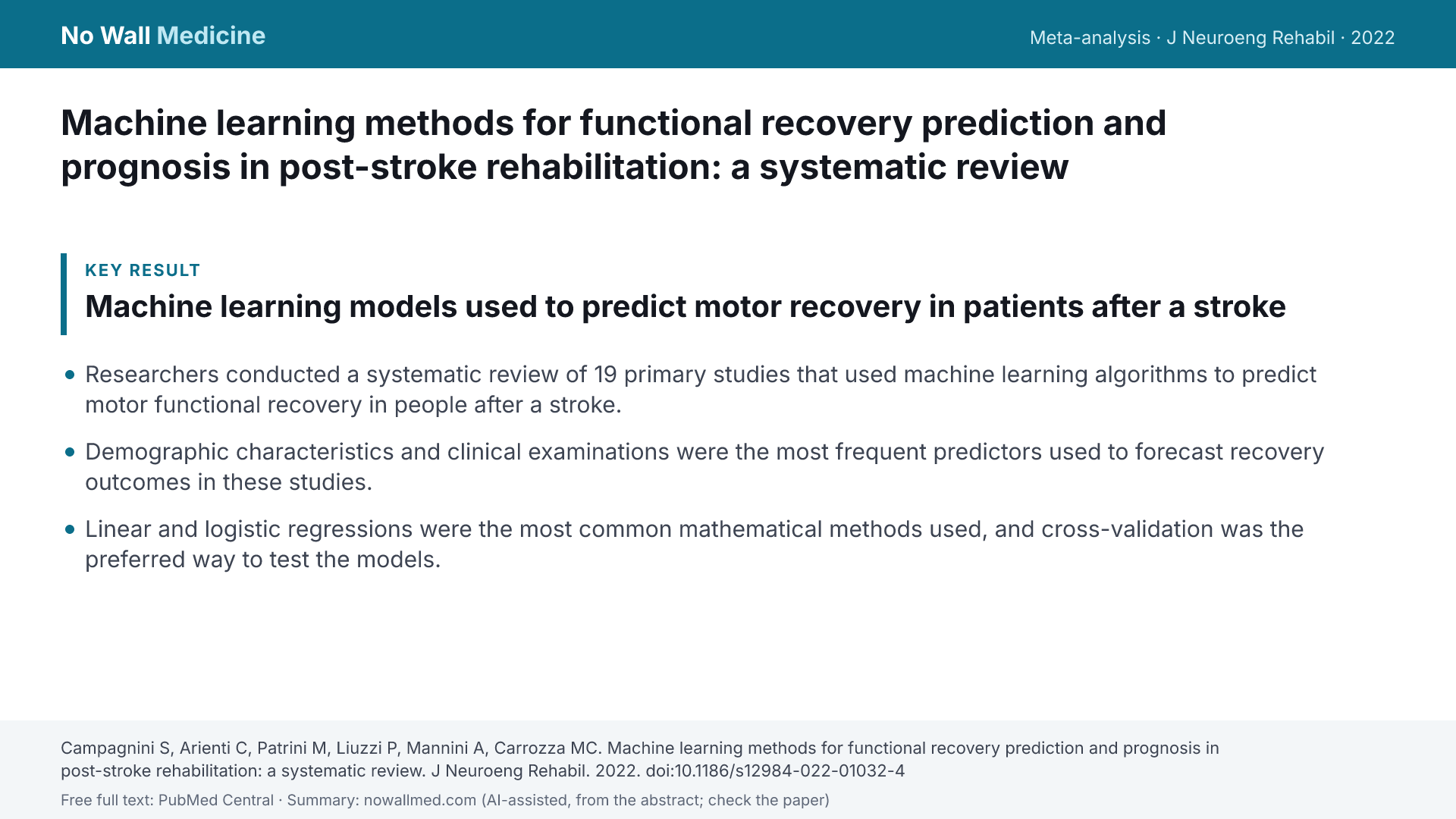
Key result: Machine learning models used to predict motor recovery in patients after a stroke
Key points
- Researchers conducted a systematic review of 19 primary studies that used machine learning algorithms to predict motor functional recovery in people after a stroke.
- Demographic characteristics and clinical examinations were the most frequent predictors used to forecast recovery outcomes in these studies.
- Linear and logistic regressions were the most common mathematical methods used, and cross-validation was the preferred way to test the models.
Why it matters: It is unknown which machine learning algorithms are most effective for predicting motor functional recovery in patients undergoing post-stroke rehabilitation.
Limitation the authors note: The authors noted small sample sizes, a limited number of external validation approaches, and high heterogeneity among input and output variables.
Discussion prompts
- Would these patients look like yours? Who was left out?
- Is the main outcome one that matters to patients?
- Is the difference large enough to change what you do?
Cite: Campagnini S, Arienti C, Patrini M, Liuzzi P, Mannini A, Carrozza MC. Machine learning methods for functional recovery prediction and prognosis in post-stroke rehabilitation: a systematic review. J Neuroeng Rehabil. 2022. doi:10.1186/s12984-022-01032-4
Free full text: PubMed Central · Summary and visual abstract: nowallmed.com/a/machine-learning-methods-for-functional-recovery-prediction-and-uqkqqf/ (AI-assisted from the abstract; check the paper before relying on it).