Machine-learning gene signature predicts survival benefit from paclitaxel in gastric cancer patients
Machine-learning model derived gene signature predictive of paclitaxel survival benefit in gastric cancer: results from the randomised phase III SAMIT trial
Randomized phase III trialBenefit found
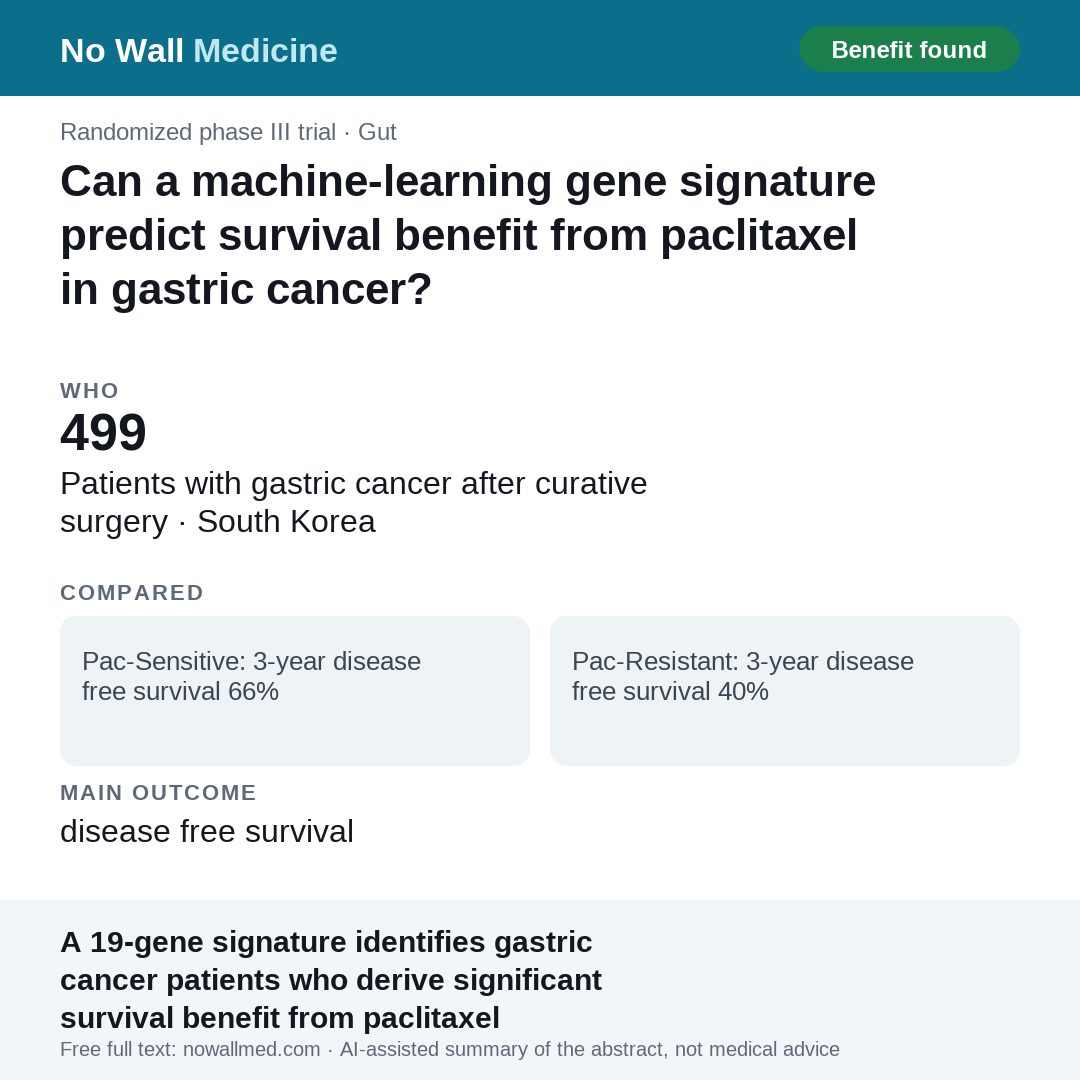
Can a machine-learning gene signature predict survival benefit from paclitaxel in gastric cancer?
Who
499
Patients with gastric cancer after curative surgery · South Korea
Compared
Pac-Sensitive: 3-year disease free survival 66%
Pac-Resistant: 3-year disease free survival 40%
Main outcome
disease free survival
Result: hazard ratio 0.44 (p=0.0029)
Bottom line: A 19-gene signature identifies gastric cancer patients who derive significant survival benefit from paclitaxel chemotherapy.
Gut · 2021-05-12Download image
Clinical question: Can a machine-learning gene signature predict survival benefit from paclitaxel in gastric cancer?
Why it matters: There are currently no predictive biomarkers to help doctors select which gastric cancer patients will benefit from paclitaxel chemotherapy.
Key points
- Researchers analyzed 499 samples from the SAMIT phase III trial to develop a 19-gene signature using a machine-learning model.
- In the Pac-UFT validation cohort, Pac-Sensitive patients had a 3-year disease-free survival of 66% compared to 40% for Pac-Resistant patients.
- The signature also predicted benefit in an external cohort of metastatic patients, with a median progression-free survival of 147 days versus 112 days.
Headline and key points written with AI from the paper’s abstract, with every number checked against it. Read the paper before relying on them.
Was this summary helpful?
Abstract
Objective
To date, there are no predictive biomarkers to guide selection of patients with gastric cancer (GC) who benefit from paclitaxel. Stomach cancer Adjuvant Multi-Institutional group Trial (SAMIT) was a 2×2 factorial randomised phase III study in which patients with GC were randomised to Pac-S-1 (paclitaxel +S-1), Pac-UFT (paclitaxel +UFT), S-1 alone or UFT alone after curative surgery. Design
The primary objective of this study was to identify a gene signature that predicts survival benefit from paclitaxel chemotherapy in GC patients. SAMIT GC samples were profiled using a customised 476 gene NanoString panel. A random forest machine-learning model was applied on the NanoString profiles to develop a gene signature. An independent cohort of metastatic patients with GC treated with paclitaxel and ramucirumab (Pac-Ram) served as an external validation cohort. Results
From the SAMIT trial 499 samples were analysed in this study. From the Pac-S-1 training cohort, the random forest model generated a 19-gene signature assigning patients to two groups: Pac-Sensitive and Pac-Resistant. In the Pac-UFT validation cohort, Pac-Sensitive patients exhibited a significant improvement in disease free survival (DFS): 3-year DFS 66% vs 40% (HR 0.44, p=0.0029). There was no survival difference between Pac-Sensitive and Pac-Resistant in the UFT or S-1 alone arms, test of interaction p<0.001. In the external Pac-Ram validation cohort, the signature predicted benefit for Pac-Sensitive (median PFS 147 days vs 112 days, HR 0.48, p=0.022). Conclusion
Using machine-learning techniques on one of the largest GC trials (SAMIT), we identify a gene signature representing the first predictive biomarker for paclitaxel benefit. Trial registration number
UMIN Clinical Trials Registry: C000000082 (SAMIT); ClinicalTrials.gov identifier, 02628951 (South Korean trial).
Abstract reproduced under the article’s CC BY NC licence.
Subject terms
Cite this article
Sundar R, Barr Kumarakulasinghe N, Huak Chan Y, Yoshida K, Yoshikawa T, Miyagi Y. Machine-learning model derived gene signature predictive of paclitaxel survival benefit in gastric cancer: results from the randomised phase III SAMIT trial. Gut. 2021. doi:10.1136/gutjnl-2021-324060
Spotted a mistake? Suggest a correction
Top studies every Monday
The week’s key trials and guidelines in your specialties, plus any topics you follow. By email, free.
Get the weekly digest