Visual abstractsVisuals
Meta-analysisJournal of Medical Internet Research · Nov 9, 2026

Machine learning models predicted glucose levels with 1.18 mmol/L root-mean-square error

Machine Learning Models for Glycemic Prediction in Type 1 and Type 2 Diabetes: Systematic Review and Meta-Analysis

Yang H, Abudukeremu D, Shi Y, Fang L, Li L, Gu W, et al
Digital Health & AIAdult
Meta-analysis of 270 studiesMixed results
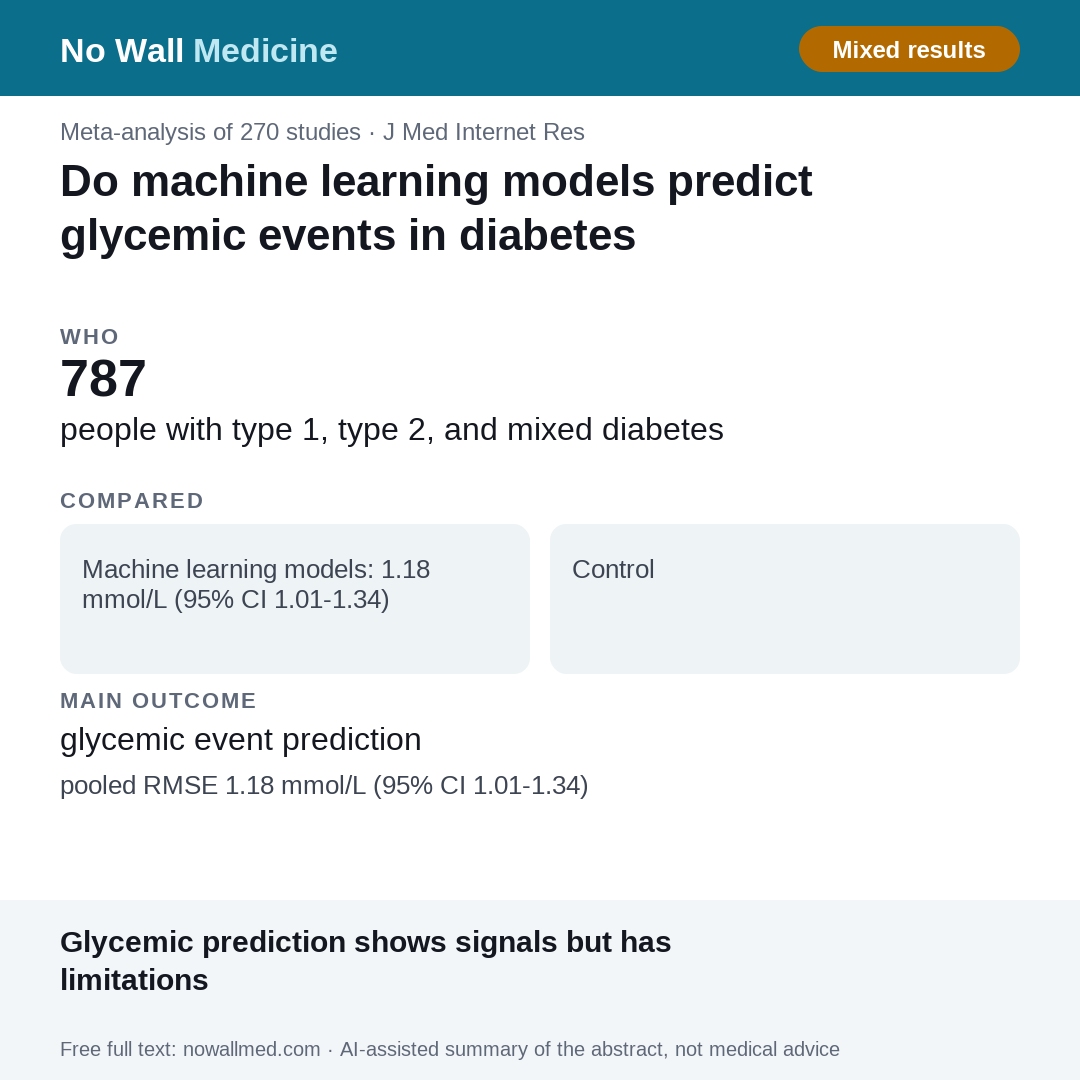
Do machine learning models predict glycemic events in diabetes
Who
787
people with type 1, type 2, and mixed diabetes
Compared
Machine learning models: 1.18 mmol/L (95% CI 1.01-1.34)
Control
Main outcome
glycemic event prediction
Result: pooled RMSE 1.18 mmol/L (95% CI 1.01-1.34)
Bottom line: Glycemic prediction shows signals but has limitations
Limitation: high risk of bias and limited validation
J Med Internet Res · 2026-11-09Download image

Why it matters: Doctors need evidence on machine learning models for glycemic prediction in diabetes

Key points

Limitation the authors note: Most studies had high risk of bias and limited external and prospective validation

Headline and key points written with AI from the paper’s abstract, with every number checked against it. Read the paper before relying on them.

Read the full paper free at PubMed Central ↗

Topics

Humans; Machine Learning; Diabetes Mellitus, Type 1; Diabetes Mellitus, Type 2; Blood Glucose; Bayes Theorem; Predictive Learning Models; Prediction Algorithms

DOI: 10.2196/100653 · PubMed: 43006686

Spotted a mistake? Suggest a correction

More in Digital Health & AI

ResearchLancet Digit Health · Nov 23, 2026 · Digital Health & AI

ClinicalAge biomarker associated with mortality and disease risk in UK datasets

ClinicalAge, a framework for modelling ageing trajectories from longitudinal electronic health records in the UK: a model development and validation study

ResearchLancet Digit Health · Nov 23, 2026 · Digital Health & AI

Facial photographs used to estimate age and predict survival in cancer patients

Foundation artificial intelligence models for health recognition by use of face photographs (FAHR-Face): a model development and validation study

ResearchLancet Digit Health · Nov 23, 2026 · Digital Health & AI

New model predicts severe fetal compromise risk at birth with 33.4% sensitivity

A prognostic model for use at labour onset to estimate the risk of severe fetal compromise at birth: a retrospective, model development and validation study

ResearchNPJ Digit Med · Nov 21, 2026 · Digital Health & AI

ECG foundation models performed well on general data but less so on athletes' data

ECG foundation models for cardiovascular screening in a cohort of young competitive athletes

ResearchJ Med Internet Res · Nov 20, 2026 · Digital Health & AI

Six large language models showed similar question-answering accuracy on medical exam questions

Medical Reasoning in Large Language Models: Development and Evaluation of the MedEvalArena Benchmark