Machine learning natural language processing shows high accuracy for identifying venous thromboembolism in medical records
Machine learning natural language processing for identifying venous thromboembolism: systematic review and meta-analysis
Meta-analysis of 13 studiesBenefit found
Can machine learning identify venous thromboembolism?
Who
Patients with electronic health records
Compared
Machine learning
Control
Main outcome
Venous thromboembolism diagnosis
Result: Pooled sensitivity 0.931 (95% CI, 0.881-0.962)
Bottom line: Machine learning can identify VTE accurately
Limitation: Significant heterogeneity in studies
Blood Adv · 2024-03-24Download image
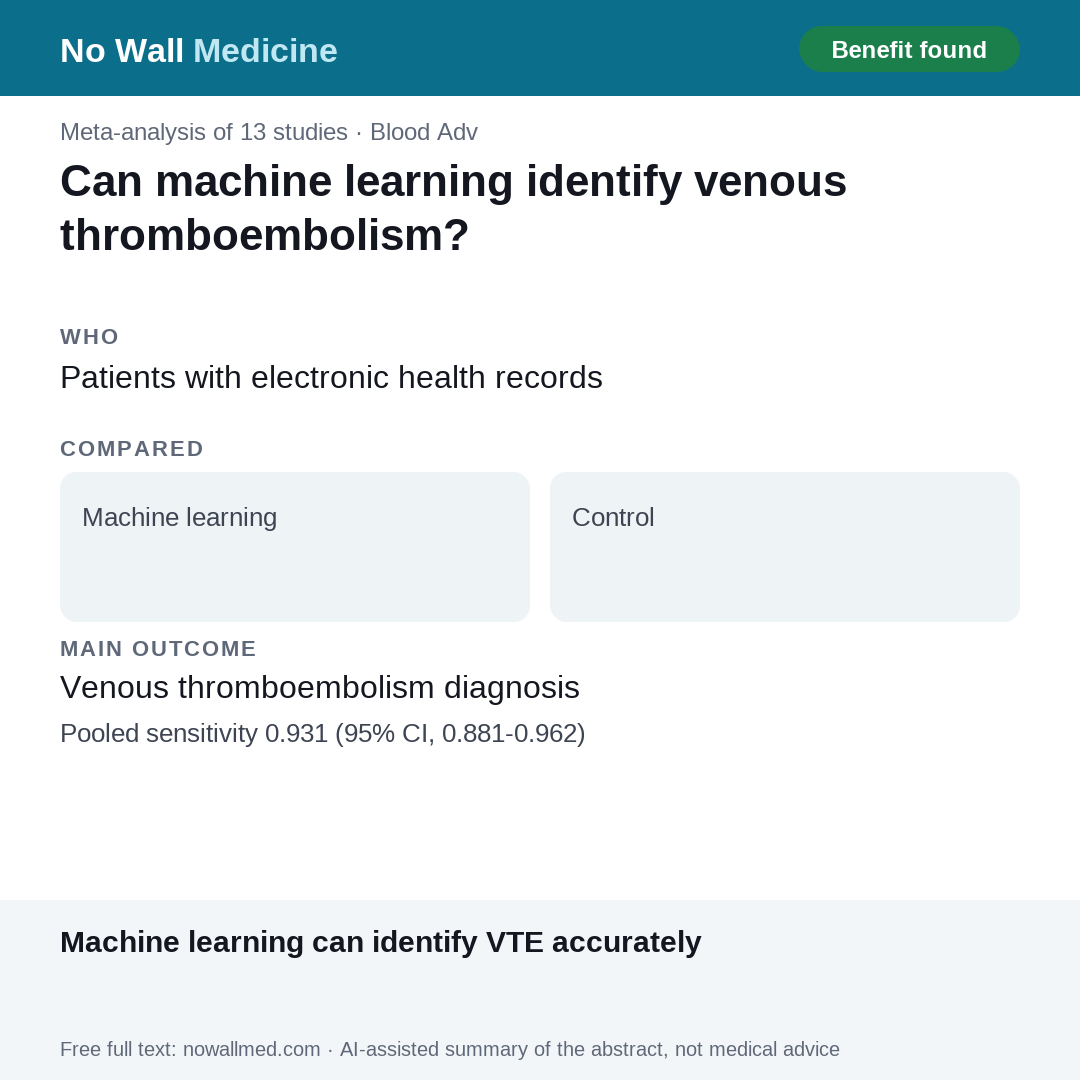
Clinical question: Can machine learning identify venous thromboembolism?
Why it matters: Manual medical record review and diagnosis code interpretation are challenging methods for monitoring venous thromboembolism cases.
Key points
- Researchers conducted a systematic review and meta-analysis of 13 studies, with 8 providing data, to evaluate machine learning natural language processing for identifying venous thromboembolism.
- The pooled analysis showed a sensitivity of 0.931, specificity of 0.984, positive predictive value of 0.910, and negative predictive value of 0.985.
- The highest performing models utilized deep-learning techniques like convolutional neural networks and vectorization rather than bag-of-words methods.
Limitation the authors note: There was significant heterogeneity in the studies, and only 4 validated their model on an external data set.
Headline and key points written with AI from the paper’s abstract, with every number checked against it. Read the paper before relying on them.
Was this summary helpful?
Abstract
Venous thromboembolism (VTE) is a leading cause of preventable in-hospital mortality. Monitoring VTE cases is limited by the challenges of manual medical record review and diagnosis code interpretation. Natural language processing (NLP) can automate the process. Rule-based NLP methods are effective but time consuming. Machine learning (ML)-NLP methods present a promising solution. We conducted a systematic review and meta-analysis of studies published before May 2023 that use ML-NLP to identify VTE diagnoses in the electronic health records. Four reviewers screened all manuscripts, excluding studies that only used a rule-based method. A meta-analysis evaluated the pooled performance of each study's best performing model that evaluated for pulmonary embolism and/or deep vein thrombosis. Pooled sensitivity, specificity, positive predictive value (PPV), and negative predictive value (NPV) with confidence interval (CI) were calculated by DerSimonian and Laird method using a random-effects model. Study quality was assessed using an adapted TRIPOD (Transparent Reporting of a multivariable prediction model for Individual Prognosis Or Diagnosis) tool. Thirteen studies were included in the systematic review and 8 had data available for meta-analysis. Pooled sensitivity was 0.931 (95% CI, 0.881-0.962), specificity 0.984 (95% CI, 0.967-0.992), PPV 0.910 (95% CI, 0.865-0.941) and NPV 0.985 (95% CI, 0.977-0.990). All studies met at least 13 of the 21 NLP-modified TRIPOD items, demonstrating fair quality. The highest performing models used vectorization rather than bag-of-words and deep-learning techniques such as convolutional neural networks. There was significant heterogeneity in the studies, and only 4 validated their model on an external data set. Further standardization of ML studies can help progress this novel technology toward real-world implementation.
Abstract reproduced under the article’s CC BY NC ND licence.
Subject terms
Cite this article
Lam BD, Chrysafi P, Chiasakul T, Khosla H, Karagkouni D, McNichol M. Machine learning natural language processing for identifying venous thromboembolism: systematic review and meta-analysis. Blood Adv. 2024. doi:10.1182/bloodadvances.2023012200
Spotted a mistake? Suggest a correction
Top studies every Monday
The week’s key trials and guidelines in your specialties, plus any topics you follow. By email, free.
Get the weekly digest