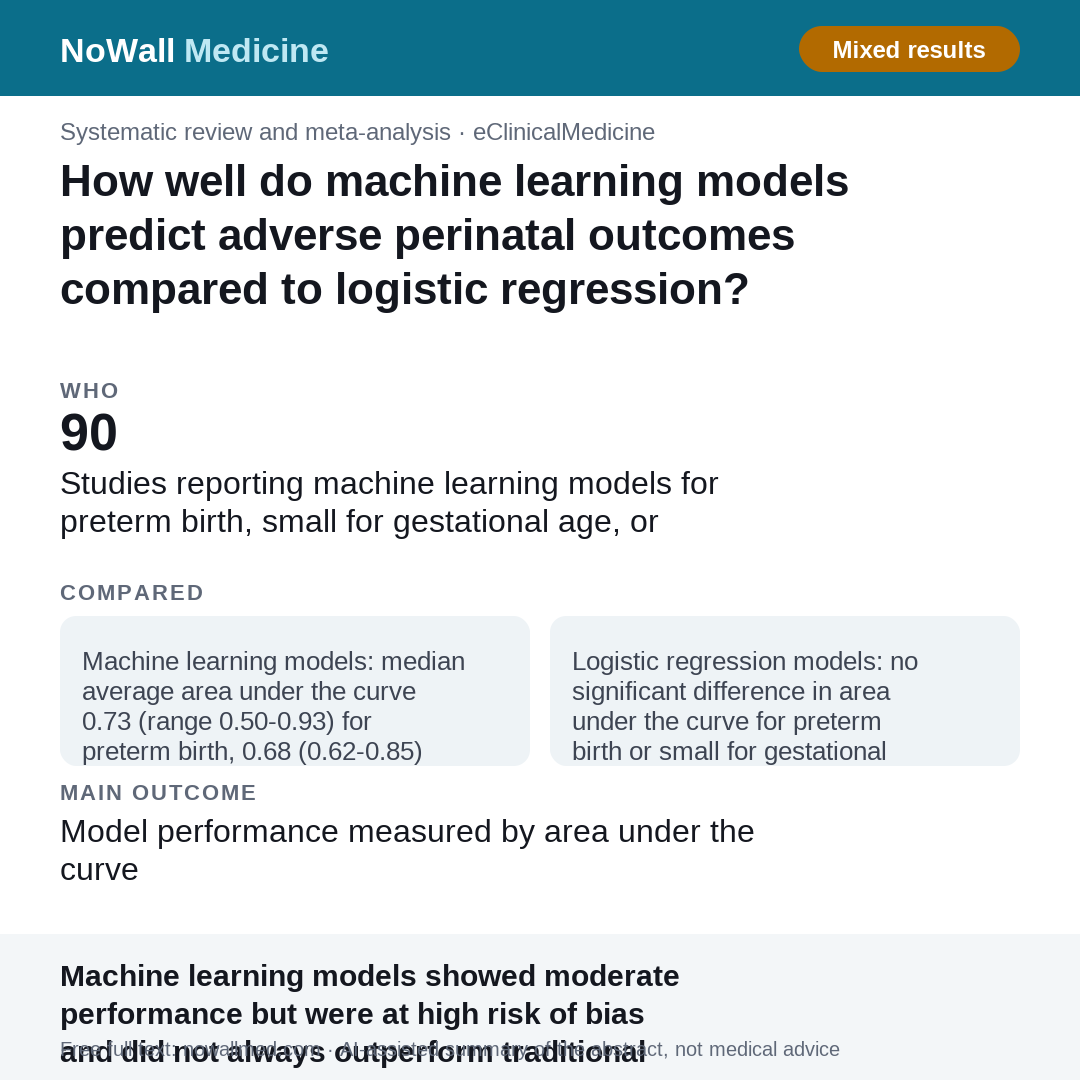
How well do machine learning models predict adverse perinatal outcomes compared to logistic regression?
Who
90
Studies reporting machine learning models for preterm birth, small for gestational age, or stillbirth · Multiple databases searched including PubMed, EMBASE, and Web of Science
Compared
Machine learning models: median average area under the curve 0.73 (range 0.50-0.93) for preterm birth, 0.68 (0.62-0.85) for small for gestational age, and 0.75 (0.57-0.98) for stillbirth
Logistic regression models: no significant difference in area under the curve for preterm birth or small for gestational age
Main outcome
Model performance measured by area under the curve
Result: higher area under the curve for stillbirth prediction (p = 0.03)
Bottom line: Machine learning models showed moderate performance but were at high risk of bias and did not always outperform traditional statistical methods.
Limitation: Almost all studies were at high risk of bias and potential publication bias was observed.
Funded by: Chinese Academy of Medical Sciences and National Institute for Health and Care Research
Clinical question: How well do machine learning models predict adverse perinatal outcomes compared to logistic regression?
Why it matters: There is a surge of publications using machine learning on clinical data, but evidence regarding model performance and comparison to traditional methods is needed.
Key points
Researchers analyzed 90 studies to evaluate machine learning performance for predicting preterm birth, small for gestational age, and stillbirth.
Median area under the curve values for internal validation were 0.73 for preterm birth, 0.68 for small for gestational age, and 0.75 for stillbirth.
Machine learning models showed no significant difference compared to logistic regression for preterm birth or small for gestational age, but performed better for stillbirth.
Limitation the authors note: Almost all included studies were at high risk of bias and potential publication bias was observed.
Headline and key points written with AI from the paper’s abstract, with every number checked against it. Read the paper before relying on them.
ClinicalAge, a framework for modelling ageing trajectories from longitudinal electronic health records in the UK: a model development and validation study
A prognostic model for use at labour onset to estimate the risk of severe fetal compromise at birth: a retrospective, model development and validation study