Machine learning algorithms outperformed radiologists in predicting cancer spread beyond lymph nodes on CT scans
Machine Learning to Predict Extranodal Extension in Head and Neck Squamous Cell Carcinoma: A Systematic Review and Meta-Analysis
Systematic review and meta-analysisBenefit found
Can machine learning algorithms diagnose extranodal extension in head and neck squamous cell carcinoma?
Who
1407
Patients with head and neck squamous cell carcinoma
Compared
Machine learning algorithms: pooled AUC of 0.92 (95% CI [0.915, 0.923])
Radiologists: pooled AUCs of 0.65 (95% CI [0.645-0.654])
Main outcome
Diagnostic accuracy of detecting extranodal extension using computed tomography imaging
Result: pooled AUC of 0.92 (95% CI [0.915, 0.923])
Bottom line: Machine learning algorithms demonstrate superior diagnostic performance in predicting extranodal extension compared to radiologists.
Laryngoscope · 2025-10-10Download image
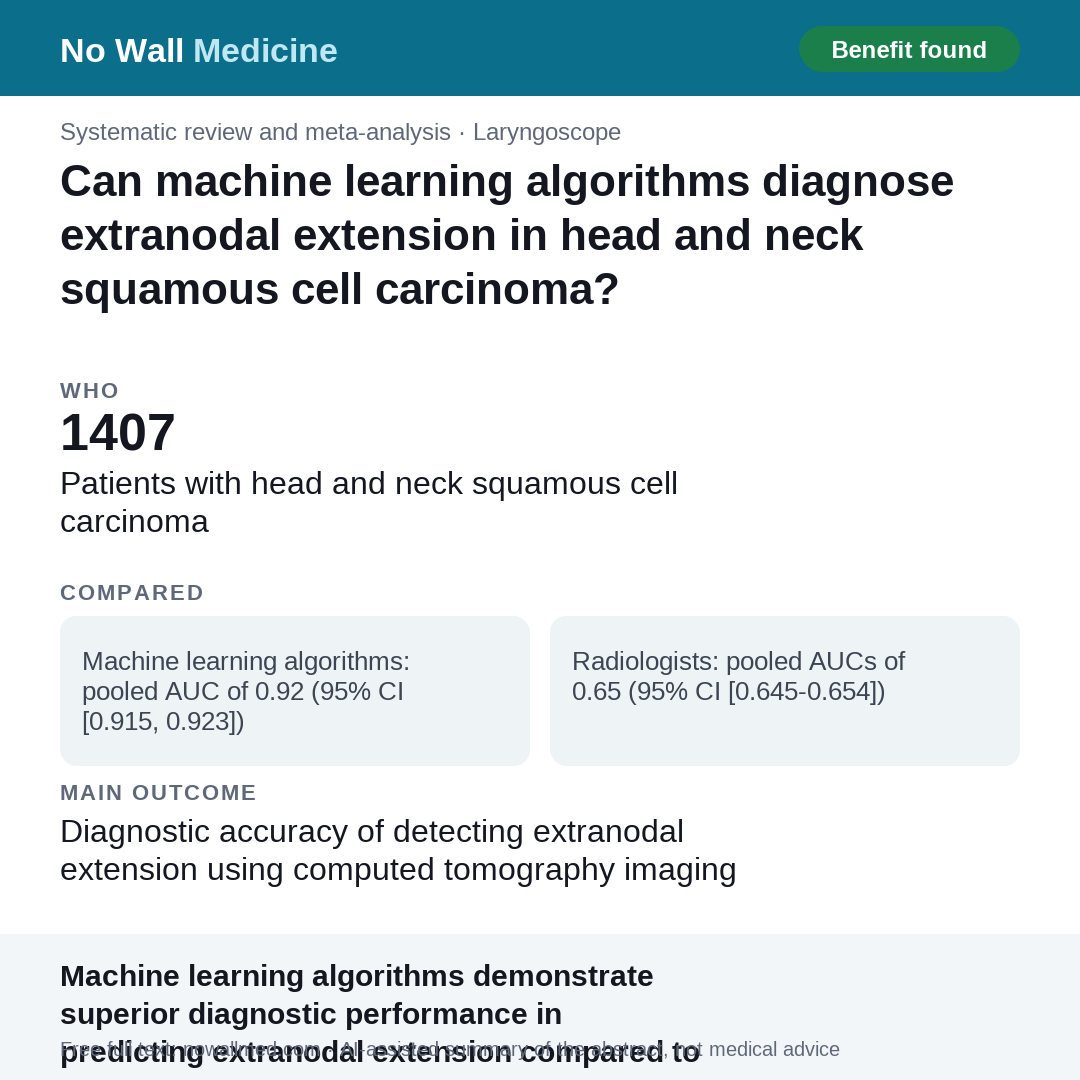
Clinical question: Can machine learning algorithms diagnose extranodal extension in head and neck squamous cell carcinoma?
Why it matters: It is unclear how accurately machine learning algorithms can diagnose extranodal extension in head and neck squamous cell carcinoma using computed tomography imaging.
Key points
- Researchers analyzed six studies involving 1407 patients and 2870 lymph nodes to evaluate machine learning for detecting extranodal extension, which is cancer spreading outside a lymph node.
- Machine learning achieved a pooled area under the curve of 0.92, while radiologists had a pooled area under the curve of 0.65.
- Machine learning sensitivity ranged from 66.9% to 91.2%, while radiologist sensitivity ranged from 24% to 96.0%.
Headline and key points written with AI from the paper’s abstract, with every number checked against it. Read the paper before relying on them.
Topics
Cite this article
Aulakh A, Sarafan M, Sekhon AS, Tran KL, Amanian A, Sabiq F. Machine Learning to Predict Extranodal Extension in Head and Neck Squamous Cell Carcinoma: A Systematic Review and Meta-Analysis. Laryngoscope. 2025. doi:10.1002/lary.70194
Spotted a mistake? Suggest a correction