Magnitude and Time-Trend Analysis of Postendoscopy Esophageal Adenocarcinoma: A Systematic Review and Meta-analysis
Key result: High proportion of esophageal cancer cases occur within one year of initial diagnosis
Systematic review and meta-analysisMixed results
What is the proportion of postendoscopy esophageal adenocarcinoma within the first year?
Who
145,726
Patients with nondysplastic Barrett's esophagus, low-grade dysplasia, or indefinite dysplasia
Compared
21%Postendoscopy esophageal adenocarcinoma alone (95% CI, 13-31)
26%Postendoscopy esophageal adenocarcinoma and high-grade dysplasia (95% CI, 19-34)
Main outcome
Proportion of postendoscopy esophageal adenocarcinoma and high-grade dysplasia
Bottom line: Postendoscopy esophageal adenocarcinoma accounts for a high proportion of high-grade dysplasia and esophageal adenocarcinoma cases.
Clin Gastroenterol Hepatol · 2021-04-23
Key points
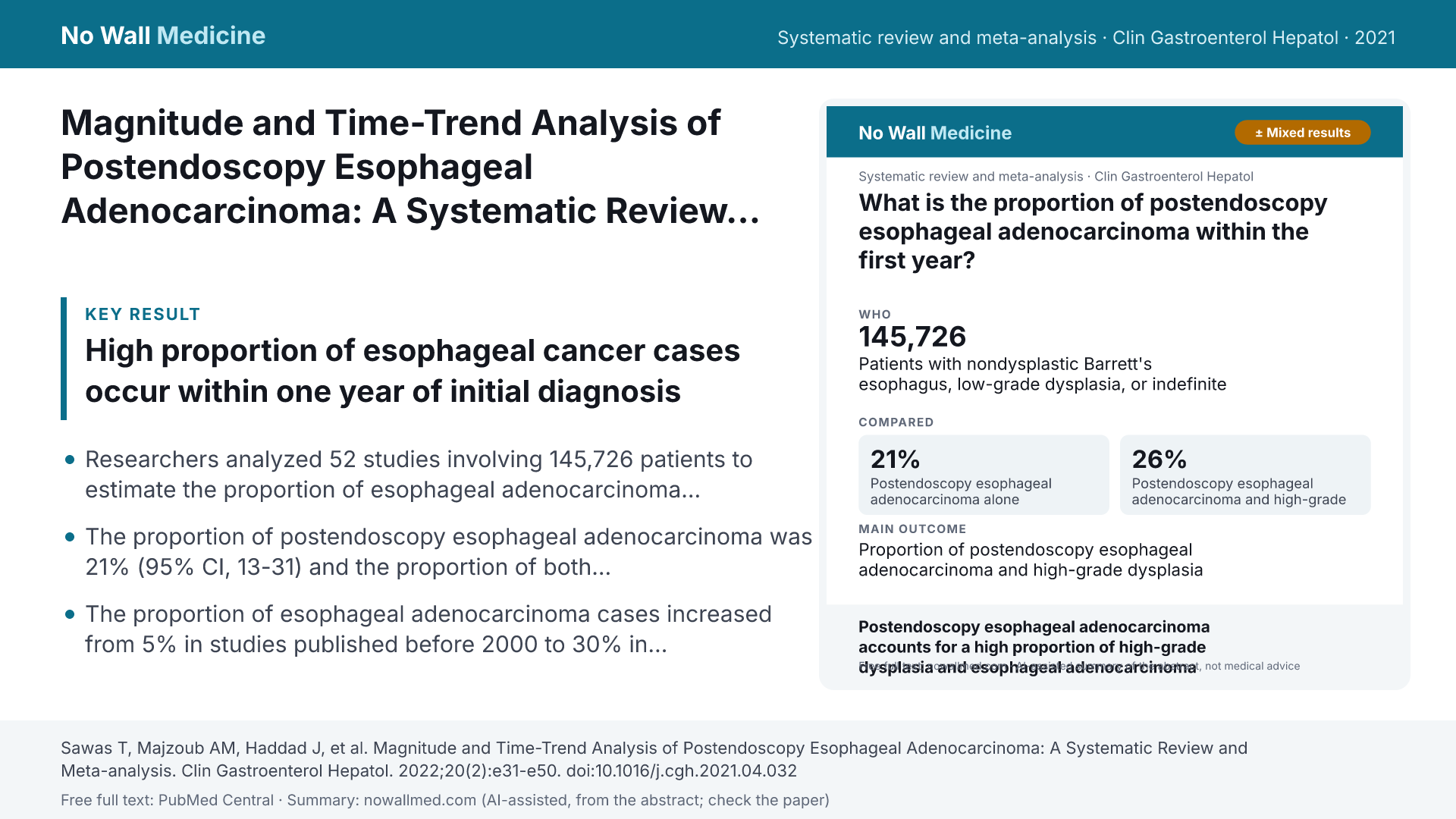
- Researchers analyzed 52 studies involving 145,726 patients to estimate the proportion of esophageal adenocarcinoma occurring within one year of a Barrett's esophagus diagnosis.
- The proportion of postendoscopy esophageal adenocarcinoma was 21% (95% CI, 13-31) and the proportion of both esophageal adenocarcinoma and high-grade dysplasia was 26% (95% CI, 19-34).
- The proportion of esophageal adenocarcinoma cases increased from 5% in studies published before 2000 to 30% in studies published after 2015.
Discussion prompts
- Would these patients look like yours? Who was left out?
- Is the main outcome one that matters to patients?
- Is the difference large enough to change what you do?
Cite: Sawas T, Majzoub AM, Haddad J, et al. Magnitude and Time-Trend Analysis of Postendoscopy Esophageal Adenocarcinoma: A Systematic Review and Meta-analysis. Clin Gastroenterol Hepatol. 2022;20(2):e31-e50. doi:10.1016/j.cgh.2021.04.032
Free full text: PubMed Central · Summary and visual abstract: nowallmed.com/a/magnitude-and-time-trend-analysis-of-postendoscopy-esophageal-rpanw3/ (AI-assisted from the abstract; check the paper before relying on it).