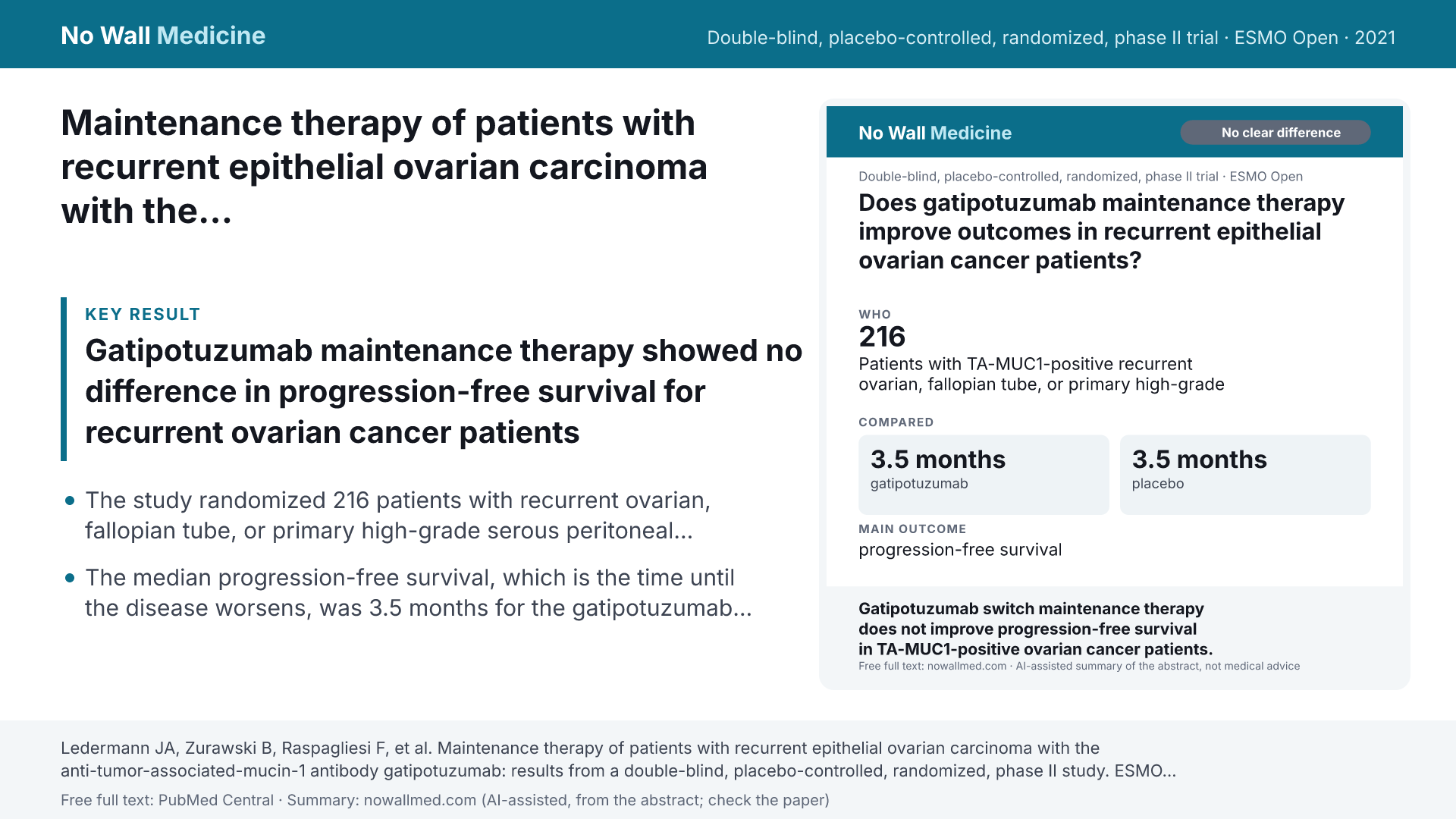
Gatipotuzumab maintenance therapy showed no difference in progression-free survival for recurrent ovarian cancer patients
Maintenance therapy of patients with recurrent epithelial ovarian carcinoma with the anti-tumor-associated-mucin-1 antibody gatipotuzumab: results from a double-blind, placebo-controlled, randomized, phase II study
Double-blind, placebo-controlled, randomized, phase II trialNo clear difference
Does gatipotuzumab maintenance therapy improve outcomes in recurrent epithelial ovarian cancer patients?
Who
216
Patients with TA-MUC1-positive recurrent ovarian, fallopian tube, or primary high-grade serous peritoneal cancer
Compared
3.5 monthsgatipotuzumab
3.5 monthsplacebo
Main outcome
progression-free survival
Result: hazard ratio 0.96 (95% confidence interval 0.69-1.33)
Bottom line: Gatipotuzumab switch maintenance therapy does not improve progression-free survival in TA-MUC1-positive ovarian cancer patients.
ESMO Open · 2021-12-15Download image
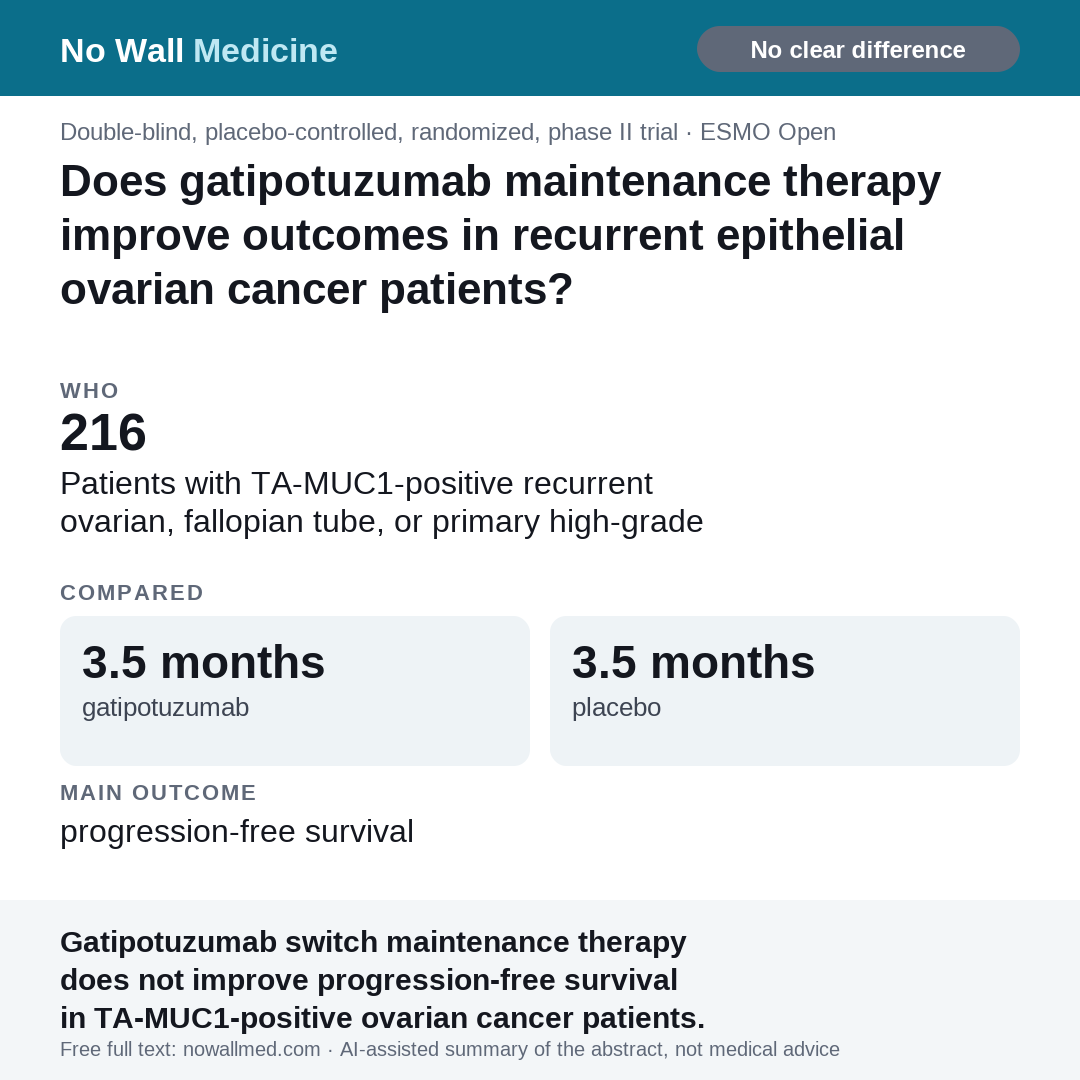
Clinical question: Does gatipotuzumab maintenance therapy improve outcomes in recurrent epithelial ovarian cancer patients?
Why it matters: It was unknown if switch maintenance therapy with the antibody gatipotuzumab could improve outcomes for patients with TA-MUC1-positive recurrent ovarian or related cancers.
Key points
- The study randomized 216 patients with recurrent ovarian, fallopian tube, or primary high-grade serous peritoneal cancer to receive either gatipotuzumab or a placebo.
- The median progression-free survival, which is the time until the disease worsens, was 3.5 months for the gatipotuzumab group and 3.5 months for the placebo group.
- Gatipotuzumab was well tolerated, though mild to moderate infusion-related reactions were the most common adverse events.
Headline and key points written with AI from the paper’s abstract, with every number checked against it. Read the paper before relying on them.
Was this summary helpful?
Subject terms
Cite this article
Ledermann JA, Zurawski B, Raspagliesi F, et al. Maintenance therapy of patients with recurrent epithelial ovarian carcinoma with the anti-tumor-associated-mucin-1 antibody gatipotuzumab: results from a double-blind, placebo-controlled, randomized, phase II study. ESMO Open. 2021. doi:10.1016/j.esmoop.2021.100311
Spotted a mistake? Suggest a correction