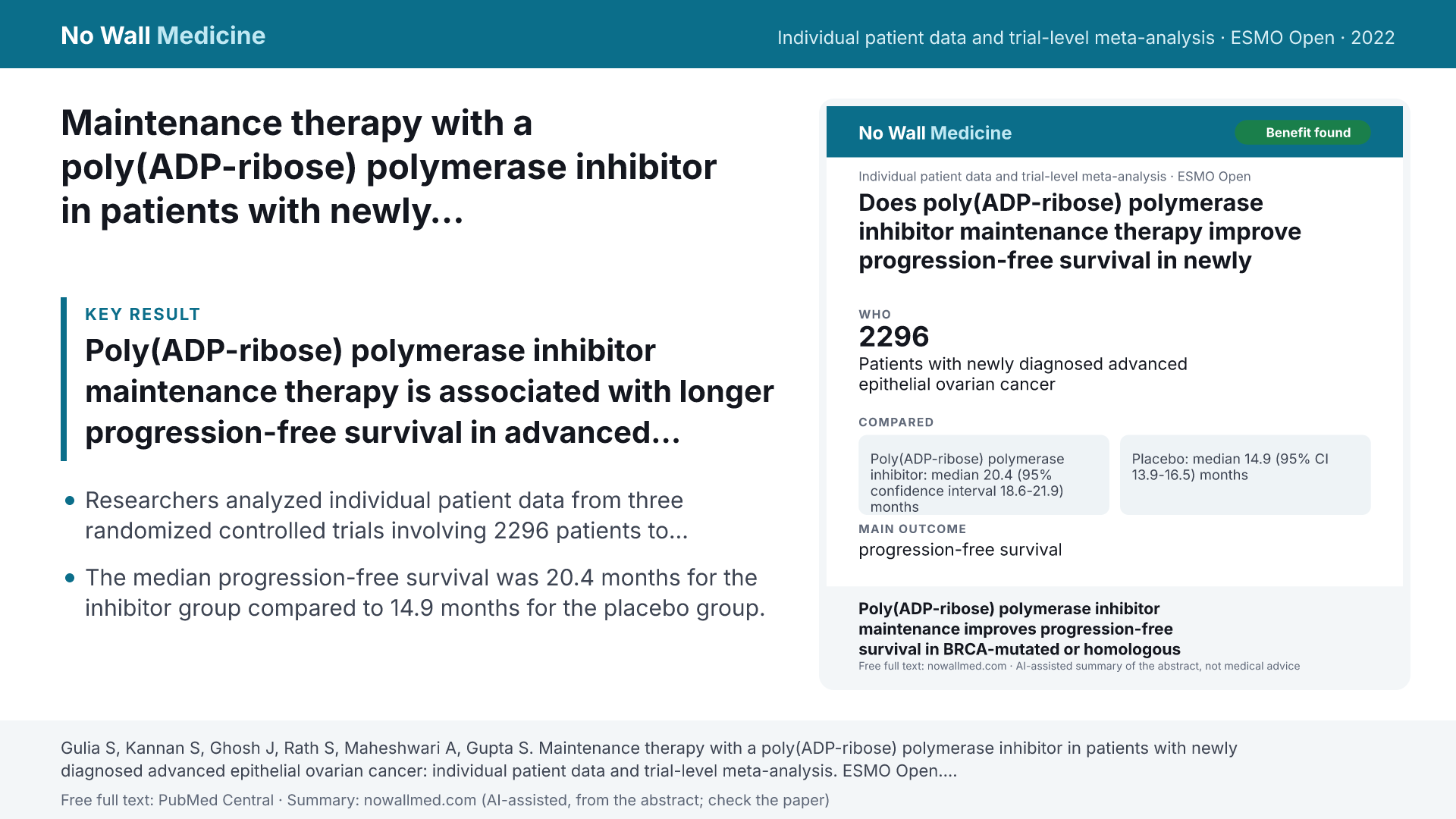
Poly(ADP-ribose) polymerase inhibitor maintenance therapy is associated with longer progression-free survival in advanced ovarian cancer
Maintenance therapy with a poly(ADP-ribose) polymerase inhibitor in patients with newly diagnosed advanced epithelial ovarian cancer: individual patient data and trial-level meta-analysis
Individual patient data and trial-level meta-analysisBenefit found
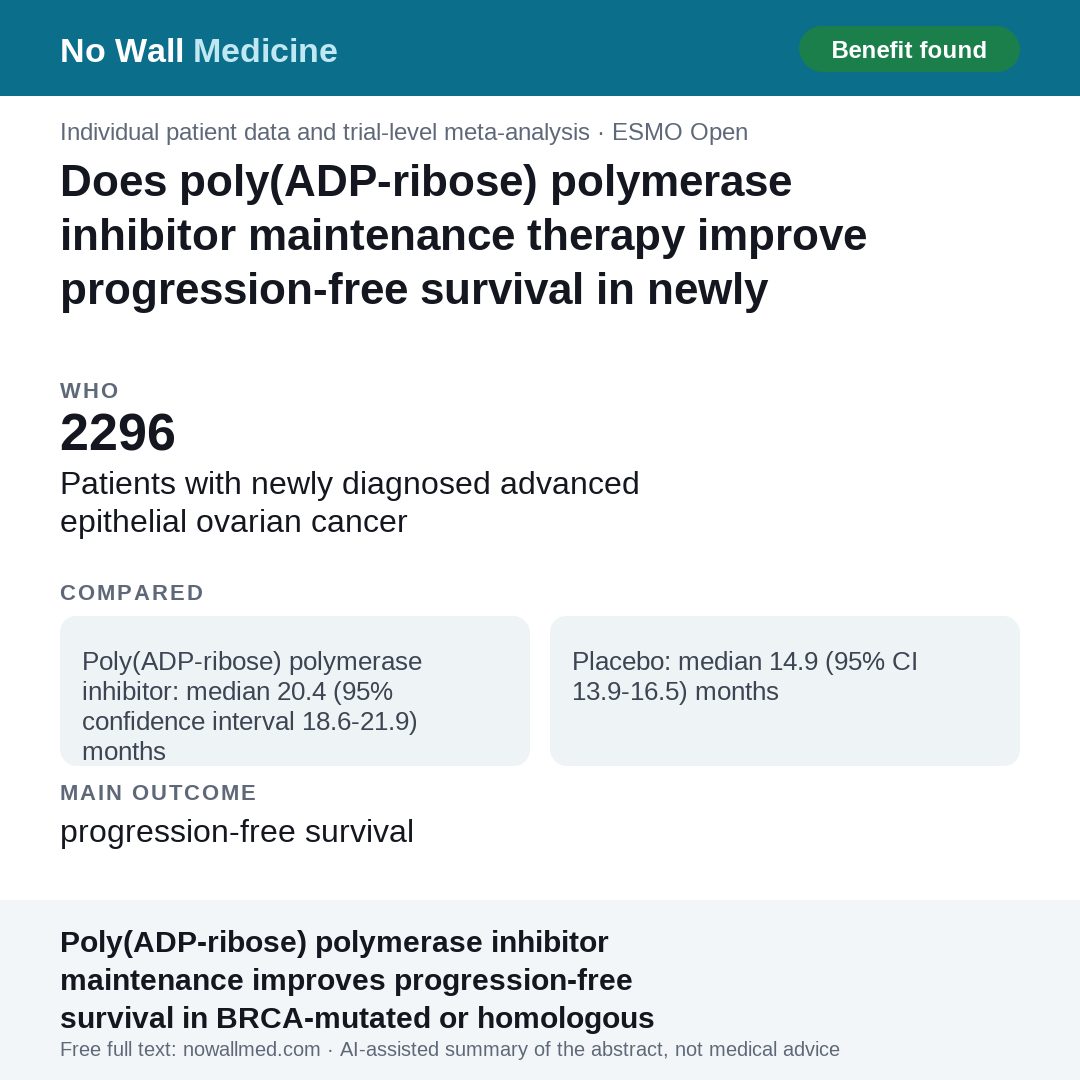
Does poly(ADP-ribose) polymerase inhibitor maintenance therapy improve progression-free survival in newly diagnosed advanced ovarian cancer?
Who
2296
Patients with newly diagnosed advanced epithelial ovarian cancer
Compared
Poly(ADP-ribose) polymerase inhibitor: median 20.4 (95% confidence interval 18.6-21.9) months
Placebo: median 14.9 (95% CI 13.9-16.5) months
Main outcome
progression-free survival
Result: hazard ratio 0.67, 95% CI 0.60-0.75
Bottom line: Poly(ADP-ribose) polymerase inhibitor maintenance improves progression-free survival in BRCA-mutated or homologous recombination deficiency-positive patients.
ESMO Open · 2022-08-22Download image
Clinical question: Does poly(ADP-ribose) polymerase inhibitor maintenance therapy improve progression-free survival in newly diagnosed advanced ovarian cancer?
Why it matters: The efficacy of poly(ADP-ribose) polymerase inhibitor maintenance therapy across different genetic subgroups in newly diagnosed advanced epithelial ovarian cancer was not fully synthesized.
Key points
- Researchers analyzed individual patient data from three randomized controlled trials involving 2296 patients to compare poly(ADP-ribose) polymerase inhibitor maintenance therapy against a placebo.
- The median progression-free survival was 20.4 months for the inhibitor group compared to 14.9 months for the placebo group.
- Longer progression-free survival was seen in patients with BRCA mutations or homologous recombination deficiency, but not in those with homologous recombination deficiency-negative tumors.
Headline and key points written with AI from the paper’s abstract, with every number checked against it. Read the paper before relying on them.
Was this summary helpful?
Subject terms
Cite this article
Gulia S, Kannan S, Ghosh J, Rath S, Maheshwari A, Gupta S. Maintenance therapy with a poly(ADP-ribose) polymerase inhibitor in patients with newly diagnosed advanced epithelial ovarian cancer: individual patient data and trial-level meta-analysis. ESMO Open. 2022. doi:10.1016/j.esmoop.2022.100558
Spotted a mistake? Suggest a correction