Major bleeding rates and mortality risks after left main coronary artery disease revascularization
Major Bleeding and Mortality After Revascularization of Left Main Disease
Randomized trialMixed results
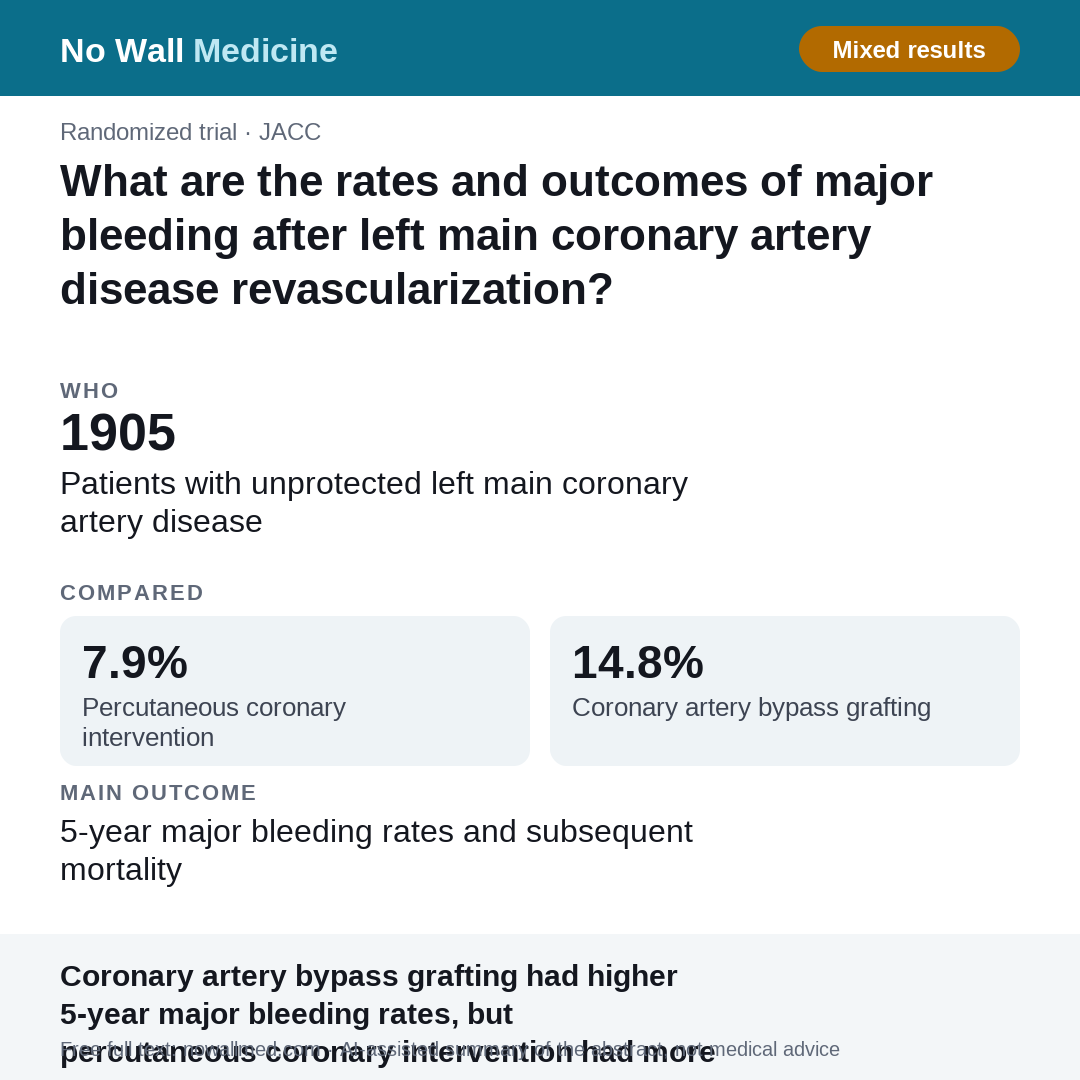
What are the rates and outcomes of major bleeding after left main coronary artery disease revascularization?
Who
1905
Patients with unprotected left main coronary artery disease
Compared
7.9%Percutaneous coronary intervention
14.8%Coronary artery bypass grafting
Main outcome
5-year major bleeding rates and subsequent mortality
Result: adjusted hazard ratio 2.71 (95% CI 1.95-3.77)
Bottom line: Coronary artery bypass grafting had higher 5-year major bleeding rates, but percutaneous coronary intervention had more postdischarge bleeding events.
JACC · 2024-12-05Download image
Clinical question: What are the rates and outcomes of major bleeding after left main coronary artery disease revascularization?
Why it matters: The incidence and prognostic impact of major bleeding after percutaneous coronary intervention and coronary artery bypass surgery for left main coronary artery disease are unknown.
Key points
- Researchers followed 1,905 patients with unprotected left main coronary artery disease for 5 years after undergoing percutaneous coronary intervention or coronary artery bypass surgery.
- The 5-year major bleeding rate was 7.9% after percutaneous coronary intervention versus 14.8% after coronary artery bypass surgery.
- Major bleeding events within 5 years were associated with a higher risk of all-cause mortality, with an adjusted hazard ratio of 2.71.
Headline and key points written with AI from the paper’s abstract, with every number checked against it. Read the paper before relying on them.
Was this summary helpful?
Subject terms
Cite this article
Giustino G, Sabik JF, Serruys PW, Puskas JD, Karmpaliotis D, Kandzari DE. Major Bleeding and Mortality After Revascularization of Left Main Disease. JACC. 2024. doi:10.1016/j.jacc.2024.07.065
Spotted a mistake? Suggest a correction
Top studies every Monday
The week’s key trials and guidelines in your specialties, plus any topics you follow. By email, free.
Get the weekly digest