Depression is linked to altered brain connectivity when processing emotional facial expressions
Major depressive disorder associated alterations in the effective connectivity of the face processing network: a systematic review
Systematic reviewMixed results
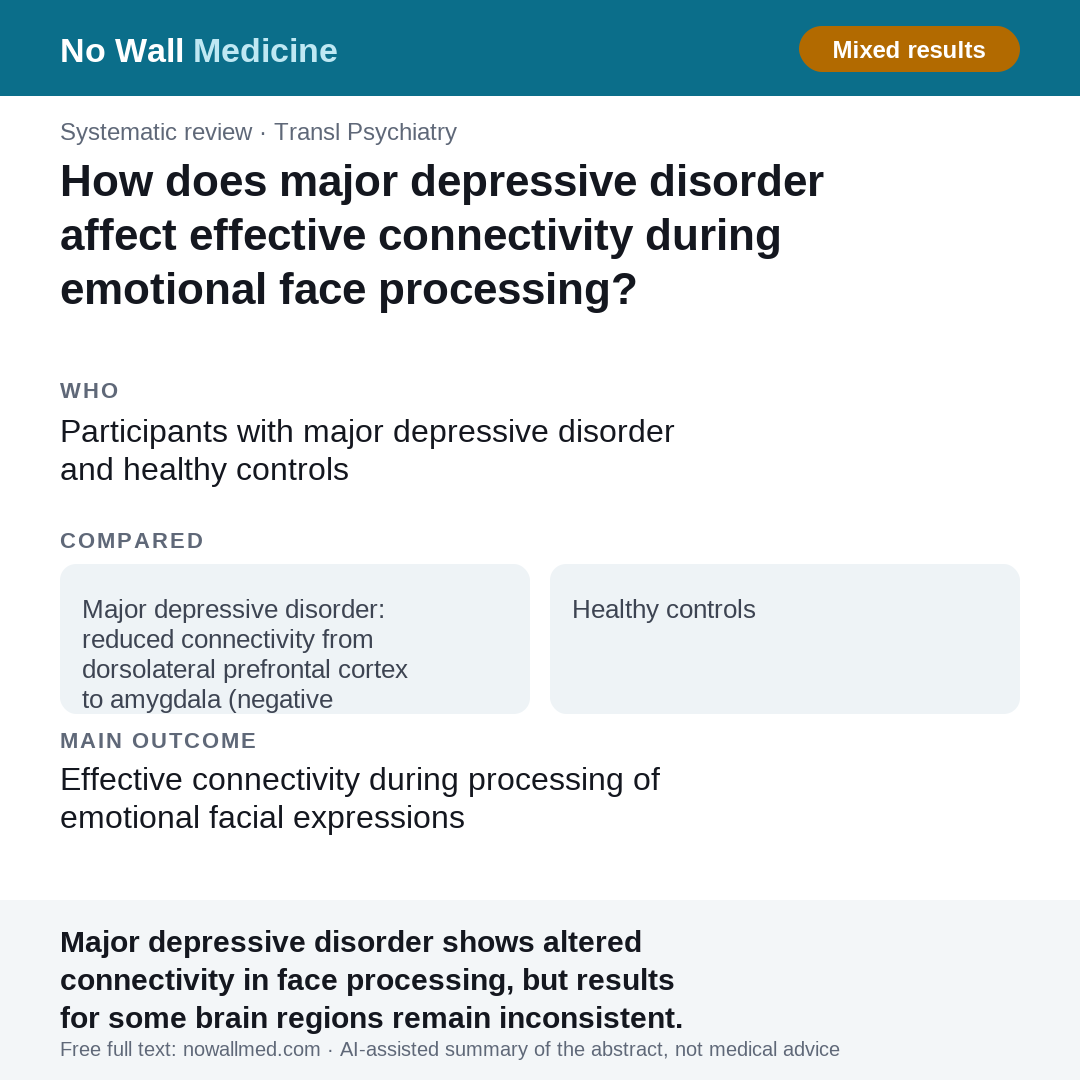
How does major depressive disorder affect effective connectivity during emotional face processing?
Who
Participants with major depressive disorder and healthy controls
Compared
Major depressive disorder: reduced connectivity from dorsolateral prefrontal cortex to amygdala (negative expressions)
Healthy controls
Main outcome
Effective connectivity during processing of emotional facial expressions
Bottom line: Major depressive disorder shows altered connectivity in face processing, but results for some brain regions remain inconsistent.
Limitation: Methodological heterogeneity and inconsistent connectivity differences in the amygdala and anterior cingulate cortex.
Transl Psychiatry · 2024-01-25Download image
Clinical question: How does major depressive disorder affect effective connectivity during emotional face processing?
Why it matters: Methodological differences in neuroimaging research have made it difficult to identify consistent effects on how brain regions interact during emotional processing in depression.
Key points
- Researchers performed a systematic review of 17 studies to examine how major depressive disorder affects directional brain interactions during facial expression processing.
- Participants with depression showed reduced connectivity from the dorsolateral prefrontal cortex to the amygdala during negative expressions and increased inhibitory connectivity from the ventromedial prefrontal cortex to the amygdala during happy expressions.
- Differences in connectivity involving the amygdala and anterior cingulate cortex were noted, but the specific nature of these differences was inconsistent across studies.
Headline and key points written with AI from the paper’s abstract, with every number checked against it. Read the paper before relying on them.
Was this summary helpful?
Subject terms
Cite this article
Jamieson AJ, Leonards CA, Davey CG, Harrison BJ. Major depressive disorder associated alterations in the effective connectivity of the face processing network: a systematic review. Transl Psychiatry. 2024. doi:10.1038/s41398-024-02734-0
Spotted a mistake? Suggest a correction
Top studies every Monday
The week’s key trials and guidelines in your specialties, plus any topics you follow. By email, free.
Get the weekly digest