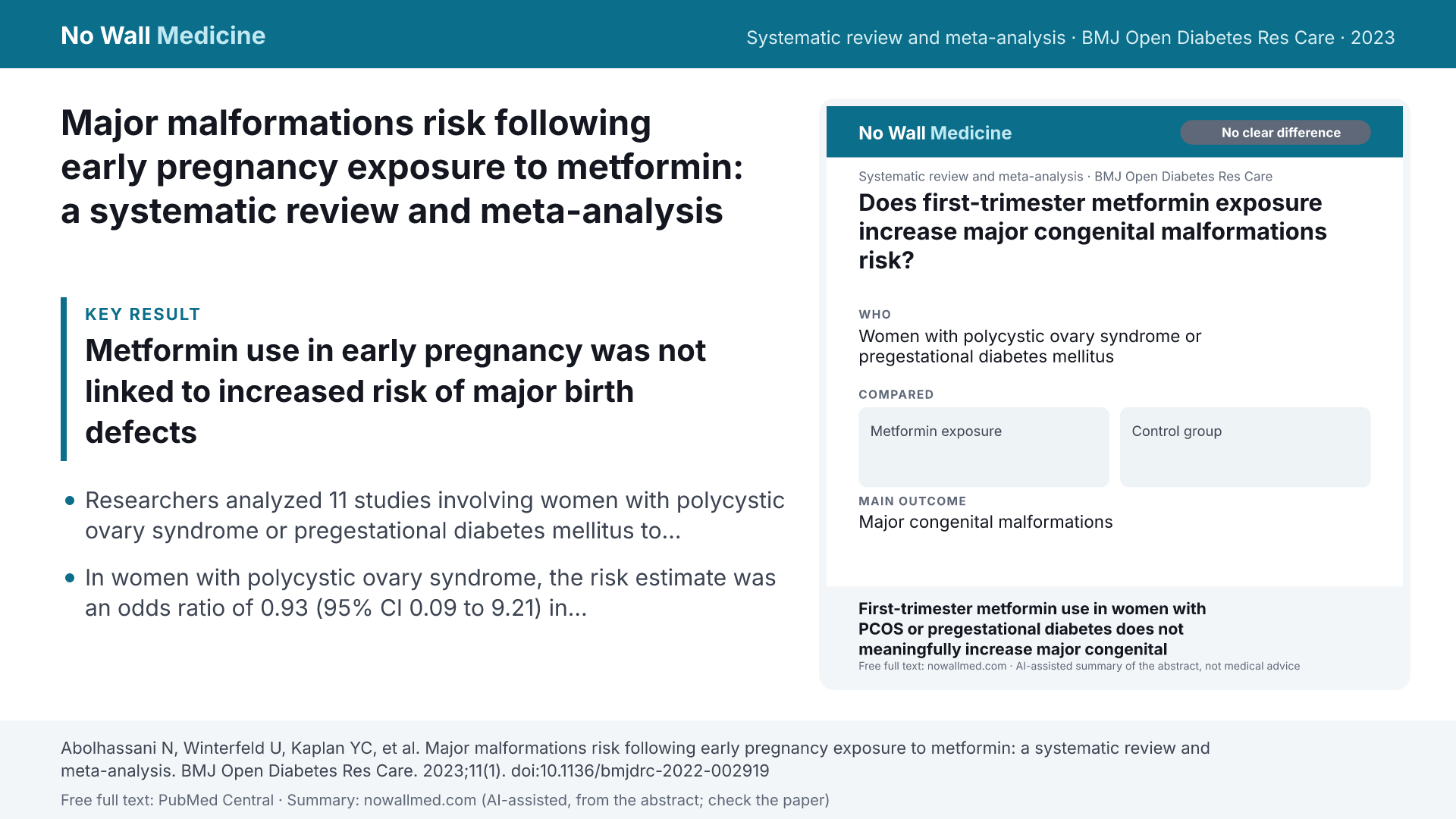
Metformin use in early pregnancy was not linked to increased risk of major birth defects
Major malformations risk following early pregnancy exposure to metformin: a systematic review and meta-analysis
Systematic review and meta-analysisNo clear difference
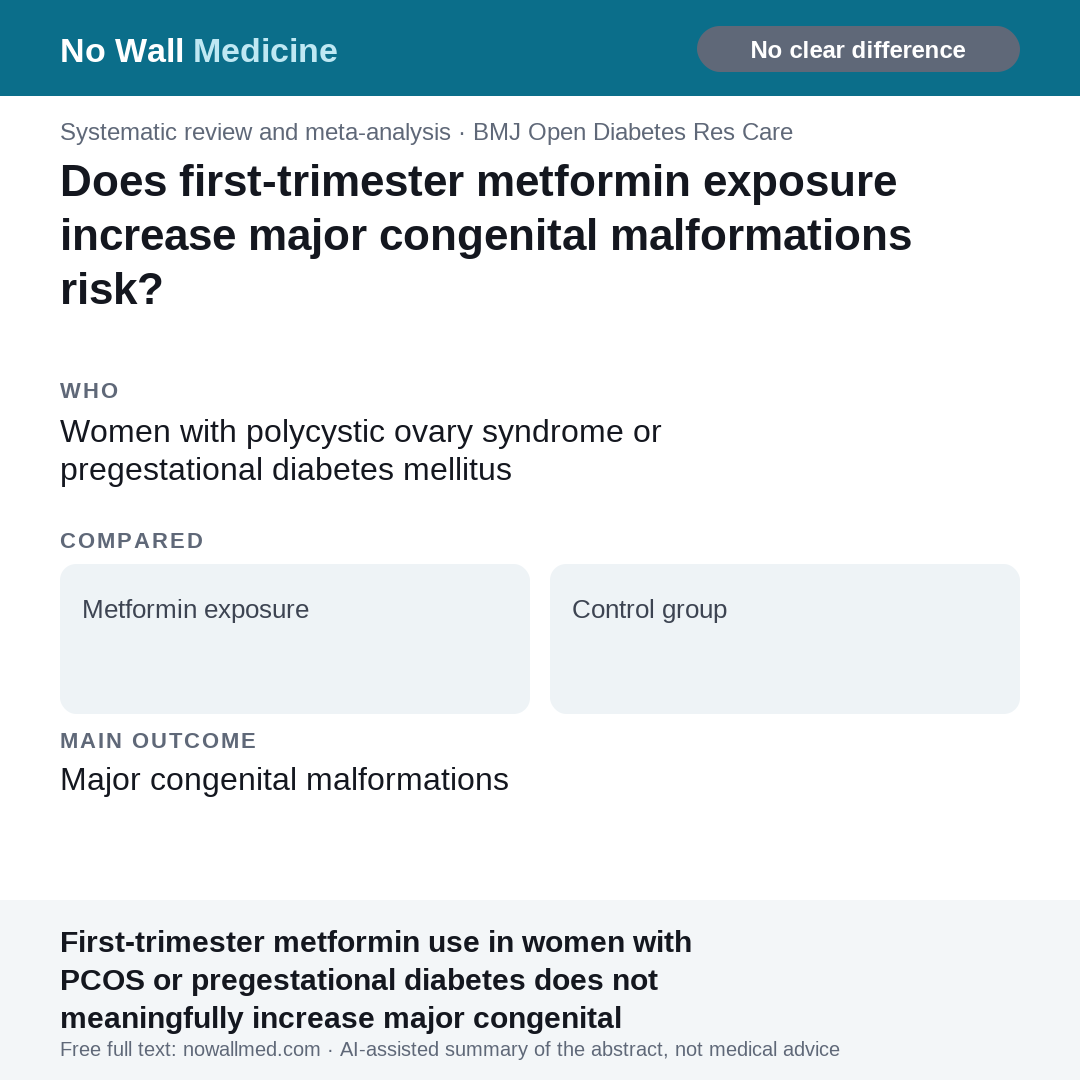
Does first-trimester metformin exposure increase major congenital malformations risk?
Who
Women with polycystic ovary syndrome or pregestational diabetes mellitus
Compared
Metformin exposure
Control group
Main outcome
Major congenital malformations
Bottom line: First-trimester metformin use in women with PCOS or pregestational diabetes does not meaningfully increase major congenital malformations risk.
Limitation: Further studies are needed to characterize residual safety concerns.
BMJ Open Diabetes Res Care · 2023-01-31Download image
Clinical question: Does first-trimester metformin exposure increase major congenital malformations risk?
Why it matters: Evidence regarding the safety of metformin during the first trimester of pregnancy is limited for women with polycystic ovary syndrome or pregestational diabetes mellitus.
Key points
- Researchers analyzed 11 studies involving women with polycystic ovary syndrome or pregestational diabetes mellitus to assess the risk of major congenital malformations, which are serious structural abnormalities present at birth.
- In women with polycystic ovary syndrome, the risk estimate was an odds ratio of 0.93 (95% CI 0.09 to 9.21) in randomized trials and 1.35 (95% CI 0.37 to 4.90) in observational studies.
- For women with pregestational diabetes mellitus, the risk estimate was an odds ratio of 1.05 (95% CI 0.50 to 2.18) across seven observational studies.
Headline and key points written with AI from the paper’s abstract, with every number checked against it. Read the paper before relying on them.
Was this summary helpful?
Abstract
Metformin is considered as first-line treatment for type 2 diabetes and an effective treatment for polycystic ovary syndrome (PCOS). However, evidence regarding its safety in pregnancy is limited. We conducted a systematic review and meta-analysis of major congenital malformations (MCMs) risk after first-trimester exposure to metformin in women with PCOS and pregestational diabetes mellitus (PGDM). Randomized controlled trials (RCTs) and observational cohort studies with a control group investigating risk of MCM after first-trimester pregnancy exposure to metformin were searched until December 2021. ORs and 95% CIs were calculated separately according to indications and study type using Mantel-Haenszel method; outcome data were combined using random-effects model. Eleven studies (two RCTs; nine observational cohorts) met the inclusion criteria: four included pregnant women with PCOS, four included those with PGDM and three evaluated both indications separately and were considered in both indication groups. In PCOS group, there were two RCTs (57 exposed, 52 control infants) and five observational studies (472 exposed, 1892 control infants); point estimates for MCM rates in RCTs and observational studies were OR 0.93 (95% CI 0.09 to 9.21) (I2=0%; Q test=0.31; p value=0.58) and OR 1.35 (95% CI 0.37 to 4.90) (I2=65%; Q test=9.43; p value=0.05), respectively. In PGDM group, all seven studies were observational (1122 exposed, 1851 control infants); the point estimate for MCM rates was OR 1.05 (95% CI 0.50 to 2.18) (I2=59%; Q test=16.34; p value=0.01). Metformin use in first-trimester pregnancy in women with PCOS or PGDM do not meaningfully increase the MCM risk overall. However, further studies are needed to characterize residual safety concerns.
Abstract reproduced under the article’s CC BY NC licence.
Subject terms
Cite this article
Abolhassani N, Winterfeld U, Kaplan YC, et al. Major malformations risk following early pregnancy exposure to metformin: a systematic review and meta-analysis. BMJ Open Diabetes Res Care. 2023. doi:10.1136/bmjdrc-2022-002919
Spotted a mistake? Suggest a correction