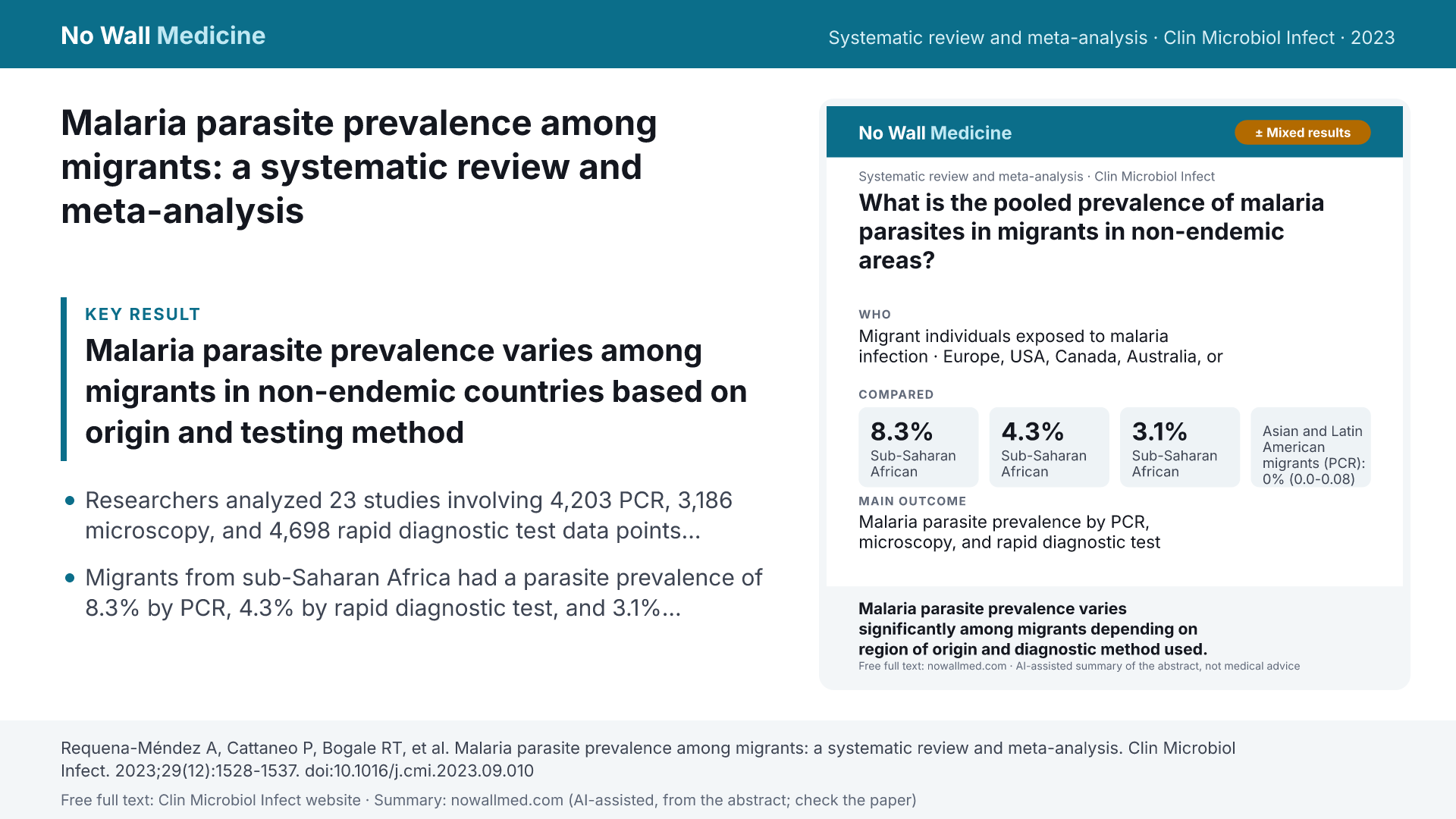
Malaria parasite prevalence varies among migrants in non-endemic countries based on origin and testing method
Malaria parasite prevalence among migrants: a systematic review and meta-analysis
Systematic review and meta-analysisMixed results
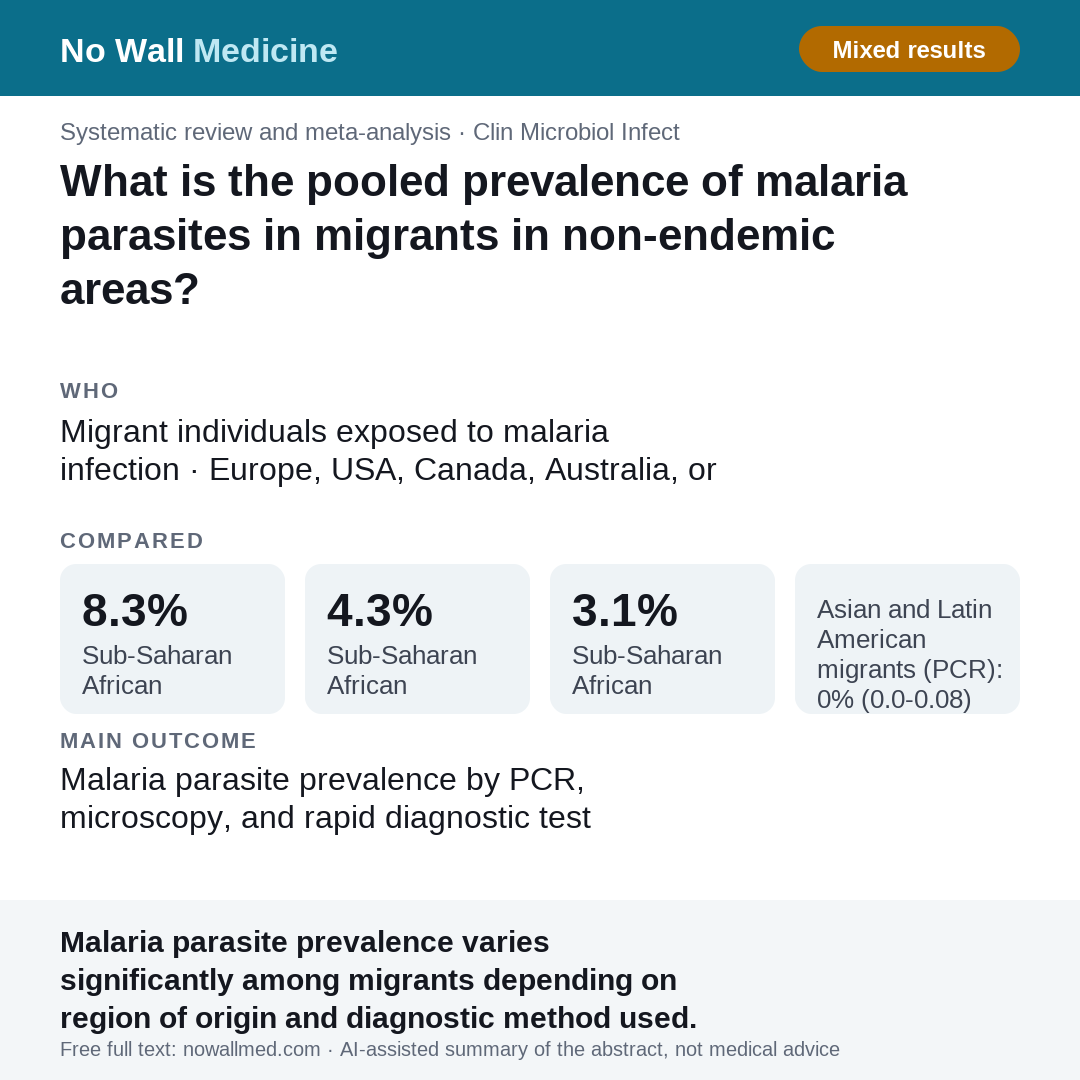
What is the pooled prevalence of malaria parasites in migrants in non-endemic areas?
Who
Migrant individuals exposed to malaria infection · Europe, USA, Canada, Australia, or New Zealand
Compared
8.3%Sub-Saharan African migrants (PCR) (95% CI 5.1-12.2)
4.3%Sub-Saharan African migrants (RDT) (1.5-8.2)
3.1%Sub-Saharan African migrants (microscopy) (0.7-6.8)
Asian and Latin American migrants (PCR): 0% (0.0-0.08) and 0.4% (0.0-1.8)
Main outcome
Malaria parasite prevalence by PCR, microscopy, and rapid diagnostic test
Bottom line: Malaria parasite prevalence varies significantly among migrants depending on region of origin and diagnostic method used.
Limitation: Despite heterogeneity between settings, these findings can contribute to inform screening strategies.
Clin Microbiol Infect · 2023-09-20Download image
Clinical question: What is the pooled prevalence of malaria parasites in migrants in non-endemic areas?
Why it matters: The estimated prevalence of asymptomatic malaria infections in migrants screened in non-endemic areas was unknown.
Key points
- Researchers analyzed 23 studies involving 4,203 PCR, 3,186 microscopy, and 4,698 rapid diagnostic test data points from migrants in Europe, USA, Canada, Australia, or New Zealand.
- Migrants from sub-Saharan Africa had a parasite prevalence of 8.3% by PCR, 4.3% by rapid diagnostic test, and 3.1% by microscopy.
- The PCR-based prevalence was 11.6% among sub-Saharan African migrants who arrived in their host country within the previous year.
Headline and key points written with AI from the paper’s abstract, with every number checked against it. Read the paper before relying on them.
Was this summary helpful?
Subject terms
Cite this article
Requena-Méndez A, Cattaneo P, Bogale RT, et al. Malaria parasite prevalence among migrants: a systematic review and meta-analysis. Clin Microbiol Infect. 2023. doi:10.1016/j.cmi.2023.09.010
Spotted a mistake? Suggest a correction