Middle meningeal artery embolization reduced recurrence of chronic subdural hematoma after surgical drainage
Management of Chronic Subdural Hematoma With Adjunctive Embolization of Middle Meningeal Artery: The EMMA-Can Randomized Clinical Trial
Randomized, open-label, blinded-end point trialBenefit found
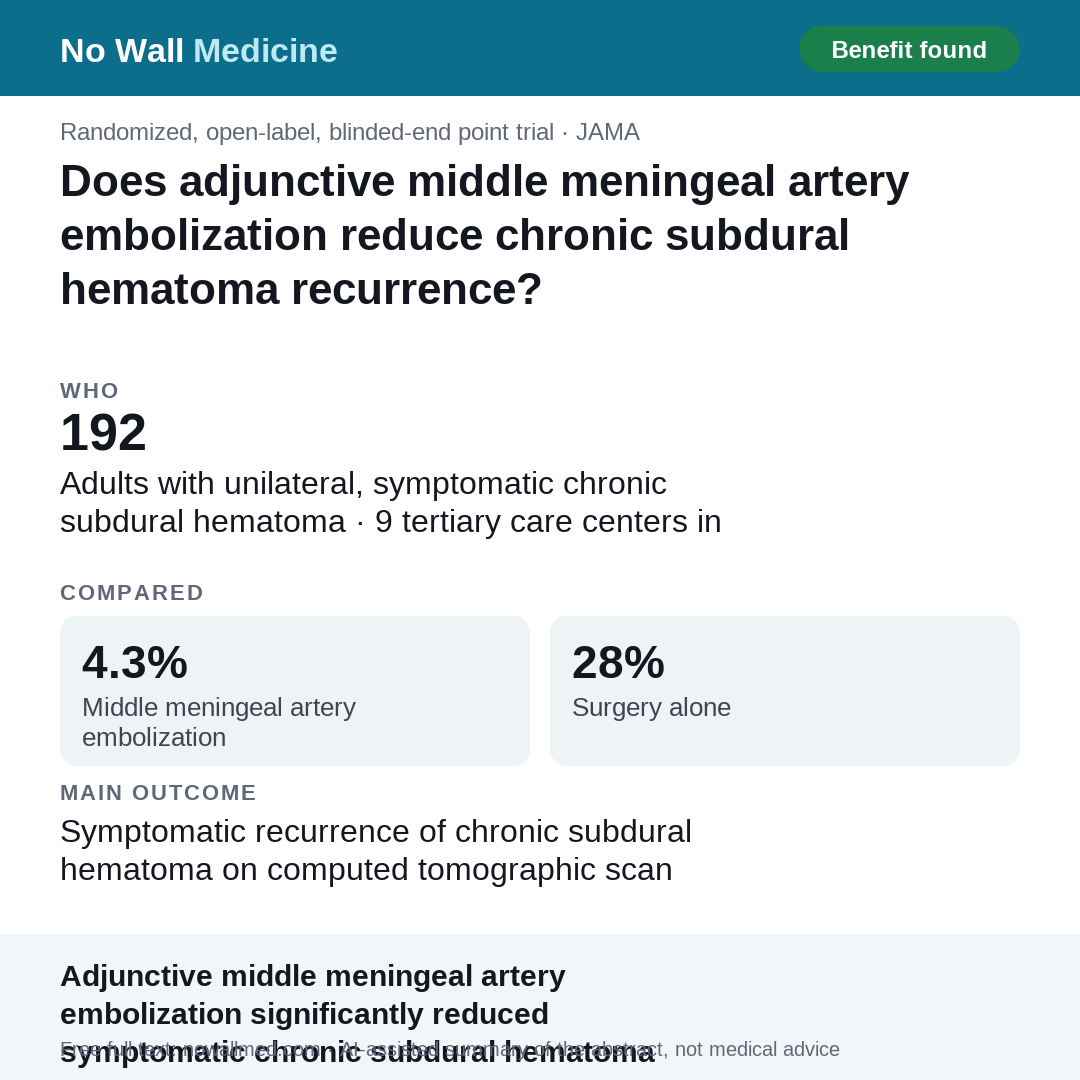
Does adjunctive middle meningeal artery embolization reduce chronic subdural hematoma recurrence?
Who
192
Adults with unilateral, symptomatic chronic subdural hematoma · 9 tertiary care centers in Canada
Compared
4.3%Middle meningeal artery embolization
28%Surgery alone
Main outcome
Symptomatic recurrence of chronic subdural hematoma on computed tomographic scan
Result: risk difference, -23.7 (95% CI, -34.1 to -13.9)
Bottom line: Adjunctive middle meningeal artery embolization significantly reduced symptomatic chronic subdural hematoma recurrence compared to surgery alone.
JAMA · 2026-04-30Download image
Clinical question: Does adjunctive middle meningeal artery embolization reduce chronic subdural hematoma recurrence?
Why it matters: Chronic subdural hematomas, which are collections of blood between the brain and its outer covering, commonly recur after surgical drainage.
Key points
- Researchers studied 192 adults with symptomatic chronic subdural hematoma, comparing surgical drainage plus middle meningeal artery embolization to surgical drainage alone.
- Symptomatic recurrence detected on computed tomographic scan at 90 days occurred in 4.3% of the embolization group compared to 28% in the control group.
- The study included 186 participants who completed the trial with a mean age of 71.8 years.
Headline and key points written with AI from the paper’s abstract, with every number checked against it. Read the paper before relying on them.
Topics
Spotted a mistake? Suggest a correction